
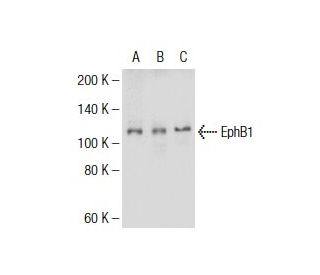


EphB1 Antibody (5F10A4): sc-130054
- EphB1 Antibody (5F10A4) is a mouse monoclonal IgG1 κ EphB1 antibody, cited in 2 publications, provided at 200 µg/ml
- raised against a recombinant protein corresponding to amino acids 19-133 of EphB1 of human origin
- recommended for detection of EphB1 of mouse, rat and human origin by WB, IP, IF, IHC(P) and ELISA
- m-IgG Fc BP-HRP, m-IgG1 BP-HRP and m-IgGκ BP-HRP are the preferred secondary detection reagents for EphB1 Antibody (5F10A4) for WB and IHC(P) applications. These reagents are now offered in bundles with EphB1 Antibody (5F10A4) (see ordering information below).

EphB1 Antibody (5F10A4) is a mouse monoclonal IgG1 kappa light chain antibody that detects EphB1 protein of mouse, rat, and human origin by western blotting (WB), immunoprecipitation (IP), immunofluorescence (IF), immunohistochemistry, and enzyme-linked immunosorbent assay (ELISA). Anti-EphB1 antibody (5F10A4) is available as a non-conjugated format. EphB1, a member of the Eph receptor family, plays a crucial role in mediating cell-cell interactions and is primarily located in the cell membrane, where EphB1 functions as a receptor for ephrin ligands. This localization enables EphB1 to participate in various signaling pathways that regulate processes such as neuronal development, angiogenesis, and tissue patterning. The interaction between EphB1 and ephrin-B1 ligands is essential for establishing boundaries between different cell types and facilitating communication during developmental processes. EphB1 receptor modulates synaptic plasticity, which is vital for learning and memory. With diverse roles in cellular signaling and development, EphB1 is a key player in both normal physiological processes and various pathological conditions, making anti-EphB1 antibody (5F10A4) an invaluable tool for researchers studying these critical biological functions.
Alexa Fluor® is a trademark of Molecular Probes Inc., OR., USA
LI-COR® and Odyssey® are registered trademarks of LI-COR Biosciences
EphB1 Antibody (5F10A4) References:
- EphB1 Suppression in Acute Myelogenous Leukemia: Regulating the DNA Damage Control System. | Kampen, KR., et al. 2015. Mol Cancer Res. 13: 982-92. PMID: 25944917
- Paradoxes of the EphB1 receptor in malignant brain tumors. | Wei, W., et al. 2017. Cancer Cell Int. 17: 21. PMID: 28194092
- EphB1 interaction with caveolin-1 in endothelial cells modulates caveolae biogenesis. | Tiruppathi, C., et al. 2020. Mol Biol Cell. 31: 1167-1182. PMID: 32238105
- EphB1 promotes the differentiation and maturation of dendritic cells in non-small cell lung cancer. | Xie, Y., et al. 2024. Cancer Lett. 582: 216567. PMID: 38070822
- EphB1 causes retinal damage through inflammatory pathways in the retina and retinal Müller cells. | Liu, L., et al. 2024. Mol Vis. 30: 167-174. PMID: 38601015
- Identification and cloning of ELF-1, a developmentally expressed ligand for the Mek4 and Sek receptor tyrosine kinases. | Cheng, HJ. and Flanagan, JG. 1994. Cell. 79: 157-68. PMID: 7522971
- Molecular cloning of a ligand for the EPH-related receptor protein-tyrosine kinase Htk. | Bennett, BD., et al. 1995. Proc Natl Acad Sci U S A. 92: 1866-70. PMID: 7534404
- Identification of full-length and truncated forms of Ehk-3, a novel member of the Eph receptor tyrosine kinase family. | Valenzuela, DM., et al. 1995. Oncogene. 10: 1573-80. PMID: 7731712
- Identification of alternatively spliced mRNAs encoding variants of MDK1, a novel receptor tyrosine kinase expressed in the murine nervous system. | Ciossek, T., et al. 1995. Oncogene. 10: 97-108. PMID: 7824284
- Ligands for the receptor tyrosine kinases hek and elk: isolation of cDNAs encoding a family of proteins. | Kozlosky, CJ., et al. 1995. Oncogene. 10: 299-306. PMID: 7838529
- cDNA cloning and tissue distribution of five human EPH-like receptor protein-tyrosine kinases. | Fox, GM., et al. 1995. Oncogene. 10: 897-905. PMID: 7898931
- Molecular characterization of a family of ligands for eph-related tyrosine kinase receptors. | Beckmann, MP., et al. 1994. EMBO J. 13: 3757-62. PMID: 8070404
Ordering Information
| Product Name | Catalog # | UNIT | Price | Qty | FAVORITES | |
EphB1 Antibody (5F10A4) | sc-130054 | 200 µg/ml | $322.00 | |||
EphB1 Antibody (5F10A4): m-IgG Fc BP-HRP Bundle | sc-528727 | 200 µg Ab; 10 µg BP | $361.00 | |||
EphB1 Antibody (5F10A4): m-IgGκ BP-HRP Bundle | sc-521205 | 200 µg Ab, 40 µg BP | $361.00 | |||
EphB1 Antibody (5F10A4): m-IgG1 BP-HRP Bundle | sc-543095 | 200 µg Ab; 20 µg BP | $361.00 |