
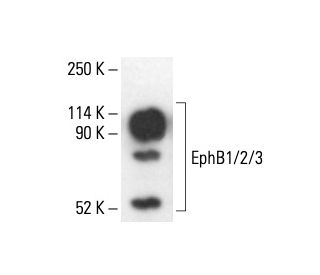


EphB1/2/3 Antibody (EfB1-3): sc-135718
- EphB1/2/3 Antibody (EfB1-3) is a mouse monoclonal IgG1 κ EphB1/2/3 antibody provided at 200 µg/ml
- raised against recombinant EphB1/Fc chimera of rat origin
- recommended for detection of the extracellular domain of EphB1, EphB2 and EphB3 of mouse, rat, chicken and bacterial origin by WB, IP and IF; non cross-reactive with other EphB proteins
- m-IgG Fc BP-HRP and m-IgG1 BP-HRP are the preferred secondary detection reagents for EphB1/2/3 Antibody (EfB1-3) for WB applications. These reagents are now offered in bundles with EphB1/2/3 Antibody (EfB1-3) (see ordering information below).

EphB1/2/3 (EfB1-3) is a mouse monoclonal IgG1 kappa light chain antibody that detects EphB1/2/3 protein of mouse, rat, and chicken origin by western blotting (WB) and immunofluorescence (IF). Anti-EphB1/2/3 antibody (EfB1-3) is available as a non-conjugated format, providing researchers with a reliable tool for studying this important protein. EphB1/2/3 belongs to the Eph receptor family, representing the largest group of receptor protein tyrosine kinases identified to date. These receptors play a crucial role in various biological processes, including cell signaling, neuronal development, and tissue organization. EphB1/2/3 mediates interactions between cells and their environment, influencing processes such as cell migration and adhesion. Normal development and function of the central nervous system depend on proper EphB1/2/3 function, and dysregulation has been implicated in various diseases, including cancer and neurological disorders. EphB1/2/3 interacts with specific ligands, such as ephrin-A4 and ephrin-B2, which are essential for initiating signaling cascades that regulate cellular responses. Using EphB1/2/3 monoclonal antibody (EfB1-3) enables researchers to gain valuable insights into mechanisms underlying these critical biological functions and their implications in health and disease.
Alexa Fluor® is a trademark of Molecular Probes Inc., OR., USA
LI-COR® and Odyssey® are registered trademarks of LI-COR Biosciences
EphB1/2/3 Antibody (EfB1-3) References:
- EphB1 Suppression in Acute Myelogenous Leukemia: Regulating the DNA Damage Control System. | Kampen, KR., et al. 2015. Mol Cancer Res. 13: 982-92. PMID: 25944917
- Ligand-independent EphB1 signaling mediates TGF-β-activated CDH2 and promotes lung cancer cell invasion and migration. | Wang, L., et al. 2020. J Cancer. 11: 4123-4131. PMID: 32368295
- Thymus aging in mice deficient in either EphB2 or EphB3, two master regulators of thymic epithelium development. | García-Ceca, J., et al. 2020. Dev Dyn. 249: 1243-1258. PMID: 32506584
- RNF186 regulates EFNB1 (ephrin B1)-EPHB2-induced autophagy in the colonic epithelial cells for the maintenance of intestinal homeostasis. | Zhang, H., et al. 2021. Autophagy. 17: 3030-3047. PMID: 33280498
- EPHB2 Activates β-Catenin to Enhance Cancer Stem Cell Properties and Drive Sorafenib Resistance in Hepatocellular Carcinoma. | Leung, HW., et al. 2021. Cancer Res. 81: 3229-3240. PMID: 33903122
- Hepatocytes demarcated by EphB2 contribute to the progression of nonalcoholic steatohepatitis. | Xiao, Y., et al. 2023. Sci Transl Med. 15: eadc9653. PMID: 36753562
- EphB1 promotes the differentiation and maturation of dendritic cells in non-small cell lung cancer. | Xie, Y., et al. 2024. Cancer Lett. 582: 216567. PMID: 38070822
- EphB2 Receptor Promotes Dermal Fibrosis in Systemic Sclerosis. | Egal, ESA., et al. 2024. Arthritis Rheumatol. 76: 1303-1316. PMID: 38589317
- EphB1 causes retinal damage through inflammatory pathways in the retina and retinal Müller cells. | Liu, L., et al. 2024. Mol Vis. 30: 167-174. PMID: 38601015
- Phosphorylation of Doc2 by EphB2 modulates Munc13-mediated SNARE complex assembly and neurotransmitter release. | Zhang, H., et al. 2024. Sci Adv. 10: eadi7024. PMID: 38758791
Ordering Information
| Product Name | Catalog # | UNIT | Price | Qty | FAVORITES | |
EphB1/2/3 Antibody (EfB1-3) | sc-135718 | 200 µg/ml | $322.00 | |||
EphB1/2/3 Antibody (EfB1-3): m-IgG Fc BP-HRP Bundle | sc-539882 | 200 µg Ab; 10 µg BP | $361.00 | |||
EphB1/2/3 Antibody (EfB1-3): m-IgG1 BP-HRP Bundle | sc-541760 | 200 µg Ab; 20 µg BP | $361.00 |