
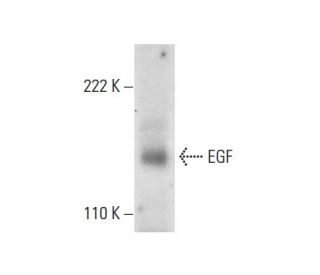


EGF Antibody (H-3): sc-271090
- EGF Antibody (H-3) is a mouse monoclonal IgG1 κ, cited in 1 publications, provided at 200 µg/ml
- specific for an epitope mapping between amino acids 984-1017 at the C-terminus of EGF of human origin
- recommended for detection of precursor and mature EGF of human origin by WB, IP, IF and ELISA
- See EGF (F-9): sc-166779 for EGF antibody conjugates, including AC, HRP, FITC, PE, Alexa Fluor® 488, 594, 647, 680 and 790.
- m-IgG Fc BP-HRP and m-IgG1 BP-HRP are the preferred secondary detection reagents for EGF Antibody (H-3) for WB applications. These reagents are now offered in bundles with EGF Antibody (H-3) (see ordering information below).

QUICK LINKS
SEE ALSO...
EGF Antibody (H-3) is a mouse monoclonal IgG1 antibody that detects epidermal growth factor (EGF) in human samples through applications such as western blotting (WB), immunoprecipitation (IP), immunofluorescence (IF), and enzyme-linked immunosorbent assay (ELISA). EGF is a crucial 53 amino acid protein known for its role as a potent mitogen, stimulating cell proliferation and differentiation in various cell types both in vivo and in vitro. anti-EGF antibody (H-3) exerts its effects by binding to the EGF receptor, which initiates a cascade of intrinsic phosphorylation on tyrosine residues, thereby activating multiple signaling pathways essential for cellular growth and survival. EGF is not only present in nearly all body fluids, including urine, saliva, milk, and platelet-rich plasma, but also shares significant amino acid homology with other growth factors such as transforming growth factor alpha (TGFα) and vaccinia virus growth factor, highlighting its importance in cellular communication and development. EGF monoclonal antibody (H-3) serves as an invaluable tool for researchers studying vital biological functions, including wound healing and tissue repair through EGF receptor interactions.
Alexa Fluor® is a trademark of Molecular Probes Inc., OR., USA
LI-COR® and Odyssey® are registered trademarks of LI-COR Biosciences
EGF Antibody (H-3) References:
- Attenuation of EGF signaling in senescent cells by caveolin. | Park, WY., et al. 2001. Ann N Y Acad Sci. 928: 79-84. PMID: 11795531
- EGF receptors as a target for cancer therapy. | Mendelsohn, J. 2004. Trans Am Clin Climatol Assoc. 115: 249-53; discussion 253-4. PMID: 17060971
- EGF Receptor Inhibition Alleviates Hyperuricemic Nephropathy. | Liu, N., et al. 2015. J Am Soc Nephrol. 26: 2716-29. PMID: 25788532
- Peptides Targeting EGF Block the EGF-EGFR Interaction. | Guardiola, S., et al. 2016. Chembiochem. 17: 702-11. PMID: 26677067
- EGF Enhances Oligodendrogenesis from Glial Progenitor Cells. | Yang, J., et al. 2017. Front Mol Neurosci. 10: 106. PMID: 28442994
- EGF signaling promotes the lineage conversion of astrocytes into oligodendrocytes. | Liu, X., et al. 2022. Mol Med. 28: 50. PMID: 35508991
- Cell-Based Sensors for the Detection of EGF and EGF-Stimulated Ca2+ Signaling. | Lee, E., et al. 2023. Biosensors (Basel). 13: PMID: 36979595
- NRF2 regulates EGF stability through OTUD4 in lung adenocarcinoma. | Hu, S., et al. 2024. Biochem Biophys Res Commun. 708: 149798. PMID: 38518721
- Clinical significance of epidermal growth factor (EGF), EGF receptor, and c-erbB-2 in human gastric cancer. | Tokunaga, A., et al. 1995. Cancer. 75: 1418-25. PMID: 7889468
- EGF receptor in neoplasia and metastasis. | Khazaie, K., et al. 1993. Cancer Metastasis Rev. 12: 255-74. PMID: 8281612
Ordering Information
| Product Name | Catalog # | UNIT | Price | Qty | FAVORITES | |
EGF Antibody (H-3) | sc-271090 | 200 µg/ml | $322.00 | |||
EGF Antibody (H-3): m-IgG Fc BP-HRP Bundle | sc-540200 | 200 µg Ab; 10 µg BP | $361.00 | |||
EGF Antibody (H-3): m-IgG1 BP-HRP Bundle | sc-541967 | 200 µg Ab; 20 µg BP | $361.00 | |||
EGF (H-3) Neutralizing Peptide | sc-271090 P | 100 µg/0.5 ml | $69.00 |