
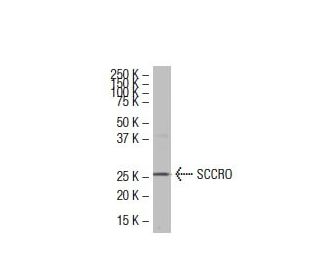


Dcun1D1 Antibody (3E1): sc-81835
- Dcun1D1 Antibody (3E1) is a mouse monoclonal IgG2b κ Dcun1D1 antibody, cited in 2 publications, provided at 100 µg/ml
- raised against recombinant Dcun1D1 of human origin
- recommended for detection of Dcun1D1 of mouse, rat and human origin by WB, IP, IF and ELISA
- At present, we have not yet completed the identification of the preferred secondary detection reagent(s) for Dcun1D1 Antibody (3E1). This work is in progress.

QUICK LINKS
Dcun1D1 Antibody (3E1) is a mouse monoclonal IgG2b kappa light chain antibody that detects Dcun1D1 protein of mouse, rat, and human origin by western blotting (WB), immunoprecipitation (IP), immunofluorescence (IF), and enzyme-linked immunosorbent assay (ELISA). Anti-Dcun1D1 antibody (3E1) is available as a non-conjugated format. Dcun1D1 protein, also known as Defective in cullin neddylation protein 1-like protein 1, DCN1-like protein 1, Rp42, or squamous cell carcinoma-related oncogene (SCCRO), plays a critical role in regulating the hedgehog (HH) signaling pathway, which is essential for development, maintenance, and regeneration of various adult tissues. Dcun1D1 protein regulates Gli1, a key transcription factor in the HH pathway, influencing cellular processes such as proliferation and differentiation. Dcun1D1 is co-expressed with vascular endothelial growth factor-A (VEGF-A), and together they promote angiogenesis, a vital process for tumor growth and metastasis. Overexpression of Dcun1D1 has been linked to invasive tumor progression and poor prognosis in non-small cell lung cancer, while low levels of Dcun1D1 expression in adjacent benign lung tissue have been associated with even worse survival rates. Dcun1D1 expression may serve as a significant marker for progressive dedifferentiation in squamous cell tumors, highlighting its potential as a target for therapeutic intervention and a biomarker for cancer prognosis.
Alexa Fluor® is a trademark of Molecular Probes Inc., OR., USA
LI-COR® and Odyssey® are registered trademarks of LI-COR Biosciences
Dcun1D1 Antibody (3E1) References:
- The role of novel oncogenes squamous cell carcinoma-related oncogene and phosphatidylinositol 3-kinase p110alpha in squamous cell carcinoma of the oral tongue. | Estilo, CL., et al. 2003. Clin Cancer Res. 9: 2300-6. PMID: 12796399
- Squamous cell carcinoma related oncogene regulates angiogenesis through vascular endothelial growth factor-A. | Talbot, SG., et al. 2004. Ann Surg Oncol. 11: 530-4. PMID: 15123463
- The Hedgehog response network: sensors, switches, and routers. | Lum, L. and Beachy, PA. 2004. Science. 304: 1755-9. PMID: 15205520
- SCCRO expression correlates with invasive progression in bronchioloalveolar carcinoma. | Sarkaria, IS., et al. 2004. Ann Thorac Surg. 78: 1734-41. PMID: 15511464
- Two-step differential expression analysis reveals a new set of genes involved in thyroid oncocytic tumors. | Jacques, C., et al. 2005. J Clin Endocrinol Metab. 90: 2314-20. PMID: 15623817
- Squamous cell carcinoma-related oncogene is highly expressed in developing, normal, and adenomatous adrenal tissue but not in aggressive adrenocortical carcinomas. | Sarkaria, IS., et al. 2004. Surgery. 136: 1122-8. PMID: 15657565
- The conserved protein DCN-1/Dcn1p is required for cullin neddylation in C. elegans and S. cerevisiae. | Kurz, T., et al. 2005. Nature. 435: 1257-61. PMID: 15988528
- Squamous cell carcinoma related oncogene/DCUN1D1 is highly conserved and activated by amplification in squamous cell carcinomas. | Sarkaria, I., et al. 2006. Cancer Res. 66: 9437-44. PMID: 17018598
Ordering Information
| Product Name | Catalog # | UNIT | Price | Qty | FAVORITES | |
Dcun1D1 Antibody (3E1) | sc-81835 | 100 µg/ml | $339.00 |