
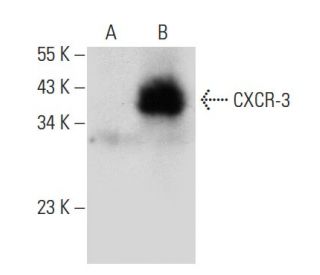

CXCR-3 Antibody (H-7): sc-133121
- CXCR-3 Antibody (H-7) is a mouse monoclonal IgG2a κ, cited in 2 publications, provided at 200 µg/ml
- raised against amino acids 1-95 of CXCR-3 of human origin
- recommended for detection of CXCR-3 of human origin by WB, IP, IF and ELISA
- m-IgG Fc BP-HRP is the preferred secondary detection reagent for CXCR-3 Antibody (H-7) for WB applications. This reagent is now offered in a bundle with CXCR-3 Antibody (H-7) (see ordering information below).

QUICK LINKS
SEE ALSO...
CXCR-3 Antibody (H-7) is a mouse monoclonal IgG2a antibody that detects CXCR-3 in human samples through applications such as western blotting (WB), immunoprecipitation (IP), immunofluorescence (IF), and enzyme-linked immunosorbent assay (ELISA). CXCR-3 is a critical member of the C-X-C chemokine receptor family, primarily functioning as a receptor for various chemokines, including IP-10 and MIG, which are essential for mediating immune responses. CXCR-3 is predominantly expressed in activated T lymphocytes, playing a vital role in the mobilization of calcium ions and the chemotactic movement of these immune cells towards sites of inflammation. CXCR-3 facilitates the recruitment of T cells to inflammatory tissues, thereby influencing the immune response during infections and autoimmune diseases. Understanding the expression and function of CXCR-3 is crucial for developing therapeutic strategies aimed at modulating immune responses, making anti-CXCR-3 antibody (H-7) an invaluable tool for researchers studying immune cell dynamics and chemokine signaling pathways.
Alexa Fluor® is a trademark of Molecular Probes Inc., OR., USA
LI-COR® and Odyssey® are registered trademarks of LI-COR Biosciences
CXCR-3 Antibody (H-7) References:
- Allergic rhinitis and CXCR3 chemokines. | Mazzi, V. and Fallahi, P. 2017. Clin Ter. 168: e54-e58. PMID: 28240764
- Neutrophils promote CXCR3-dependent itch in the development of atopic dermatitis. | Walsh, CM., et al. 2019. Elife. 8: PMID: 31631836
- CXCL10/CXCR3 Signaling in the DRG Exacerbates Neuropathic Pain in Mice. | Kong, YF., et al. 2021. Neurosci Bull. 37: 339-352. PMID: 33196963
- The role of CXCR3 and its ligands in cancer. | Wang, X., et al. 2022. Front Oncol. 12: 1022688. PMID: 36479091
- Neurotoxic A1 astrocytes promote neuronal ferroptosis via CXCL10/CXCR3 axis in epilepsy. | Liang, P., et al. 2023. Free Radic Biol Med. 195: 329-342. PMID: 36610561
- Research progress of CXCR3 inhibitors. | Yuan, Z. 2024. Anticancer Drugs. 35: 36-45. PMID: 37694856
- Interferon-γ production by Tfh cells is required for CXCR3+ pre-memory B cell differentiation and subsequent lung-resident memory B cell responses. | Arroyo-Díaz, NM., et al. 2023. Immunity. 56: 2358-2372.e5. PMID: 37699392
- Identification and Characterization of CD8+ CD27+ CXCR3- T Cell Dysregulation and Progression-Associated Biomarkers in Systemic Lupus Erythematosus. | Zhang, L., et al. 2023. Adv Sci (Weinh). 10: e2300123. PMID: 37875396
- The IFN-γ-CXCL9/CXCL10-CXCR3 axis in vitiligo: Pathological mechanism and treatment. | Liu, H., et al. 2024. Eur J Immunol. 54: e2250281. PMID: 37937817
- Targeting anti-CXCR3 autoantibodies as potential cardioprotective therapy: promises and challenges. | Tang, WHW. 2023. Eur Heart J. 44: 4950-4952. PMID: 37944029
Ordering Information
| Product Name | Catalog # | UNIT | Price | Qty | FAVORITES | |
CXCR-3 Antibody (H-7) | sc-133121 | 200 µg/ml | $322.00 | |||
CXCR-3 Antibody (H-7): m-IgG Fc BP-HRP Bundle | sc-539852 | 200 µg Ab; 10 µg BP | $361.00 |