
Date published: 2026-4-5

1-800-457-3801

SCBT Portrait Logo
Seach Input

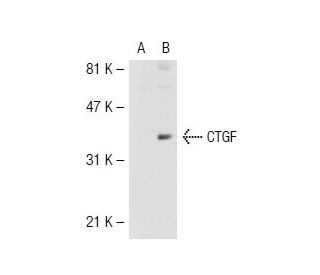
CTGF Antibody (6B13): sc-101586

4.0(9)
Write a reviewAsk a question

Datasheets
  • CTGF Antibody (6B13) is a mouse monoclonal IgG1, cited in 48 publications, provided at 100 µg/ml
  • raised against recombinant CTGF of human origin
  • recommended for detection of CTGF of mouse, rat and human origin by WB, IP, IF, IHC(P) and ELISA
  • See CTGF (E-5): sc-365970 for CTGF antibody conjugates, including AC, HRP, FITC, PE, Alexa Fluor® 488, 594, 647, 680 and 790.
  • m-IgG Fc BP-HRP and m-IgG1 BP-HRP are the preferred secondary detection reagents for CTGF Antibody (6B13) for WB and IHC(P) applications. These reagents are now offered in bundles with CTGF Antibody (6B13) (see ordering information below).

Gene Editing Promo Banner

QUICK LINKS

SEE ALSO...

CTGF Antibody (6B13) is a mouse monoclonal IgG1 antibody specifically designed to recognize Connective Tissue Growth Factor (CTGF), also known as CCN2 or Hypertrophic Chondrocyte-Specific Gene Product 24 (Hcs24). Anti-CTGF antibody (6B13) targets recombinant human CTGF and reliably detects CTGF from mouse, rat, and human sources using western blotting (WB), immunoprecipitation (IP), immunofluorescence (IF), immunohistochemistry (with or without antigen retrieval), and enzyme-linked immunosorbent assay (ELISA). CTGF is a crucial member of the CCN family of immediate early proteins, playing a significant role in cell proliferation, migration, and extracellular matrix production, which are essential processes in tissue development, repair, and fibrosis. As a cysteine-rich secreted protein, CTGF is produced by endothelial cells, fibroblasts, smooth muscle cells, and myofibroblasts, and expression is notably increased in various fibrotic diseases, including proliferative and fibrogenic renal disorders. Additionally, CTGF functions as a growth factor for vascular smooth muscle cells, promoting growth and migration, which is important in the study of vascular diseases and atherosclerosis. The upregulation of CTGF in fibrotic conditions underscores importance in the pathogenesis of these diseases, making CTGF a valuable target for research and therapeutic intervention. Available in a non-conjugated form, CTGF (6B13) antibody offers versatility for diverse experimental applications, ensuring accurate and consistent detection of CTGF in studies focused on fibrosis, tissue remodeling, and vascular biology.

For Research Use Only. Not Intended for Diagnostic or Therapeutic Use.

Ordering Information

Product NameCatalog #UNITPriceQtyFAVORITES

CTGF Antibody (6B13)

sc-101586
100 µg/ml
$322.00

CTGF Antibody (6B13): m-IgG Fc BP-HRP Bundle

sc-539784
100 µg Ab; 10 µg BP
$361.00

CTGF Antibody (6B13): m-IgG1 BP-HRP Bundle

sc-541706
100 µg Ab; 20 µg BP
$361.00

Do you have a CTGF antibody for immunohistochemistry with mouse tissues? Thanks!

Asked by: Mir 2022
Thank you for your question. It would be helpful if you could call 800-457-3801, allowing for a more interactive discussion of this and other related questions.
Answered by: Technical Service
Date published: 2022-03-09

what is expected size of ctfg with reduced (BME) and non-reduced conditions with CTFG ab (6B13) in cell lysates

Asked by: ghhi
The predicted molecular weight for CTGF is 38 kDa. We have not tested this antibody using non-reducing conditions and so we can not provide any molecular weight reference for this application.
Answered by: Technical Support
Date published: 2018-12-11

Can I use this CTGF (6B13) antibody as a 'Neutralizing Ab' in cell culture experiments? Please provide the information if this can also be used as a Neutralizing AB. Thanks Nidhi

Asked by: ndwivedi
Thank you for your question. We have not tested this antibody, CTGF (6B13): sc-101586, for functional use such as neutralizing or blocking and so this application is not recommended at this time. We are also not aware of any publications citing use of the antibody for these applications.
Answered by: Technical Support
Date published: 2017-11-17

Could you please find me which CTGF domain does this antibody recognize? 

Asked by: Shixin
Thank you for your question. Unfortunately, we do not know any further details about what specific domain of CTGF this mouse monoclonal antibody, CTGF (6B13): sc-101586, recognizes. The antibody is raised against a recombinant protein, and the epitope recognized has not been determined.
Answered by: Technical Support
Date published: 2017-05-18

What is the recommended secondary reagent to be used with this mouse monoclonal primary?

Asked by: jerojero
We recommend using one our exclusive Mouse IgG Binding Proteins as a secondary detection reagent. A complete list of available binding proteins is available on our website here: https://www.scbt.com/scbt/browse/support-products-mouse-igg-binding-proteins/_/N-ecrety
Answered by: Technical Support 7
Date published: 2017-02-15
  • y_2026, m_3, d_26, h_7CST
  • bvseo_bulk, prod_bvqa, vn_bulk_3.0.43
  • cp_1, bvpage1
  • co_hasquestionsanswers, tq_5
  • loc_en_US, sid_101586, prod, sort_[SortEntry(order=LAST_APPROVED_ANSWER_SUBMISSION_TIME, direction=DESCENDING)]
  • clientName_scbt
  • bvseo_sdk, java_sdk, bvseo-4.0.0
  • CLOUD, getContent, 96ms
  • QUESTIONS, PRODUCT
Rated 5 out of 5 by from 免疫荧光效果很好免疫荧光1:100,效果很好,相比其它品牌santa抗体做免疫荧光更划算。值得购买。希望可以出一些Rb或者Rat的抗体
Date published: 2021-11-17
Rated 2 out of 5 by from several bandswe recently tested that antibody but got serveral bands between 35 kDa to 70 kDa (dilution 1:250)
Date published: 2018-03-16
Rated 5 out of 5 by from Good in IFThis antibody shows bright and sharp staining when used in IF with methanol fixed cells.
Date published: 2017-01-23
Rated 5 out of 5 by from strong signal for WBI tried the free sample in WB, detect mouse brain tissue, shows strong band.
Date published: 2017-01-18
Rated 4 out of 5 by from Strong signal in WB in mouse transfectedStrong signal in WB in mouse transfected 293T whole cell lysates. -SCBT QC
Date published: 2015-03-30
Rated 3 out of 5 by from Produced acceptable immunofluorescence cytoplasmicProduced acceptable immunofluorescence cytoplasmic and extracellular staining in methanol-fixed HeLa cells. -SCBT QC
Date published: 2015-03-19
Rated 4 out of 5 by from Good specificity in WB in human PSCs(PancreaticGood specificity in WB in human PSCs(Pancreatic stellate cells). -SCBT Publication Review
Date published: 2015-03-02
Rated 4 out of 5 by from Good publishable data in WB in human MDAGood publishable data in WB in human MDA-MB-231 cells, hTERT-BJ1 cells. -SCBT Publication Review
Date published: 2015-02-24
  • y_2026, m_3, d_26, h_7
  • bvseo_bulk, prod_bvrr, vn_bulk_3.0.43
  • cp_1, bvpage1
  • co_hasreviews, tv_0, tr_9
  • loc_en_US, sid_101586, prod, sort_[SortEntry(order=SUBMISSION_TIME, direction=DESCENDING)]
  • clientName_scbt
  • bvseo_sdk, java_sdk, bvseo-4.0.0
  • CLOUD, getReviews, 10ms
  • REVIEWS, PRODUCT
CTGF Antibody (6B13) is rated 4.0 out of 5 by 9.
  • y_2026, m_3, d_26, h_7
  • bvseo_bulk, prod_bvrr, vn_bulk_3.0.43
  • cp_1, bvpage1
  • co_hasreviews, tv_0, tr_9
  • loc_en_US, sid_101586, prod, sort_[SortEntry(order=SUBMISSION_TIME, direction=DESCENDING)]
  • clientName_scbt
  • bvseo_sdk, java_sdk, bvseo-4.0.0
  • CLOUD, getAggregateRating, 99ms
  • REVIEWS, PRODUCT