
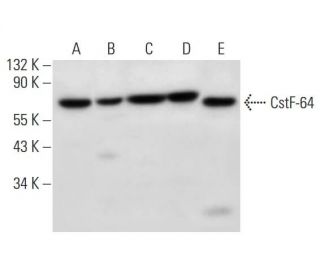


CstF-64 Antibody (E-9): sc-398840
- CstF-64 Antibody (E-9) is a mouse monoclonal IgG3 κ provided at 200 µg/ml
- raised against amino acids 278-577 mapping at the C-terminus of CstF-64 of human origin
- recommended for detection of CstF-64 and CstF-64T of human origin by WB, IP, IF and ELISA
- m-IgGκ BP-HRP is the preferred secondary detection reagent for CstF-64 Antibody (E-9) for WB applications. This reagent is now offered in a bundle with CstF-64 Antibody (E-9) (see ordering information below). For additional m-IgGκ BP conjugates see our complete list of Mouse IgG Binding Proteins.

CstF-64 Antibody (E-9) is a mouse monoclonal IgG3 antibody that detects CstF-64 in human samples through applications such as western blotting (WB), immunoprecipitation (IP), immunofluorescence (IF), and enzyme-linked immunosorbent assay (ELISA). CstF-64 plays a crucial role in the polyadenylation of mRNA precursors, a vital process for gene expression regulation, as CstF-64 is involved in the endonucleolytic cleavage of polyadenylation substrates. CstF-64 is expressed in all somatic cells and is particularly important in B cell activation, where an increase in CstF-64 concentration facilitates the switch of immunoglobulin M (IgM) heavy chain mRNA from membrane-bound to secreted forms, thereby influencing antibody production. Notably, CstF-64 is encoded by the CSTF2 gene located on the X chromosome, while its larger variant, t CstF-64, is produced from an autosomal gene and is predominantly expressed in meiotic and postmeiotic cells in the testis, highlighting its significance in germ cell development. CstF-64′s ability to regulate mRNA processing underscores its importance in maintaining proper cellular function and response, making anti-CstF-64 antibody (E-9) an essential tool for researchers studying gene expression and B cell differentiation.
Alexa Fluor® is a trademark of Molecular Probes Inc., OR., USA
LI-COR® and Odyssey® are registered trademarks of LI-COR Biosciences
CstF-64 Antibody (E-9) References:
- Recognition of GU-rich polyadenylation regulatory elements by human CstF-64 protein. | Pérez Cañadillas, JM. and Varani, G. 2003. EMBO J. 22: 2821-30. PMID: 12773396
- Protein and RNA dynamics play key roles in determining the specific recognition of GU-rich polyadenylation regulatory elements by human Cstf-64 protein. | Deka, P., et al. 2005. J Mol Biol. 347: 719-33. PMID: 15769465
- Enterovirus 71 3C protease cleaves a novel target CstF-64 and inhibits cellular polyadenylation. | Weng, KF., et al. 2009. PLoS Pathog. 5: e1000593. PMID: 19779565
- The hinge domain of the cleavage stimulation factor protein CstF-64 is essential for CstF-77 interaction, nuclear localization, and polyadenylation. | Hockert, JA., et al. 2010. J Biol Chem. 285: 695-704. PMID: 19887456
- Transcriptome-wide analyses of CstF64-RNA interactions in global regulation of mRNA alternative polyadenylation. | Yao, C., et al. 2012. Proc Natl Acad Sci U S A. 109: 18773-8. PMID: 23112178
- Overlapping and distinct functions of CstF64 and CstF64τ in mammalian mRNA 3' processing. | Yao, C., et al. 2013. RNA. 19: 1781-90. PMID: 24149845
- CstF-64 and 3'-UTR cis-element determine Star-PAP specificity for target mRNA selection by excluding PAPα. | Kandala, DT., et al. 2016. Nucleic Acids Res. 44: 811-23. PMID: 26496945
- PAPERCLIP Identifies MicroRNA Targets and a Role of CstF64/64tau in Promoting Non-canonical poly(A) Site Usage. | Hwang, HW., et al. 2016. Cell Rep. 15: 423-35. PMID: 27050522
- The structural basis of CstF-77 modulation of cleavage and polyadenylation through stimulation of CstF-64 activity. | Grozdanov, PN., et al. 2018. Nucleic Acids Res. 46: 12022-12039. PMID: 30257008
- CstF64-Induced Shortening of the BID 3'UTR Promotes Esophageal Squamous Cell Carcinoma Progression by Disrupting ceRNA Cross-talk with ZFP36L2. | Lin, A., et al. 2021. Cancer Res. 81: 5638-5651. PMID: 34607841
Ordering Information
| Product Name | Catalog # | UNIT | Price | Qty | FAVORITES | |
CstF-64 Antibody (E-9) | sc-398840 | 200 µg/ml | $322.00 | |||
CstF-64 Antibody (E-9): m-IgGκ BP-HRP Bundle | sc-524504 | 200 µg Ab, 40 µg BP | $361.00 |