
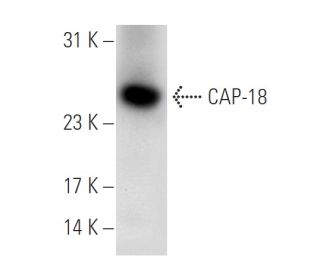
CAP-18 Antibody (G-1): sc-166055
- CAP-18 Antibody (G-1) is a mouse monoclonal IgG2a κ CAP-18 antibody, cited in 10 publications, provided at 200 µg/ml
- raised against amino acids 6-175 mapping at the C-terminus of CAP-18 of rat origin
- CAP-18 Antibody (G-1) is recommended for detection of CAP-18 of mouse and rat origin by WB, IP, IF and ELISA
- Anti-CAP-18 Antibody (G-1) is available conjugated to agarose for IP; HRP for WB, IHC(P) and ELISA; and to either phycoerythrin or FITC for IF, IHC(P) and FCM
- also available conjugated to Alexa Fluor® 488, Alexa Fluor® 546, Alexa Fluor® 594 or Alexa Fluor® 647 for WB (RGB), IF, IHC(P) and FCM, and for use with RGB fluorescent imaging systems, such as iBright™ FL1000, FluorChem™, Typhoon, Azure and other comparable systems
- also available conjugated to Alexa Fluor® 680 or Alexa Fluor® 790 for WB (NIR), IF and FCM; for use with Near-Infrared (NIR) detection systems, such as LI-COR®Odyssey®, iBright™ FL1000, FluorChem™, Typhoon, Azure and other comparable systems
- m-IgG Fc BP-HRP, m-IgG2a BP-HRP and m-IgGκ BP-HRP are the preferred secondary detection reagents for CAP-18 Antibody (G-1) for WB applications. These reagents are now offered in bundles with CAP-18 Antibody (G-1) (see ordering information below).

QUICK LINKS
SEE ALSO...
CAP-18 Antibody (G-1) is a mouse monoclonal IgG2a kappa light chain antibody that detects CAP-18 of mouse and rat origin by western blotting (WB), immunoprecipitation (IP), immunofluorescence (IF), and enzyme-linked immunosorbent assay (ELISA). CAP-18 (G-1) antibody is available in both non-conjugated and various conjugated forms, including agarose, horseradish peroxidase (HRP), phycoerythrin (PE), fluorescein isothiocyanate (FITC), and multiple Alexa Fluor® conjugates. CAP-18, also known as cathelicidin antimicrobial peptide, plays a crucial role in the innate immune response by acting as an antimicrobial agent that helps to prevent infections and modulate inflammation. CAP-18 is primarily expressed in neutrophils, bone marrow, and testis, and is particularly important in inflammatory skin diseases such as psoriasis and dermatitis, where CAP-18 is found in elevated levels. CAP-18 contains the antibacterial peptide LL-37, which is known for its ability to adopt an amphipathic α-helical conformation, allowing CAP-18 to interact effectively with bacterial lipopolysaccharides and recruit immune cells to sites of infection. The presence of LL-37 in inflammatory conditions highlights CAP-18′s significance in host defense mechanisms, making anti-CAP-18 antibody (G-1) an essential tool for researchers studying antimicrobial peptides and their roles in immune responses.
Alexa Fluor® is a trademark of Molecular Probes Inc., OR., USA
LI-COR® and Odyssey® are registered trademarks of LI-COR Biosciences
CAP-18 Antibody (G-1) References:
- Human cathelicidin, hCAP-18, is processed to the antimicrobial peptide LL-37 by extracellular cleavage with proteinase 3. | Sørensen, OE., et al. 2001. Blood. 97: 3951-9. PMID: 11389039
- A cathelicidin family of human antibacterial peptide LL-37 induces mast cell chemotaxis. | Niyonsaba, F., et al. 2002. Immunology. 106: 20-6. PMID: 11972628
- Cathelicidin antimicrobial peptides are expressed in salivary glands and saliva. | Murakami, M., et al. 2002. J Dent Res. 81: 845-50. PMID: 12454100
- Neonatal skin in mice and humans expresses increased levels of antimicrobial peptides: innate immunity during development of the adaptive response. | Dorschner, RA., et al. 2003. Pediatr Res. 53: 566-72. PMID: 12612195
- Phylogeny, processing and expression of the rat cathelicidin rCRAMP: a model for innate antimicrobial peptides. | Termén, S., et al. 2003. Cell Mol Life Sci. 60: 536-49. PMID: 12737313
- The cathelicidins--structure, function and evolution. | Tomasinsig, L. and Zanetti, M. 2005. Curr Protein Pept Sci. 6: 23-34. PMID: 15638766
- Cathelicidin antimicrobial peptide as a serologic marker and potential pathogenic factor in antineutrophil cytoplasmic antibody-associated vasculitis. | Gasim, A. 2014. Arthritis Res Ther. 16: 105. PMID: 25164257
- Cathelicidin Antimicrobial Peptide Acts as a Tumor Suppressor in Hepatocellular Carcinoma. | Huang, LH., et al. 2023. Int J Mol Sci. 24: PMID: 37958632
- Cathelicidin antimicrobial peptide expression in neutrophils and neurons antagonistically modulates neuroinflammation. | Verma, SC., et al. 2024. J Clin Invest. 135: PMID: 39656548
- A novel murine cathelin-like protein expressed in bone marrow. | Popsueva, AE., et al. 1996. FEBS Lett. 391: 5-8. PMID: 8706928
- Identification of CRAMP, a cathelin-related antimicrobial peptide expressed in the embryonic and adult mouse. | Gallo, RL., et al. 1997. J Biol Chem. 272: 13088-93. PMID: 9148921
- The expression of the gene coding for the antibacterial peptide LL-37 is induced in human keratinocytes during inflammatory disorders. | Frohm, M., et al. 1997. J Biol Chem. 272: 15258-63. PMID: 9182550
Ordering Information
| Product Name | Catalog # | UNIT | Price | Qty | FAVORITES | |
CAP-18 Antibody (G-1) | sc-166055 | 200 µg/ml | $322.00 | |||
CAP-18 Antibody (G-1): m-IgG Fc BP-HRP Bundle | sc-528899 | 200 µg Ab; 10 µg BP | $361.00 | |||
CAP-18 Antibody (G-1): m-IgGκ BP-HRP Bundle | sc-521497 | 200 µg Ab, 40 µg BP | $361.00 | |||
CAP-18 Antibody (G-1): m-IgG2a BP-HRP Bundle | sc-547201 | 200 µg Ab; 10 µg BP | $361.00 | |||
CAP-18 Antibody (G-1) AC | sc-166055 AC | 500 µg/ml, 25% agarose | $424.00 | |||
CAP-18 Antibody (G-1) HRP | sc-166055 HRP | 200 µg/ml | $322.00 | |||
CAP-18 Antibody (G-1) FITC | sc-166055 FITC | 200 µg/ml | $336.00 | |||
CAP-18 Antibody (G-1) PE | sc-166055 PE | 200 µg/ml | $349.00 | |||
CAP-18 Antibody (G-1) Alexa Fluor® 488 | sc-166055 AF488 | 200 µg/ml | $364.00 | |||
CAP-18 Antibody (G-1) Alexa Fluor® 546 | sc-166055 AF546 | 200 µg/ml | $364.00 | |||
CAP-18 Antibody (G-1) Alexa Fluor® 594 | sc-166055 AF594 | 200 µg/ml | $364.00 | |||
CAP-18 Antibody (G-1) Alexa Fluor® 647 | sc-166055 AF647 | 200 µg/ml | $364.00 | |||
CAP-18 Antibody (G-1) Alexa Fluor® 680 | sc-166055 AF680 | 200 µg/ml | $364.00 | |||
CAP-18 Antibody (G-1) Alexa Fluor® 790 | sc-166055 AF790 | 200 µg/ml | $364.00 |