
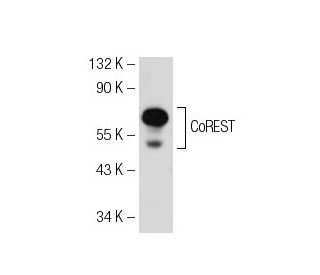


CoREST Antibody (26): sc-135873
- CoREST Antibody (26) is a mouse monoclonal IgG1 provided at 50 µg/0.5 ml
- raised against amino acids 78-192 of CoREST of human origin
- recommended for detection of CoREST of mouse, rat and human origin by WB, IP and IF
- At present, we have not yet completed the identification of the preferred secondary detection reagent(s) for CoREST Antibody (26). This work is in progress.

QUICK LINKS
SEE ALSO...
CoREST Antibody (26) is a mouse monoclonal IgG1 antibody that detects CoREST in mouse, rat, and human samples through applications such as western blotting (WB), immunoprecipitation (IP), and immunofluorescence (IF). CoREST, or Co-repressor of REST, plays a crucial role in the regulation of gene expression by forming a repressor complex with the neuron-restrictive silencer factor (NRSF). This complex is essential for maintaining the silencing of neuronal genes in non-neuronal cells, thereby preventing inappropriate expression of neuronal markers in these tissues. The interaction between CoREST and NRSF is mediated through a single zinc finger motif located in the carboxy-terminal repressor domain of NRSF, which is vital for the recruitment of histone deacetylases to the repressor complex. This recruitment is significant because it leads to the hypoacetylation of chromatin, a modification that is associated with transcriptional repression. The functionality of CoREST has been conserved across various species, including humans, mice, Xenopus, and C. elegans, highlighting its fundamental role in gene regulation. Anti-CoREST antibody (26) is an invaluable tool for researchers studying the mechanisms of gene silencing and the intricate regulatory networks involved in cellular differentiation and identity.
Alexa Fluor® is a trademark of Molecular Probes Inc., OR., USA
LI-COR® and Odyssey® are registered trademarks of LI-COR Biosciences
CoREST Antibody (26) References:
- The co-repressor mSin3A is a functional component of the REST-CoREST repressor complex. | Grimes, JA., et al. 2000. J Biol Chem. 275: 9461-7. PMID: 10734093
- Components of the REST/CoREST/histone deacetylase repressor complex are disrupted, modified, and translocated in HSV-1-infected cells. | Gu, H., et al. 2005. Proc Natl Acad Sci U S A. 102: 7571-6. PMID: 15897453
- MeCP2 deficiency in the brain decreases BDNF levels by REST/CoREST-mediated repression and increases TRKB production. | Abuhatzira, L., et al. 2007. Epigenetics. 2: 214-22. PMID: 18075316
- REST and CoREST are transcriptional and epigenetic regulators of seminal neural fate decisions. | Qureshi, IA., et al. 2010. Cell Cycle. 9: 4477-86. PMID: 21088488
- The CoREST/REST repressor is both necessary and inimical for expression of herpes simplex virus genes. | Zhou, G., et al. 2010. mBio. 2: e00313-10. PMID: 21221247
- The checkpoints of viral gene expression in productive and latent infection: the role of the HDAC/CoREST/LSD1/REST repressor complex. | Roizman, B. 2011. J Virol. 85: 7474-82. PMID: 21450817
- The role of the CoREST/REST repressor complex in herpes simplex virus 1 productive infection and in latency. | Zhou, G., et al. 2013. Viruses. 5: 1208-18. PMID: 23628827
- More than a Corepressor: The Role of CoREST Proteins in Neurodevelopment. | Maksour, S., et al. 2020. eNeuro. 7: PMID: 32075869
- Inhibition of the CoREST Repressor Complex Promotes Wound Re-Epithelialization through the Regulation of Keratinocyte Migration. | Kida, M., et al. 2024. J Invest Dermatol. 144: 378-386.e2. PMID: 37633457
- GSE1 links the HDAC1/CoREST co-repressor complex to DNA damage. | Vcelkova, T., et al. 2023. Nucleic Acids Res. 51: 11748-11769. PMID: 37878419
Ordering Information
| Product Name | Catalog # | UNIT | Price | Qty | FAVORITES | |
CoREST Antibody (26) | sc-135873 | 50 µg/0.5 ml | $322.00 |