
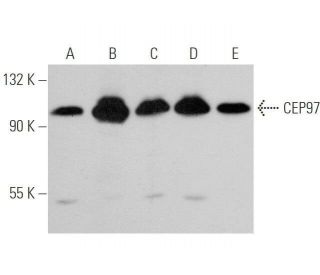


CEP97 Anticuerpo (B-4): sc-515526
- CEP97 Anticuerpo B-4 es un monoclonal de ratón IgM (kappa light chain) CEP97 Anticuerpo proporcionado como 200 µg/ml
- específico para un epítopo localizado entre los amino ácidos 823-842 cerca del C-terminus de CEP97 oe orgiendf humanorigin
- recomendado para detectar CEP97 de human origen, mediante WB, IP, IF y ELISA
- m-IgGκ BP-HRP es el reactivo de detección secundario preferido para CEP97 Anticuerpo (B-4) para aplicaciones WB. Este reactivo se ofrece ahora en un paquete con CEP97 Anticuerpo (B-4)(ver información de pedido más abajo). Para otros conjugados m-IgGκ BP, consulte nuestra lista completa de proteínas de unión a IgG de ratón.

ENLACES RÁPIDOS
VER TAMBIÉN ....
El anticuerpo CEP97 (B-4) es un anticuerpo IgM monoclonal de ratón que detecta CEP97 de origen humano mediante Western blotting (WB), inmunoprecipitación (IP), inmunofluorescencia (IF) y ensayo inmunoenzimático (ELISA). El anticuerpo anti-CEP97 (B-4) está disponible en forma no conjugada. La CEP97, también conocida como proteína centrosomal de 97 kDa o LRRIQ2, es una proteína de 865 aminoácidos caracterizada por la presencia de seis motivos de repetición rica en leucina (LRR) y un dominio IQ, que facilita la interacción con la calmodulina. CEP97 se localiza principalmente en el centrosoma, donde desempeña un papel crucial en la citocinesis y es esencial para la correcta formación del huso durante la división celular. La importancia de CEP97 se extiende al reclutamiento de CEP110, una proteína clave necesaria para la duplicación centrosómica, asegurando así una división celular precisa y manteniendo la estabilidad genómica. Las mutaciones en genes que codifican proteínas como CEP97 pueden dar lugar a diversas enfermedades humanas, lo que pone de relieve la importancia de CEP97 en los procesos celulares. El anticuerpo anti-CEP97 (B-4) es una herramienta inestimable para estudiar la dinámica de las proteínas centrosómicas y sus implicaciones en la salud y la enfermedad.
Alexa Fluor® es una marca registrada de Molecular Probes Inc., OR., USA
REIVEW LI-COR® y Odyssey® son marcas registradas de LI-COR Biosciences.
CEP97 Anticuerpo (B-4) Referencias:
- La repetición rica en leucina como motivo de reconocimiento de proteínas. | Kobe, B. and Kajava, AV. 2001. Curr Opin Struct Biol. 11: 725-32. PMID: 11751054
- Centrosomas en la regulación celular. | Doxsey, S., et al. 2005. Annu Rev Cell Dev Biol. 21: 411-34. PMID: 16212501
- Análisis estructural de variantes de la repetición rica en leucina en proteínas asociadas a enfermedades humanas. | Matsushima, N., et al. 2005. Cell Mol Life Sci. 62: 2771-91. PMID: 16231091
- El análisis de sustratos de ATM y ATR revela amplias redes de proteínas que responden al daño del ADN. | Matsuoka, S., et al. 2007. Science. 316: 1160-6. PMID: 17525332
- Cep97 y CP110 suprimen un programa de ensamblaje de cilios. | Spektor, A., et al. 2007. Cell. 130: 678-90. PMID: 17719545
- La superfamilia de repeticiones extracelulares ricas en leucina: estudio comparativo y análisis de las relaciones evolutivas y los patrones de expresión. | Dolan, J., et al. 2007. BMC Genomics. 8: 320. PMID: 17868438
- Doble vida de los centriolos: CP110 en el punto de mira. | Bettencourt-Dias, M. and Carvalho-Santos, Z. 2008. Trends Cell Biol. 18: 8-11. PMID: 18068367
- La degradación de CEP97 mediada por Cullin-3-KCTD10 promueve la formación de cilios primarios. | Nagai, T., et al. 2018. J Cell Sci. 131: PMID: 30404837
- Cep97 es necesario para la integridad estructural del centriolo y la formación de cilios en Drosophila. | Dobbelaere, J., et al. 2020. Curr Biol. 30: 3045-3056.e7. PMID: 32589908
- La fosforilación de CEP97 por Dyrk1a es crítica para la separación de centríolos durante la multiciliogénesis. | Lee, M., et al. 2022. J Cell Biol. 221: PMID: 34787650
- ENKD1 promueve la eliminación de CP110 compitiendo con CEP97 para iniciar la ciliogénesis. | Song, T., et al. 2022. EMBO Rep. 23: e54090. PMID: 35301795
- La repetición rica en leucina: un motivo de unión versátil. | Kobe, B. and Deisenhofer, J. 1994. Trends Biochem Sci. 19: 415-21. PMID: 7817399
Información sobre pedidos
| Nombre del producto | Número de catálogo | UNIDAD | Precio | CANTIDAD | Favoritos | |
CEP97 Anticuerpo (B-4) | sc-515526 | 200 µg/ml | $322.00 | |||
Paquete de CEP97 (B-4): m-IgGκ BP-HRP | sc-552741 | 200 µg Ab; 40 µg BP | $361.00 | |||
CEP97 (B-4) péptido neutralizante | sc-515526 P | 100 µg/0.5 ml | $69.00 |