
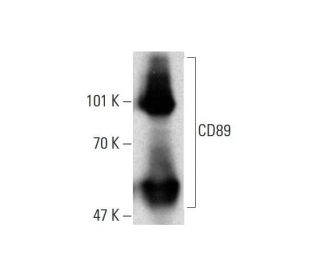


CD89 Antibody (A3): sc-19680
- CD89 Antibody (A3) is a mouse monoclonal IgG1 κ CD89 antibody, cited in 2 publications, provided at 200 µg/ml
- raised against purified Fc αreceptors (CD89) isolated from a human monocytic cell line
- CD89 Antibody (A3) is recommended for detection of CD89 of human origin by WB, IP, IF and FCM
- Anti-CD89 Antibody (A3) is available conjugated to agarose for IP; HRP for WB, IHC(P) and ELISA; and to either phycoerythrin or FITC for IF, IHC(P) and FCM
- also available conjugated to Alexa Fluor® 488, Alexa Fluor® 546, Alexa Fluor® 594 or Alexa Fluor® 647 for WB (RGB), IF, IHC(P) and FCM, and for use with RGB fluorescent imaging systems, such as iBright™ FL1000, FluorChem™, Typhoon, Azure and other comparable systems
- also available conjugated to Alexa Fluor® 680 or Alexa Fluor® 790 for WB (NIR), IF and FCM; for use with Near-Infrared (NIR) detection systems, such as LI-COR®Odyssey®, iBright™ FL1000, FluorChem™, Typhoon, Azure and other comparable systems
- m-IgG Fc BP-HRP and m-IgGκ BP-HRP are the preferred secondary detection reagents for CD89 Antibody (A3) for WB applications. These reagents are now offered in bundles with CD89 Antibody (A3) (see ordering information below).

QUICK LINKS
SEE ALSO...
CD89 Antibody (A3) is a mouse monoclonal IgG1 kappa light chain antibody that detects CD89 protein of human origin by western blotting (WB), immunoprecipitation (IP), immunofluorescence (IF), and flow cytometry (FCM). CD89 (A3) antibody is available in both non-conjugated and various conjugated forms, including agarose, horseradish peroxidase (HRP), phycoerythrin (PE), fluorescein isothiocyanate (FITC), and multiple Alexa Fluor® conjugates. CD89, also known as Immunoglobulin alpha Fc receptor (Fc α RI), plays a crucial role in the immune response by binding to aggregated IgA, which is essential for the clearance of pathogens and immune complexes. This glycoprotein is predominantly expressed on the surface of immune cells such as neutrophils, monocytes, macrophages, and eosinophils, where CD89 acts as a potent cytotoxic trigger. CD89 interaction with IgA not only facilitates the endocytosis of IgA-coated antigens but also enhances antibody production in B cells through T cell antigen presentation, thereby amplifying the immune response. Additionally, cytokines can induce a high-affinity binding state for CD89, which is mediated by CD89′s intracellular C-terminus, highlighting CD89′s dynamic role in immune regulation. Notably, polymorphisms in the gene encoding CD89 have been linked to an increased susceptibility to IgA nephropathy, a glomerulonephritis characterized by the deposition of IgA antibodies in the kidney glomeruli, underscoring CD89′s clinical significance in both health and disease.
Alexa Fluor® is a trademark of Molecular Probes Inc., OR., USA
LI-COR® and Odyssey® are registered trademarks of LI-COR Biosciences
CD89 Antibody (A3) References:
- Polymorphism in promoter region of Fcalpha receptor gene in patients with IgA nephropathy. | Tsuge, T., et al. 2001. Hum Genet. 108: 128-33. PMID: 11281451
- Insights into IgA-mediated immune responses from the crystal structures of human FcalphaRI and its complex with IgA1-Fc. | Herr, AB., et al. 2003. Nature. 423: 614-20. PMID: 12768205
- The gene for the human IgA Fc receptor maps to 19q13.4. | Kremer, EJ., et al. 1992. Hum Genet. 89: 107-8. PMID: 1577457
- Functionality of the IgA Fc receptor (FcalphaR, CD89) is down-regulated by extensive engagement of FcepsilonRI. | Matsui, T., et al. 2008. Clin Immunol. 129: 155-62. PMID: 18700185
- Inside-out regulation of Fc alpha RI (CD89) depends on PP2A. | Bakema, JE., et al. 2008. J Immunol. 181: 4080-8. PMID: 18768864
- Functional expression of IgA receptor FcalphaRI on human platelets. | Qian, K., et al. 2008. J Leukoc Biol. 84: 1492-500. PMID: 18784345
- Analysis of IgA1 N-glycosylation and its contribution to FcalphaRI binding. | Gomes, MM., et al. 2008. Biochemistry. 47: 11285-99. PMID: 18826328
- Soluble CD89 is a critical factor for mesangial proliferation in childhood IgA nephropathy. | Cambier, A., et al. 2022. Kidney Int. 101: 274-287. PMID: 34756952
- Targeting CD89 on tumor-associated macrophages overcomes resistance to immune checkpoint blockade. | Xu, L., et al. 2022. J Immunother Cancer. 10: PMID: 36460336
- Antagonizing FcαR1 (CD89) as treatment in IgA-mediated chronic inflammation and autoimmunity. | van Delft, MAM., et al. 2023. Front Immunol. 14: 1118539. PMID: 37081893
- SIgA structures bound to Streptococcus pyogenes M4 and human CD89 provide insights into host-pathogen interactions. | Liu, Q. and Stadtmueller, BM. 2023. Nat Commun. 14: 6726. PMID: 37872175
- Structure of the gene for the human myeloid IgA Fc receptor (CD89). | de Wit, TP., et al. 1995. J Immunol. 155: 1203-9. PMID: 7636188
Ordering Information
| Product Name | Catalog # | UNIT | Price | Qty | FAVORITES | |
CD89 Antibody (A3) | sc-19680 | 200 µg/ml | $322.00 | |||
CD89 Antibody (A3): m-IgG Fc BP-HRP Bundle | sc-528343 | 200 µg Ab; 10 µg BP | $361.00 | |||
CD89 Antibody (A3): m-IgGκ BP-HRP Bundle | sc-520697 | 200 µg Ab, 40 µg BP | $361.00 | |||
CD89 Antibody (A3) AC | sc-19680 AC | 500 µg/ml, 25% agarose | $424.00 | |||
CD89 Antibody (A3) HRP | sc-19680 HRP | 200 µg/ml | $322.00 | |||
CD89 Antibody (A3) FITC | sc-19680 FITC | 200 µg/ml | $336.00 | |||
CD89 Antibody (A3) PE | sc-19680 PE | 200 µg/ml | $349.00 | |||
CD89 Antibody (A3) Alexa Fluor® 488 | sc-19680 AF488 | 200 µg/ml | $364.00 | |||
CD89 Antibody (A3) Alexa Fluor® 546 | sc-19680 AF546 | 200 µg/ml | $364.00 | |||
CD89 Antibody (A3) Alexa Fluor® 594 | sc-19680 AF594 | 200 µg/ml | $364.00 | |||
CD89 Antibody (A3) Alexa Fluor® 647 | sc-19680 AF647 | 200 µg/ml | $364.00 | |||
CD89 Antibody (A3) Alexa Fluor® 680 | sc-19680 AF680 | 200 µg/ml | $364.00 | |||
CD89 Antibody (A3) Alexa Fluor® 790 | sc-19680 AF790 | 200 µg/ml | $364.00 |