
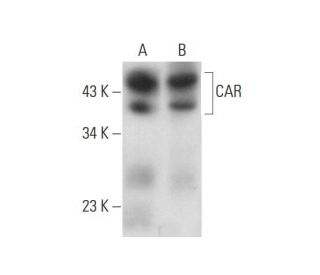


CAR Antibody (A-10): sc-365836
- CAR Antibody (A-10) is a mouse monoclonal IgG2a provided at 200 µg/ml
- raised against amino acids 1-300 of CAR of human origin
- recommended for detection of CAR of mouse, rat and human origin by WB, IP, IF and ELISA
- See CAR (E-1): sc-373791 for CAR antibody conjugates, including AC, HRP, FITC, PE, Alexa Fluor® 488, 594, 647, 680 and 790.
- m-IgG Fc BP-HRP, m-IgG2a BP-HRP and m-IgGκ BP-HRP are the preferred secondary detection reagents for CAR Antibody (A-10) for WB applications. These reagents are now offered in bundles with CAR Antibody (A-10) (see ordering information below).

QUICK LINKS
SEE ALSO...
CAR Antibody (A-10) is a mouse monoclonal IgG2a antibody that detects coxsackie and adenovirus receptor (CAR) in mouse, rat, and human samples through applications such as western blotting (WB), immunoprecipitation (IP), immunofluorescence (IF), and enzyme-linked immunosorbent assay (ELISA). CAR plays a crucial role in mediating viral infection by facilitating the binding of various adenoviruses through specific protein interactions, particularly between the viral knob domain and the extracellular amino-terminal domain known as D1. This interaction is vital for understanding the mechanisms of viral entry into host cells and has significant implications for the development of gene therapy strategies that utilize adenoviruses as vectors. Notably, the D1 domain of CAR is sufficient for binding to the adenoviral knob, highlighting its importance in the viral infection process. CAR is expressed in a variety of human and murine cell types, but cells with low CAR expression levels are less susceptible to adenoviral infection, which poses challenges for therapeutic applications. To address this issue, strategies such as supplementing CAR levels or engineering adenoviral knobs to target alternative receptors are being explored, making the study of CAR and its interactions increasingly relevant in the field of virology and gene therapy. Anti-CAR antibody (A-10) is an essential tool for researchers investigating these critical interactions and their implications in viral pathogenesis and therapeutic development.
Alexa Fluor® is a trademark of Molecular Probes Inc., OR., USA
LI-COR® and Odyssey® are registered trademarks of LI-COR Biosciences
CAR Antibody (A-10) References:
- Integrin alpha(v) and coxsackie adenovirus receptor expression in clinical bladder cancer. | Sachs, MD., et al. 2002. Urology. 60: 531-6. PMID: 12350512
- Loss of coxsackie and adenovirus receptor expression is associated with features of aggressive bladder cancer. | Matsumoto, K., et al. 2005. Urology. 66: 441-6. PMID: 16040097
- The Coxsackie and adenovirus receptor binds microtubules and plays a role in cell migration. | Fok, PT., et al. 2007. J Biol Chem. 282: 7512-21. PMID: 17210569
- Expression of coxsackie and adenovirus receptor reduces the lung metastatic potential of murine tumor cells. | Yamashita, M., et al. 2007. Int J Cancer. 121: 1690-6. PMID: 17546646
- Loss of the coxsackie and adenovirus receptor contributes to gastric cancer progression. | Anders, M., et al. 2009. Br J Cancer. 100: 352-9. PMID: 19142187
- Expression of coxsackie and adenovirus receptor distinguishes transitional cancer states in therapy-induced cellular senescence. | Wu, PC., et al. 2010. Cell Death Dis. 1: e70. PMID: 21364674
- Coxsackie and adenovirus receptor is a target and a mediator of estrogen action in breast cancer. | Vindrieux, D., et al. 2011. Endocr Relat Cancer. 18: 311-21. PMID: 21389059
- Expression of the coxsackie and adenovirus receptor in human lung cancers. | Chen, Z., et al. 2013. Tumour Biol. 34: 17-24. PMID: 23307165
- Coxsackie and adenovirus receptor is a critical regulator for the survival and growth of oral squamous carcinoma cells. | Saito, K., et al. 2014. Oncogene. 33: 1274-86. PMID: 23503462
- CAR: A key regulator of adhesion and inflammation. | Ortiz-Zapater, E., et al. 2017. Int J Biochem Cell Biol. 89: 1-5. PMID: 28545889
Ordering Information
| Product Name | Catalog # | UNIT | Price | Qty | FAVORITES | |
CAR Antibody (A-10) | sc-365836 | 200 µg/ml | $322.00 | |||
CAR Antibody (A-10): m-IgG Fc BP-HRP Bundle | sc-537845 | 200 µg Ab; 10 µg BP | $361.00 | |||
CAR Antibody (A-10): m-IgGκ BP-HRP Bundle | sc-535268 | 200 µg Ab; 40 µg BP | $361.00 | |||
CAR Antibody (A-10): m-IgG2a BP-HRP Bundle | sc-548130 | 200 µg Ab; 10 µg BP | $361.00 |