
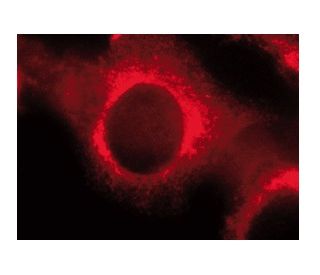
CaBP4 Anticorpo (D-6): sc-271885
- CaBP4 Anticorpo D-6é um anticorpo monoclonal produzido em camundongo IgA (kappa light chain) CaBP4 anticorpo fornecido em 200 µg/ml
- específico para um epítopo mapeado entre os aminoácidos2-21 no N-terminus de CaBP4 de mouse origem
- recomendado para a detecção de CaBP4 de mouse, rat e human origem em
- Atualmente, ainda não concluímos a identificação do(s) reagente(s) de deteção secundário(s) preferido(s) para CaBP4 Anticorpo (D-6). Este trabalho está em curso.

LINKS RÁPIDOS
O Anticorpo CaBP4 (D-6) é um anticorpo monoclonal IgA κ de camundongo CaBP4 (também designado anticorpo CaBP4) que detecta a proteína CaBP4 de origem de camundongo, rato e humana por WB, IP, IF e ELISA. O anticorpo CaBP4 (D-6) está disponível como anticorpo anti-CaBP4 não conjugado. A família da proteína de ligação ao cálcio (CaBP) partilha muitas semelhanças com a calmodulina. Foi demonstrado que as proteínas CaBP podem substituir funcionalmente, e provavelmente aumentar a função da calmodulina. As proteínas de ligação ao cálcio são uma parte crucial da transdução de sinais celulares mediada pelo cálcio no sistema nervoso central. Existem vários membros da família com padrões de expressão variáveis. A CaBP1 e a CaBP2 podem ser expressas como variantes múltiplas, com splicing alternativo, no cérebro e na retina. As CaBP3, CaBP4 e CaBP 5 estão limitadas às células dos bastonetes e cones da retina.
Alexa Fluor® é uma marca comercial da Molecular Probes Inc., OR., EUA
LI-COR® e Odyssey® são marcas registadas da LI-COR Biosciences
Referencias do CaBP4 Anticorpo (D-6):
- Cinco membros de uma nova subfamília de proteínas de ligação ao Ca(2+) (CABP) com similaridade à calmodulina. | Haeseleer, F., et al. 2000. J Biol Chem. 275: 1247-60. PMID: 10625670
- Diferentes tipos de proteínas Lys-Asp-Glu-Leu no fígado de ratos. | Peter, F., et al. 1992. J Biol Chem. 267: 10631-7. PMID: 1316906
- Papel essencial da proteína 4 de ligação ao Ca2+, um regulador do canal Cav1.4, na função sináptica dos fotorreceptores. | Haeseleer, F., et al. 2004. Nat Neurosci. 7: 1079-87. PMID: 15452577
- Um papel crítico do CaBP4 na sinapse do cone. | Maeda, T., et al. 2005. Invest Ophthalmol Vis Sci. 46: 4320-7. PMID: 16249514
- As mutações no CABP4, o gene que codifica a proteína 4 de ligação ao Ca2+, causam cegueira nocturna autossómica recessiva. | Zeitz, C., et al. 2006. Am J Hum Genet. 79: 657-67. PMID: 16960802
- Fosforilação da proteína de ligação ao Ca2+ CaBP4 pela proteína quinase C zeta nos fotorreceptores. | Lee, A., et al. 2007. J Neurosci. 27: 12743-54. PMID: 18003854
- Interação e colocalização da CaBP4 e da Unc119 (MRG4) nos fotorreceptores. | Haeseleer, F. 2008. Invest Ophthalmol Vis Sci. 49: 2366-75. PMID: 18296658
- Uma nova mutação homozigótica sem sentido no CABP4 causa uma perturbação sináptica congénita da haste cónica. | Littink, KW., et al. 2009. Invest Ophthalmol Vis Sci. 50: 2344-50. PMID: 19074807
- Fosforilação de CaBP1 e CaBP2 pela proteína quinase CK2. | Janson, IM., et al. 1997. J Biochem. 121: 112-7. PMID: 9058200
Informacoes sobre ordens
| Nome do Produto | Numero de Catalogo | UNID | Preco | Qde | FAVORITOS | |
CaBP4 Anticorpo (D-6) | sc-271885 | 200 µg/ml | $322.00 | |||
CaBP4 (D-6) peptídeo neutralizante | sc-271885 P | 100 µg/0.5 ml | $69.00 |