
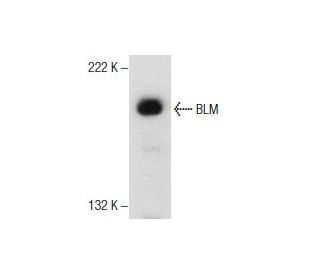

BLM Antibody (F-5): sc-376616
- BLM Antibody (F-5) is a mouse monoclonal IgM κ, cited in 1 publications, provided at 200 µg/ml
- specific for an epitope mapping between amino acids 1393-1417 at the C-terminus of BLM of human origin
- recommended for detection of BLM of human origin by WB, IP, IF and ELISA; also reactive with additional species, including and canine, bovine and porcine
- m-IgGκ BP-HRP is the preferred secondary detection reagent for BLM Antibody (F-5) for WB applications. This reagent is now offered in a bundle with BLM Antibody (F-5) (see ordering information below). For additional m-IgGκ BP conjugates see our complete list of Mouse IgG Binding Proteins.

QUICK LINKS
SEE ALSO...
BLM Antibody (F-5) is a mouse monoclonal IgM antibody that detects BLM in human samples through applications such as western blotting (WB), immunoprecipitation (IP), immunofluorescence (IF), and enzyme-linked immunosorbent assay (ELISA). Anti-BLM antibody (F-5) targets BLM protein, which plays a crucial role in maintaining genomic stability by unwinding DNA during replication and repair processes. This function is particularly important as BLM helps prevent the accumulation of DNA damage that can lead to genomic instability and cancer, a hallmark of Bloom′s syndrome. BLM protein is primarily located in the nucleus, where BLM interacts with both single- and double-stranded DNA, and BLM activity is regulated by ATP binding and hydrolysis. Mutations in the BLM gene can disrupt these essential functions, resulting in an increased frequency of sister chromatid exchanges and a higher susceptibility to various malignancies. BLM (F-5) antibody is an invaluable tool for researchers studying the molecular mechanisms underlying Bloom′s syndrome and related disorders, providing insights into the critical processes of DNA repair and cellular response to genomic stress.
Alexa Fluor® is a trademark of Molecular Probes Inc., OR., USA
LI-COR® and Odyssey® are registered trademarks of LI-COR Biosciences
BLM Antibody (F-5) References:
- Expression and nuclear localization of BLM, a chromosome stability protein mutated in Bloom's syndrome, suggest a role in recombination during meiotic prophase. | Moens, PB., et al. 2000. J Cell Sci. 113 (Pt 4): 663-72. PMID: 10652259
- Expression of BLM (the causative gene for Bloom syndrome) and screening of Bloom syndrome. | Morimoto, W., et al. 2002. Int J Mol Med. 10: 95-9. PMID: 12060858
- The Bloom syndrome helicase BLM interacts with TRF2 in ALT cells and promotes telomeric DNA synthesis. | Stavropoulos, DJ., et al. 2002. Hum Mol Genet. 11: 3135-44. PMID: 12444098
- Deficiency of Bloom's syndrome protein causes hypersensitivity of C. elegans to ionizing radiation but not to UV radiation, and induces p53-dependent physiological apoptosis. | Kim, YM., et al. 2005. Mol Cells. 20: 228-34. PMID: 16267397
- Solution structure of the HRDC domain of human Bloom syndrome protein BLM. | Sato, A., et al. 2010. J Biochem. 148: 517-25. PMID: 20739603
- Heterozygous germline BLM mutations increase susceptibility to asbestos and mesothelioma. | Bononi, A., et al. 2020. Proc Natl Acad Sci U S A. 117: 33466-33473. PMID: 33318203
- Single-cell transcription profiles in Bloom syndrome patients link BLM deficiency with altered condensin complex expression signatures. | Gönenc, II., et al. 2022. Hum Mol Genet. 31: 2185-2193. PMID: 35099000
- A CK2 and SUMO-dependent, PML NB-involved regulatory mechanism controlling BLM ubiquitination and G-quadruplex resolution. | Liu, S., et al. 2023. Nat Commun. 14: 6111. PMID: 37777511
- A case of Bloom syndrome manifesting with therapy-related myelodysplastic syndromes harboring a novel BLM gene variant. | Ohashi, T., et al. 2024. Int J Hematol. 119: 603-607. PMID: 38489090
- ESL attenuates BLM-induced IPF in mice: Dual mediation of the TLR4/NF-κB and TGF-β1/PI3K/Akt/FOXO3a pathways. | Jia, C., et al. 2024. Phytomedicine. 132: 155545. PMID: 38972238
Ordering Information
| Product Name | Catalog # | UNIT | Price | Qty | FAVORITES | |
BLM Antibody (F-5) | sc-376616 | 200 µg/ml | $322.00 | |||
BLM Antibody (F-5): m-IgGκ BP-HRP Bundle | sc-552427 | 200 µg Ab; 40 µg BP | $361.00 | |||
BLM (F-5) Neutralizing Peptide | sc-376616 P | 100 µg/0.5 ml | $69.00 |