
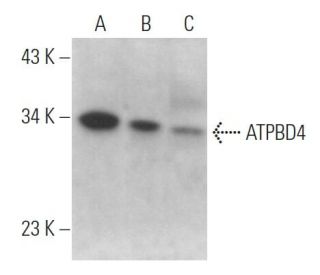


ATPBD4 Antibody (G-6): sc-398185
- ATPBD4 Antibody (G-6) is a mouse monoclonal IgG1 κ ATPBD4 antibody provided at 200 µg/ml
- specific for an epitope mapping between amino acids 189-216 within an internal region of ATPBD4 of human origin
- ATPBD4 Antibody (G-6) is recommended for detection of ATPBD4 of mouse, rat and human origin by WB, IP, IF and ELISA; also reactive with additional species, including and canine and bovine
- Anti-ATPBD4 Antibody (G-6) is available conjugated to agarose for IP; HRP for WB, IHC(P) and ELISA; and to either phycoerythrin or FITC for IF, IHC(P) and FCM
- also available conjugated to Alexa Fluor® 488, Alexa Fluor® 546, Alexa Fluor® 594 or Alexa Fluor® 647 for WB (RGB), IF, IHC(P) and FCM, and for use with RGB fluorescent imaging systems, such as iBright™ FL1000, FluorChem™, Typhoon, Azure and other comparable systems
- also available conjugated to Alexa Fluor® 680 or Alexa Fluor® 790 for WB (NIR), IF and FCM; for use with Near-Infrared (NIR) detection systems, such as LI-COR®Odyssey®, iBright™ FL1000, FluorChem™, Typhoon, Azure and other comparable systems
- m-IgG Fc BP-HRP and m-IgG1 BP-HRP are the preferred secondary detection reagents for ATPBD4 Antibody (G-6) for WB applications. These reagents are now offered in bundles with ATPBD4 Antibody (G-6) (see ordering information below).

QUICK LINKS
ATPBD4 Antibody (G-6) is a mouse monoclonal IgG1 kappa light chain antibody that detects ATPBD4 of mouse, rat, and human origin by western blotting (WB), immunoprecipitation (IP), immunofluorescence (IF), and enzyme-linked immunosorbent assay (ELISA). ATPBD4 (G-6) antibody is available in both non-conjugated and various conjugated forms, including agarose, horseradish peroxidase (HRP), phycoerythrin (PE), fluorescein isothiocyanate (FITC), and multiple Alexa Fluor® conjugates. ATPBD4, which consists of 267 amino acids, plays a crucial role in cellular processes by binding ATP and is involved in the regulation of various signaling pathways. ATPBD4′s function is particularly important as ATPBD4 influences energy metabolism and cellular stress responses, which are vital for maintaining cellular homeostasis and function. ATPBD4 is highly conserved across multiple species, including chimpanzees, dogs, cows, and various model organisms, and is located on human chromosome 15q14. This chromosome harbors over 700 genes and is implicated in several genetic disorders, including Angelman and Prader-Willi syndromes, which arise from deletions or mutations in the 15q11-q13 region. ATPBD4′s presence in these pathways underscores ATPBD4′s potential role in developmental and neurological functions, making ATPBD4 a valuable target for research in both basic and clinical settings.
Alexa Fluor® is a trademark of Molecular Probes Inc., OR., USA
LI-COR® and Odyssey® are registered trademarks of LI-COR Biosciences
ATPBD4 Antibody (G-6) References:
- Analysis of the DNA sequence and duplication history of human chromosome 15. | Zody, MC., et al. 2006. Nature. 440: 671-5. PMID: 16572171
- Effective gene therapy in an authentic model of Tay-Sachs-related diseases. | Cachón-González, MB., et al. 2006. Proc Natl Acad Sci U S A. 103: 10373-10378. PMID: 16801539
- Pyrimethamine as a potential pharmacological chaperone for late-onset forms of GM2 gangliosidosis. | Maegawa, GH., et al. 2007. J Biol Chem. 282: 9150-61. PMID: 17237499
- Detailed analysis of 15q11-q14 sequence corrects errors and gaps in the public access sequence to fully reveal large segmental duplications at breakpoints for Prader-Willi, Angelman, and inv dup(15) syndromes. | Makoff, AJ. and Flomen, RH. 2007. Genome Biol. 8: R114. PMID: 17573966
- Fibrillin-rich microfibrils: Structural determinants of morphogenetic and homeostatic events. | Ramirez, F. and Dietz, HC. 2007. J Cell Physiol. 213: 326-30. PMID: 17708531
- Extracellular control of TGFbeta signalling in vascular development and disease. | ten Dijke, P. and Arthur, HM. 2007. Nat Rev Mol Cell Biol. 8: 857-69. PMID: 17895899
- A data integration approach to mapping OCT4 gene regulatory networks operative in embryonic stem cells and embryonal carcinoma cells. | Jung, M., et al. 2010. PLoS One. 5: e10709. PMID: 20505756
- Molecular epigenetics of Angelman syndrome. | Lalande, M. and Calciano, MA. 2007. Cell Mol Life Sci. 64: 947-60. PMID: 17347796
- [The Prader-Willi syndrome]. | Diene, G., et al. 2007. Ann Endocrinol (Paris). 68: 129-37. PMID: 17499572
Ordering Information
| Product Name | Catalog # | UNIT | Price | Qty | FAVORITES | |
ATPBD4 Antibody (G-6) | sc-398185 | 200 µg/ml | $322.00 | |||
ATPBD4 Antibody (G-6): m-IgG Fc BP-HRP Bundle | sc-527747 | 200 µg Ab; 10 µg BP | $361.00 | |||
ATPBD4 Antibody (G-6): m-IgG1 BP-HRP Bundle | sc-533120 | 200 µg Ab; 20 µg BP | $361.00 | |||
ATPBD4 Antibody (G-6) AC | sc-398185 AC | 500 µg/ml, 25% agarose | $424.00 | |||
ATPBD4 Antibody (G-6) HRP | sc-398185 HRP | 200 µg/ml | $322.00 | |||
ATPBD4 Antibody (G-6) FITC | sc-398185 FITC | 200 µg/ml | $336.00 | |||
ATPBD4 Antibody (G-6) PE | sc-398185 PE | 200 µg/ml | $349.00 | |||
ATPBD4 Antibody (G-6) Alexa Fluor® 488 | sc-398185 AF488 | 200 µg/ml | $364.00 | |||
ATPBD4 Antibody (G-6) Alexa Fluor® 546 | sc-398185 AF546 | 200 µg/ml | $364.00 | |||
ATPBD4 Antibody (G-6) Alexa Fluor® 594 | sc-398185 AF594 | 200 µg/ml | $364.00 | |||
ATPBD4 Antibody (G-6) Alexa Fluor® 647 | sc-398185 AF647 | 200 µg/ml | $364.00 | |||
ATPBD4 Antibody (G-6) Alexa Fluor® 680 | sc-398185 AF680 | 200 µg/ml | $364.00 | |||
ATPBD4 Antibody (G-6) Alexa Fluor® 790 | sc-398185 AF790 | 200 µg/ml | $364.00 | |||
ATPBD4 (G-6) Neutralizing Peptide | sc-398185 P | 100 µg/0.5 ml | $69.00 |