
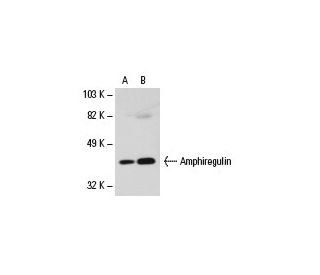
Amphiregulin Antibody (G-4): sc-74501
- Amphiregulin Antibody (G-4) is a mouse monoclonal IgG1 κ Amphiregulin antibody, cited in 29 publications, provided at 200 µg/ml
- raised against amino acids 1-155 of Amphiregulin of human origin
- Amphiregulin Antibody (G-4) is recommended for detection of Amphiregulin of mouse, rat and human origin by WB, IP, IF, IHC(P) and ELISA
- Anti-Amphiregulin Antibody (G-4) is available conjugated to agarose for IP; HRP for WB, IHC(P) and ELISA; and to either phycoerythrin or FITC for IF, IHC(P) and FCM
- also available conjugated to Alexa Fluor® 488, Alexa Fluor® 546, Alexa Fluor® 594 or Alexa Fluor® 647 for WB (RGB), IF, IHC(P) and FCM, and for use with RGB fluorescent imaging systems, such as iBright™ FL1000, FluorChem™, Typhoon, Azure and other comparable systems
- also available conjugated to Alexa Fluor® 680 or Alexa Fluor® 790 for WB (NIR), IF and FCM; for use with Near-Infrared (NIR) detection systems, such as LI-COR®Odyssey®, iBright™ FL1000, FluorChem™, Typhoon, Azure and other comparable systems
- m-IgG Fc BP-HRP, m-IgG1 BP-HRP and m-IgGκ BP-HRP are the preferred secondary detection reagents for Amphiregulin Antibody (G-4) for WB and IHC(P) applications. These reagents are now offered in bundles with Amphiregulin Antibody (G-4) (see ordering information below).

QUICK LINKS
SEE ALSO...
Amphiregulin Antibody (G-4) is a mouse monoclonal IgG1 kappa light chain antibody that detects Amphiregulin protein of mouse, rat, and human origin by western blotting (WB), immunoprecipitation (IP), immunofluorescence (IF), immunohistochemistry, and enzyme-linked immunosorbent assay (ELISA). Anti-Amphiregulin antibody (G-4) is available in both non-conjugated and various conjugated forms, including agarose, horseradish peroxidase (HRP), phycoerythrin (PE), fluorescein isothiocyanate (FITC), and multiple Alexa Fluor® conjugates. Amphiregulin, a member of the epidermal growth factor (EGF) family, plays a crucial role in cellular signaling and is primarily produced by keratinocytes, where Amphiregulin functions as an autocrine growth factor. Amphiregulin is vital for normal human keratinocyte proliferation and binds to the ErbB-1 receptor, which is essential for the development of epithelial tissues in the skin, lungs, and gastrointestinal tract. Research has shown that withdrawal of Amphiregulin leads to downregulation of telomerase activity in human keratinocytes, indicating Amphiregulin′s role in regulating cellular aging processes. Using Amphiregulin monoclonal antibody (G-4) in research can provide insights into the mechanisms of epithelial development and Amphiregulin′s implications in various physiological and pathological conditions.
Alexa Fluor® is a trademark of Molecular Probes Inc., OR., USA
LI-COR® and Odyssey® are registered trademarks of LI-COR Biosciences
Amphiregulin Antibody (G-4) References:
- Influence of aging and cell senescence on telomerase activity in keratinocytes. | Matsui, M., et al. 2000. J Dermatol Sci. 22: 80-7. PMID: 10674820
- Epiregulin, a novel member of the epidermal growth factor family, is an autocrine growth factor in normal human keratinocytes. | Shirakata, Y., et al. 2000. J Biol Chem. 275: 5748-53. PMID: 10681561
- Training for physical medicine. | TEGNER, WS. 1954. Acta Physiother Rheumatol Belg. 9: 49-52. PMID: 13180383
- A heparin sulfate-regulated human keratinocyte autocrine factor is similar or identical to amphiregulin. | Cook, PW., et al. 1991. Mol Cell Biol. 11: 2547-57. PMID: 2017164
- Emerging functions of amphiregulin in orchestrating immunity, inflammation, and tissue repair. | Zaiss, DMW., et al. 2015. Immunity. 42: 216-226. PMID: 25692699
- A Macrophage-Pericyte Axis Directs Tissue Restoration via Amphiregulin-Induced Transforming Growth Factor Beta Activation. | Minutti, CM., et al. 2019. Immunity. 50: 645-654.e6. PMID: 30770250
- Th17 Cell-Derived Amphiregulin Promotes Colitis-Associated Intestinal Fibrosis Through Activation of mTOR and MEK in Intestinal Myofibroblasts. | Zhao, X., et al. 2023. Gastroenterology. 164: 89-102. PMID: 36113570
- Regulation of the alveolar regenerative niche by amphiregulin-producing regulatory T cells. | Kaiser, KA., et al. 2023. J Exp Med. 220: PMID: 36534084
- Role of MR1-driven signals and amphiregulin on the recruitment and repair function of MAIT cells during skin wound healing. | du Halgouet, A., et al. 2023. Immunity. 56: 78-92.e6. PMID: 36630919
- Amphiregulin from regulatory T cells promotes liver fibrosis and insulin resistance in non-alcoholic steatohepatitis. | Savage, TM., et al. 2024. Immunity. 57: 303-318.e6. PMID: 38309273
- Sustained amphiregulin expression in intermediate alveolar stem cells drives progressive fibrosis. | Zhao, R., et al. 2024. Cell Stem Cell. 31: 1344-1358.e6. PMID: 39096904
- Activation of HER4 by heparin-binding EGF-like growth factor stimulates chemotaxis but not proliferation. | Elenius, K., et al. 1997. EMBO J. 16: 1268-78. PMID: 9135143
Ordering Information
| Product Name | Catalog # | UNIT | Price | Qty | FAVORITES | |
Amphiregulin Antibody (G-4) | sc-74501 | 200 µg/ml | $322.00 | |||
Amphiregulin Antibody (G-4): m-IgG Fc BP-HRP Bundle | sc-528674 | 200 µg Ab; 10 µg BP | $361.00 | |||
Amphiregulin Antibody (G-4): m-IgGκ BP-HRP Bundle | sc-521123 | 200 µg Ab, 40 µg BP | $361.00 | |||
Amphiregulin Antibody (G-4): m-IgG1 BP-HRP Bundle | sc-543063 | 200 µg Ab; 20 µg BP | $361.00 | |||
Amphiregulin Antibody (G-4) AC | sc-74501 AC | 500 µg/ml, 25% agarose | $424.00 | |||
Amphiregulin Antibody (G-4) HRP | sc-74501 HRP | 200 µg/ml | $322.00 | |||
Amphiregulin Antibody (G-4) FITC | sc-74501 FITC | 200 µg/ml | $336.00 | |||
Amphiregulin Antibody (G-4) PE | sc-74501 PE | 200 µg/ml | $349.00 | |||
Amphiregulin Antibody (G-4) Alexa Fluor® 488 | sc-74501 AF488 | 200 µg/ml | $364.00 | |||
Amphiregulin Antibody (G-4) Alexa Fluor® 546 | sc-74501 AF546 | 200 µg/ml | $364.00 | |||
Amphiregulin Antibody (G-4) Alexa Fluor® 594 | sc-74501 AF594 | 200 µg/ml | $364.00 | |||
Amphiregulin Antibody (G-4) Alexa Fluor® 647 | sc-74501 AF647 | 200 µg/ml | $364.00 | |||
Amphiregulin Antibody (G-4) Alexa Fluor® 680 | sc-74501 AF680 | 200 µg/ml | $364.00 | |||
Amphiregulin Antibody (G-4) Alexa Fluor® 790 | sc-74501 AF790 | 200 µg/ml | $364.00 |