
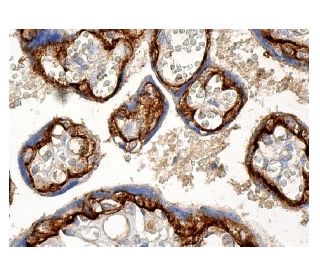
α-dystroglycan Antibody (IIH6): sc-53987
- α-dystroglycan Antibody (IIH6) is a mouse monoclonal IgM κ α-dystroglycan antibody, cited in 32 publications, provided at 200 µg/ml
- raised against purified dystrophin-glycoprotein complex of rabbit origin
- recommended for detection of α-dystroglycan of mouse, rat, human, rabbit and canine origin by WB, IP, IF and IHC(P)
- m-IgGκ BP-HRP is the preferred secondary detection reagent for α-dystroglycan Antibody (IIH6) for WB and IHC(P) applications. This reagent is now offered in a bundle with α-dystroglycan Antibody (IIH6) (see ordering information below). For additional m-IgGκ BP conjugates see our complete list of Mouse IgG Binding Proteins.

QUICK LINKS
α-dystroglycan Antibody (IIH6) is a mouse monoclonal IgM antibody that detects α-dystroglycan of mouse, rat, human, rabbit, and canine origin by western blotting (WB), immunoprecipitation (IP), immunofluorescence (IF), and immunohistochemistry. α-dystroglycan (IIH6) antibody is available as both non-conjugated and in various Alexa Fluor® conjugates. α-dystroglycan plays a crucial role as a cell surface receptor for several extracellular matrix molecules, including laminins, Agrin, and Perlecan, which are essential for basement membrane formation during early development and laminin organization on cell surfaces. α-dystroglycan′s location at cell membranes facilitates interaction with dystrophin and utrophin, forming dystrophin-associated protein complex and utrophin-associated protein complex, respectively. These complexes maintain structural integrity of muscle cells and cluster nicotinic acetylcholine receptors at neuromuscular junctions, essential for effective synaptic transmission. α-dystroglycan′s interactions with these proteins underscore α-dystroglycan (IIH6) monoclonal antibody′s value for researchers studying muscle biology and related disorders.
Alexa Fluor® is a trademark of Molecular Probes Inc., OR., USA
LI-COR® and Odyssey® are registered trademarks of LI-COR Biosciences
α-dystroglycan Antibody (IIH6) References:
- Chimaeric mice deficient in dystroglycans develop muscular dystrophy and have disrupted myoneural synapses. | Côté, PD., et al. 1999. Nat Genet. 23: 338-42. PMID: 10610181
- Differential targeting of components of the dystrophin complex to the postsynaptic membrane. | Marchand, S., et al. 2001. Eur J Neurosci. 13: 221-9. PMID: 11168526
- Distinct roles for dystroglycan, beta1 integrin and perlecan in cell surface laminin organization. | Henry, MD., et al. 2001. J Cell Sci. 114: 1137-44. PMID: 11228157
- Expression of dystroglycan complex in satellite cells of dorsal root ganglia. | Masaki, T., et al. 2001. Acta Neuropathol. 101: 174-8. PMID: 11271373
- Syntheses of alpha-dystroglycan derived glycosyl amino acids carrying a novel mannosyl serine/threonine linkage. | Seifert, J., et al. 2000. Glycoconj J. 17: 407-23. PMID: 11294507
- Dystroglycan: a possible mediator for reducing congenital muscular dystrophy? | Sciandra, F., et al. 2007. Trends Biotechnol. 25: 262-8. PMID: 17416431
- Inflammation and response to steroid treatment in limb-girdle muscular dystrophy 2I. | Darin, N., et al. 2007. Eur J Paediatr Neurol. 11: 353-7. PMID: 17446099
- Expression of the murine Pomt1 gene in both the developing brain and adult muscle tissues and its relationship with clinical aspects of Walker-Warburg syndrome. | Prados, B., et al. 2007. Am J Pathol. 170: 1659-68. PMID: 17456771
- Localized treatment with a novel FDA-approved proteasome inhibitor blocks the degradation of dystrophin and dystrophin-associated proteins in mdx mice. | Bonuccelli, G., et al. 2007. Cell Cycle. 6: 1242-8. PMID: 17495527
- Small molecules enhance functional O-mannosylation of Alpha-dystroglycan. | Lv, F., et al. 2015. Bioorg Med Chem. 23: 7661-70. PMID: 26652968
- Mechanistic aspects of the formation of α-dystroglycan and therapeutic research for the treatment of α-dystroglycanopathy: A review. | Taniguchi-Ikeda, M., et al. 2016. Mol Aspects Med. 51: 115-24. PMID: 27421908
- GMPPA defects cause a neuromuscular disorder with α-dystroglycan hyperglycosylation. | Franzka, P., et al. 2021. J Clin Invest. 131: PMID: 33755596
Ordering Information
| Product Name | Catalog # | UNIT | Price | Qty | FAVORITES | |
α-dystroglycan Antibody (IIH6) | sc-53987 | 200 µg/ml | $322.00 | |||
α-dystroglycan Antibody (IIH6): m-IgGκ BP-HRP Bundle | sc-521003 | 200 µg Ab, 40 µg BP | $361.00 |