
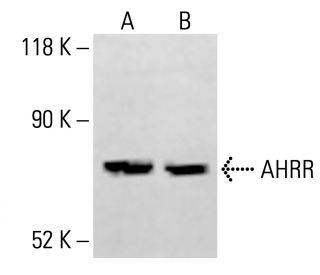


AHRR Antibody (5G11): sc-293297
- AHRR Antibody (5G11) is a mouse monoclonal IgG2a κ AHRR antibody, cited in 1 publications, provided at 100 µg/ml
- raised against amino acids 617-715 of AHRR of human origin
- recommended for detection of AHRR of human origin by WB, IP and ELISA
- m-IgG Fc BP-HRP, m-IgG2a BP-HRP and m-IgGκ BP-HRP are the preferred secondary detection reagents for AHRR Antibody (5G11) for WB applications. These reagents are now offered in bundles with AHRR Antibody (5G11) (see ordering information below).

QUICK LINKS
SEE ALSO...
AHRR Antibody (5G11) is a mouse monoclonal IgG2a kappa light chain antibody that detects AHRR protein of human origin by western blotting (WB), immunoprecipitation (IP), and enzyme-linked immunosorbent assay (ELISA). Anti-AHRR antibody (5G11) is available as a non-conjugated format. AHRR, also known as aryl-hydrocarbon receptor repressor or bHLHe77, is a 701 amino acid protein encoded by a gene located on human chromosome 5p15.33, which exists in three alternatively spliced isoforms. AHRR plays a crucial role in regulating dioxin toxicity and is involved in cell growth regulation and differentiation. Initially localized in the cytoplasm, AHRR interacts with Arnt 1 protein and translocates to the nucleus, where AHRR exerts regulatory functions. AHRR contains a basic helix-loop-helix (bHLH) domain and a PAS (PER-ARNT-SIM) domain, which are essential for interaction with other proteins and DNA. AHRR is highly expressed in various tissues, including testis, lung, ovary, spleen, pancreas, kidney, and thymus, as well as in mononuclear cells from umbilical cord blood. Notably, AHRR autoregulates expression by binding to its own xenobiotic response element (XRE) site, thereby competing with Ah receptor for heterodimer formation with Arnt 1 and subsequently binding to XRE sequence in the promoter. This mechanism allows AHRR to suppress transcriptional activity of CYP1A1 and may link AHRR to conditions such as male infertility and endometriosis susceptibility.
Alexa Fluor® is a trademark of Molecular Probes Inc., OR., USA
LI-COR® and Odyssey® are registered trademarks of LI-COR Biosciences
AHRR Antibody (5G11) References:
- Characterization of the aryl hydrocarbon receptor repressor gene and association of its Pro185Ala polymorphism with micropenis. | Fujita, H., et al. 2002. Teratology. 65: 10-8. PMID: 11835227
- Characteristic expression of aryl hydrocarbon receptor repressor gene in human tissues: organ-specific distribution and variable induction patterns in mononuclear cells. | Yamamoto, J., et al. 2004. Life Sci. 74: 1039-49. PMID: 14672759
- Association of male infertility with Pro185Ala polymorphism in the aryl hydrocarbon receptor repressor gene: implication for the susceptibility to dioxins. | Watanabe, M., et al. 2004. Fertil Steril. 82 Suppl 3: 1067-71. PMID: 15474075
- Analysis of the AhR, ARNT, and AhRR gene polymorphisms: genetic contribution to endometriosis susceptibility and severity. | Tsuchiya, M., et al. 2005. Fertil Steril. 84: 454-8. PMID: 16084889
- The contribution of genetic variations of aryl hydrocarbon receptor pathway genes to male factor infertility. | Merisalu, A., et al. 2007. Fertil Steril. 88: 854-9. PMID: 17559847
- Analysis of the transcriptional regulation and molecular function of the aryl hydrocarbon receptor repressor in human cell lines. | Haarmann-Stemmann, T., et al. 2007. Drug Metab Dispos. 35: 2262-9. PMID: 17890447
- Identification of intracellular localization signals and of mechanisms underlining the nucleocytoplasmic shuttling of human aryl hydrocarbon receptor repressor. | Kanno, Y., et al. 2007. Biochem Biophys Res Commun. 364: 1026-31. PMID: 17980155
- The aryl hydrocarbon receptor repressor is a putative tumor suppressor gene in multiple human cancers. | Zudaire, E., et al. 2008. J Clin Invest. 118: 640-50. PMID: 18172554
- SUMO modification regulates the transcriptional repressor function of aryl hydrocarbon receptor repressor. | Oshima, M., et al. 2009. J Biol Chem. 284: 11017-26. PMID: 19251700
- The complex biology of aryl hydrocarbon receptor activation in cancer and beyond. | Opitz, CA., et al. 2023. Biochem Pharmacol. 216: 115798. PMID: 37696456
- Altered DNA methylation within DNMT3A, AHRR, LTA/TNF loci mediates the effect of smoking on inflammatory bowel disease. | Zhang, H., et al. 2024. Nat Commun. 15: 595. PMID: 38238335
- AHRR and SFRP2 in primary versus recurrent high-grade serous ovarian carcinoma and their prognostic implication. | Monjé, N., et al. 2024. Br J Cancer. 130: 1249-1260. PMID: 38361045
Ordering Information
| Product Name | Catalog # | UNIT | Price | Qty | FAVORITES | |
AHRR Antibody (5G11) | sc-293297 | 100 µg/ml | $322.00 | |||
AHRR Antibody (5G11): m-IgG Fc BP-HRP Bundle | sc-537736 | 100 µg Ab; 10 µg BP | $361.00 | |||
AHRR Antibody (5G11): m-IgGκ BP-HRP Bundle | sc-535102 | 100 µg Ab; 40 µg BP | $361.00 | |||
AHRR Antibody (5G11): m-IgG2a BP-HRP Bundle | sc-548101 | 100 µg Ab; 10 µg BP | $361.00 |