
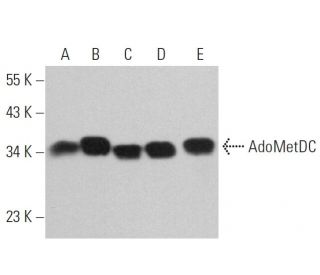
AdoMetDC Antibody (E-6): sc-166970
- AdoMetDC Antibody (E-6) is a mouse monoclonal IgG1 κ AdoMetDC antibody, cited in 3 publications, provided at 200 µg/ml
- raised against amino acids 5-219 of AdoMetDC of human origin
- AdoMetDC Antibody (E-6) is recommended for detection of AdoMetDC of mouse, rat and human origin by WB, IP, IF and ELISA
- Anti-AdoMetDC Antibody (E-6) is available conjugated to agarose for IP; HRP for WB, IHC(P) and ELISA; and to either phycoerythrin or FITC for IF, IHC(P) and FCM
- also available conjugated to Alexa Fluor® 488, Alexa Fluor® 546, Alexa Fluor® 594 or Alexa Fluor® 647 for WB (RGB), IF, IHC(P) and FCM, and for use with RGB fluorescent imaging systems, such as iBright™ FL1000, FluorChem™, Typhoon, Azure and other comparable systems
- also available conjugated to Alexa Fluor® 680 or Alexa Fluor® 790 for WB (NIR), IF and FCM; for use with Near-Infrared (NIR) detection systems, such as LI-COR®Odyssey®, iBright™ FL1000, FluorChem™, Typhoon, Azure and other comparable systems
- m-IgG Fc BP-HRP, m-IgG1 BP-HRP and m-IgGκ BP-HRP are the preferred secondary detection reagents for AdoMetDC Antibody (E-6) for WB applications. These reagents are now offered in bundles with AdoMetDC Antibody (E-6) (see ordering information below).

QUICK LINKS
SEE ALSO...
AdoMetDC Antibody (E-6) is a mouse monoclonal IgG1 kappa light chain antibody that detects AdoMetDC protein of mouse, rat, and human origin by western blotting (WB), immunoprecipitation (IP), immunofluorescence (IF), and enzyme-linked immunosorbent assay (ELISA). anti-AdoMetDC antibody (E-6) is available in both non-conjugated and various conjugated forms, including agarose, horseradish peroxidase (HRP), phycoerythrin (PE), fluorescein isothiocyanate (FITC), and multiple Alexa Fluor® conjugates. AdoMetDC, or adenosylmethionine decarboxylase 1, is a crucial enzyme in the polyamine biosynthesis pathway, which plays a significant role in cellular growth, proliferation, and tumor promotion. This 334 amino acid protein is synthesized as an inactive proenzyme that undergoes self-maturation to produce two non-identical subunits, α and β, which then assemble into an active heterotetramer composed of two α chains and two β chains. AdoMetDC utilizes a pyruvoyl group as a cofactor to convert S-adenosyl-L-methionine into (5-deoxy-5-adenosyl)(3-aminopropyl)-methylsulfonium salt and carbon dioxide. Processing of the AdoMetDC proenzyme and catalytic activity are stimulated by putrescine, while iodoacetic acid serves as an inhibitor, highlighting the regulatory mechanisms that control polyamine synthesis and their implications in cellular functions and cancer biology.
Alexa Fluor® is a trademark of Molecular Probes Inc., OR., USA
LI-COR® and Odyssey® are registered trademarks of LI-COR Biosciences
AdoMetDC Antibody (E-6) References:
- Structure of a human S-adenosylmethionine decarboxylase self-processing ester intermediate and mechanism of putrescine stimulation of processing as revealed by the H243A mutant. | Ekstrom, JL., et al. 2001. Biochemistry. 40: 9495-504. PMID: 11583148
- Mechanism of human S-adenosylmethionine decarboxylase proenzyme processing as revealed by the structure of the S68A mutant. | Tolbert, WD., et al. 2003. Biochemistry. 42: 2386-95. PMID: 12600205
- S-adenosylmethionine decarboxylase degradation by the 26 S proteasome is accelerated by substrate-mediated transamination. | Yerlikaya, A. and Stanley, BA. 2004. J Biol Chem. 279: 12469-78. PMID: 14718534
- HSG cells differentiated by culture on extracellular matrix involves induction of S-adenosylmethione decarboxylase and ornithine decarboxylase. | Lam, K., et al. 2005. J Cell Physiol. 203: 353-61. PMID: 15521072
- S-Adenosylmethionine decarboxylase partially regulates cell growth of HL-60 cells by controlling the intracellular ROS level: Early senescence and sensitization to gamma-radiation. | Kim, JS., et al. 2006. Arch Biochem Biophys. 456: 58-70. PMID: 17069747
- S-adenosyl methionine and DNA methyltransferase-1 mRNA overexpression in psychosis. | Guidotti, A., et al. 2007. Neuroreport. 18: 57-60. PMID: 17259861
- Effects of antisense RNA targeting of ODC and AdoMetDC on the synthesis of polyamine synthesis and cell growth in prostate cancer cells using a prostatic androgen-dependent promoter in adenovirus. | Li, W., et al. 2008. Prostate. 68: 1354-61. PMID: 18548481
- Structural basis for putrescine activation of human S-adenosylmethionine decarboxylase. | Bale, S., et al. 2008. Biochemistry. 47: 13404-17. PMID: 19053272
- Role of the sulfonium center in determining the ligand specificity of human s-adenosylmethionine decarboxylase. | Bale, S., et al. 2009. Biochemistry. 48: 6423-30. PMID: 19527050
Ordering Information
| Product Name | Catalog # | UNIT | Price | Qty | FAVORITES | |
AdoMetDC Antibody (E-6) | sc-166970 | 200 µg/ml | $322.00 | |||
AdoMetDC Antibody (E-6): m-IgG Fc BP-HRP Bundle | sc-529095 | 200 µg Ab; 10 µg BP | $361.00 | |||
AdoMetDC Antibody (E-6): m-IgGκ BP-HRP Bundle | sc-521812 | 200 µg Ab, 40 µg BP | $361.00 | |||
AdoMetDC Antibody (E-6): m-IgG1 BP-HRP Bundle | sc-543315 | 200 µg Ab; 20 µg BP | $361.00 | |||
AdoMetDC Antibody (E-6) AC | sc-166970 AC | 500 µg/ml, 25% agarose | $424.00 | |||
AdoMetDC Antibody (E-6) HRP | sc-166970 HRP | 200 µg/ml | $322.00 | |||
AdoMetDC Antibody (E-6) FITC | sc-166970 FITC | 200 µg/ml | $336.00 | |||
AdoMetDC Antibody (E-6) PE | sc-166970 PE | 200 µg/ml | $349.00 | |||
AdoMetDC Antibody (E-6) Alexa Fluor® 488 | sc-166970 AF488 | 200 µg/ml | $364.00 | |||
AdoMetDC Antibody (E-6) Alexa Fluor® 546 | sc-166970 AF546 | 200 µg/ml | $364.00 | |||
AdoMetDC Antibody (E-6) Alexa Fluor® 594 | sc-166970 AF594 | 200 µg/ml | $364.00 | |||
AdoMetDC Antibody (E-6) Alexa Fluor® 647 | sc-166970 AF647 | 200 µg/ml | $364.00 | |||
AdoMetDC Antibody (E-6) Alexa Fluor® 680 | sc-166970 AF680 | 200 µg/ml | $364.00 | |||
AdoMetDC Antibody (E-6) Alexa Fluor® 790 | sc-166970 AF790 | 200 µg/ml | $364.00 |