
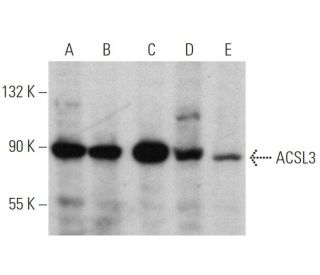
ACSL3 Antibody (H-9): sc-166374
- ACSL3 Antibody (H-9) is a mouse monoclonal IgG2b κ ACSL3 antibody, cited in 12 publications, provided at 200 µg/ml
- specific for an epitope mapping between amino acids 645-672 at the C-terminus of ACSL3 of human origin
- ACSL3 Antibody (H-9) is recommended for detection of ACSL3 of mouse, rat and human origin by WB, IP, IF, IHC(P) and ELISA; also reactive with additional species, including and equine, canine, bovine and porcine
- Anti-ACSL3 Antibody (H-9) is available conjugated to agarose for IP; HRP for WB, IHC(P) and ELISA; and to either phycoerythrin or FITC for IF, IHC(P) and FCM
- also available conjugated to Alexa Fluor® 488, Alexa Fluor® 546, Alexa Fluor® 594 or Alexa Fluor® 647 for WB (RGB), IF, IHC(P) and FCM, and for use with RGB fluorescent imaging systems, such as iBright™ FL1000, FluorChem™, Typhoon, Azure and other comparable systems
- also available conjugated to Alexa Fluor® 680 or Alexa Fluor® 790 for WB (NIR), IF and FCM; for use with Near-Infrared (NIR) detection systems, such as LI-COR®Odyssey®, iBright™ FL1000, FluorChem™, Typhoon, Azure and other comparable systems
- m-IgG2b BP-HRP and m-IgGκ BP-HRP are the preferred secondary detection reagents for ACSL3 Antibody (H-9) for WB and IHC(P) applications. These reagents are now offered in bundles with ACSL3 Antibody (H-9) (see ordering information below).

QUICK LINKS
ACSL3 Antibody (H-9) is a mouse monoclonal IgG2b kappa light chain antibody that detects ACSL3 protein of mouse, rat, and human origin by western blotting (WB), immunoprecipitation (IP), immunofluorescence (IF), immunohistochemistry, and enzyme-linked immunosorbent assay (ELISA). ACSL3 (H-9) antibody is available in both non-conjugated and various conjugated forms, including agarose, horseradish peroxidase (HRP), phycoerythrin (PE), fluorescein isothiocyanate (FITC), and multiple Alexa Fluor® conjugates. ACSL3 protein, a member of the acyl-CoA synthetase family, plays a crucial role in lipid metabolism by catalyzing the conversion of long-chain fatty acids into acyl-CoA, which is essential for the synthesis of cellular lipids and the β-oxidation pathway. This enzymatic activity is vital for energy production and the formation of key lipid molecules such as triacylglycerols, phospholipids, and cholesteryl esters. ACSL3 is particularly important in tissues with high metabolic demands, such as the brain and heart, where ACSL3 preferentially utilizes fatty acids like laurate, myristate, arachidonate, and eicosapentaenoate. ACSL3 expression in various tissues, including the placenta, prostate, skeletal muscle, testis, and thymus, highlights diverse physiological roles, and ACSL3 regulation is critical for maintaining lipid homeostasis and overall cellular function.
Alexa Fluor® is a trademark of Molecular Probes Inc., OR., USA
LI-COR® and Odyssey® are registered trademarks of LI-COR Biosciences
ACSL3 Antibody (H-9) References:
- Regulation by adrenocorticotropic hormone and arachidonate of the expression of acyl-CoA synthetase 4, an arachidonate-preferring enzyme expressed in steroidogenic tissues. | Cho, YY., et al. 2000. Biochem Biophys Res Commun. 274: 741-5. PMID: 10924347
- Acyl-CoAs are functionally channeled in liver: potential role of acyl-CoA synthetase. | Muoio, DM., et al. 2000. Am J Physiol Endocrinol Metab. 279: E1366-73. PMID: 11093925
- Abnormal uterus with polycysts, accumulation of uterine prostaglandins, and reduced fertility in mice heterozygous for acyl-CoA synthetase 4 deficiency. | Cho, YY., et al. 2001. Biochem Biophys Res Commun. 284: 993-7. PMID: 11409893
- Exon/intron organization and transcription units of the human acyl-CoA synthetase 4 gene. | Minekura, H., et al. 2001. Biochem Biophys Res Commun. 286: 80-6. PMID: 11485311
- Genomic organization and transcription units of the human acyl-CoA synthetase 3 gene. | Minekura, H., et al. 2001. Gene. 278: 185-92. PMID: 11707336
- Do long-chain acyl-CoA synthetases regulate fatty acid entry into synthetic versus degradative pathways? | Coleman, RA., et al. 2002. J Nutr. 132: 2123-6. PMID: 12163649
- Baicalein ameliorates cerebral ischemia-reperfusion injury by inhibiting ferroptosis via regulating GPX4/ACSL4/ACSL3 axis. | Li, M., et al. 2022. Chem Biol Interact. 366: 110137. PMID: 36055377
- ACSL3 regulates lipid droplet biogenesis and ferroptosis sensitivity in clear cell renal cell carcinoma. | Klasson, TD., et al. 2022. Cancer Metab. 10: 14. PMID: 36192773
- ACSL3 and ACSL4, Distinct Roles in Ferroptosis and Cancers. | Yang, Y., et al. 2022. Cancers (Basel). 14: PMID: 36497375
- ANKRD1 aggravates renal ischaemia‒reperfusion injury via promoting TRIM25-mediated ubiquitination of ACSL3. | Han, S., et al. 2024. Clin Transl Med. 14: e70024. PMID: 39285846
- Molecular characterization and expression of rat acyl-CoA synthetase 3. | Fujino, T., et al. 1996. J Biol Chem. 271: 16748-52. PMID: 8663269
- Alternative translation initiation generates acyl-CoA synthetase 3 isoforms with heterogeneous amino termini. | Fujino, T., et al. 1997. J Biochem. 122: 212-6. PMID: 9276691
Ordering Information
| Product Name | Catalog # | UNIT | Price | Qty | FAVORITES | |
ACSL3 Antibody (H-9) | sc-166374 | 200 µg/ml | $322.00 | |||
ACSL3 Antibody (H-9): m-IgGκ BP-HRP Bundle | sc-521581 | 200 µg Ab, 40 µg BP | $361.00 | |||
ACSL3 Antibody (H-9): m-IgG2b BP-HRP Bundle | sc-548931 | 200 µg Ab; 10 µg BP | $361.00 | |||
ACSL3 Antibody (H-9) AC | sc-166374 AC | 500 µg/ml, 25% agarose | $424.00 | |||
ACSL3 Antibody (H-9) HRP | sc-166374 HRP | 200 µg/ml | $322.00 | |||
ACSL3 Antibody (H-9) FITC | sc-166374 FITC | 200 µg/ml | $336.00 | |||
ACSL3 Antibody (H-9) PE | sc-166374 PE | 200 µg/ml | $349.00 | |||
ACSL3 Antibody (H-9) Alexa Fluor® 488 | sc-166374 AF488 | 200 µg/ml | $364.00 | |||
ACSL3 Antibody (H-9) Alexa Fluor® 546 | sc-166374 AF546 | 200 µg/ml | $364.00 | |||
ACSL3 Antibody (H-9) Alexa Fluor® 594 | sc-166374 AF594 | 200 µg/ml | $364.00 | |||
ACSL3 Antibody (H-9) Alexa Fluor® 647 | sc-166374 AF647 | 200 µg/ml | $364.00 | |||
ACSL3 Antibody (H-9) Alexa Fluor® 680 | sc-166374 AF680 | 200 µg/ml | $364.00 | |||
ACSL3 Antibody (H-9) Alexa Fluor® 790 | sc-166374 AF790 | 200 µg/ml | $364.00 | |||
ACSL3 (H-9) Neutralizing Peptide | sc-166374 P | 100 µg/0.5 ml | $69.00 |