
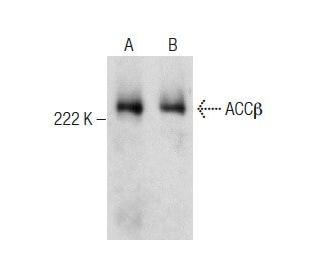

ACCβ Antibody (F-9): sc-377313
- ACCβ Antibody (F-9) is a mouse monoclonal IgG1 κ ACCβ antibody, cited in 3 publications, provided at 200 µg/ml
- raised against amino acids 146-220 mapping near the N-terminus of ACCβ of human origin
- ACC beta Antibody (F-9) is recommended for detection of ACCβ of human origin by WB, IP, IF and ELISA
- Anti-ACC beta Antibody (F-9) is available conjugated to agarose for IP; HRP for WB, IHC(P) and ELISA; and to either phycoerythrin or FITC for IF, IHC(P) and FCM
- also available conjugated to Alexa Fluor® 488, Alexa Fluor® 546, Alexa Fluor® 594 or Alexa Fluor® 647 for WB (RGB), IF, IHC(P) and FCM, and for use with RGB fluorescent imaging systems, such as iBright™ FL1000, FluorChem™, Typhoon, Azure and other comparable systems
- also available conjugated to Alexa Fluor® 680 or Alexa Fluor® 790 for WB (NIR), IF and FCM; for use with Near-Infrared (NIR) detection systems, such as LI-COR®Odyssey®, iBright™ FL1000, FluorChem™, Typhoon, Azure and other comparable systems
- m-IgG Fc BP-HRP and m-IgG1 BP-HRP are the preferred secondary detection reagents for ACCβ Antibody (F-9) for WB applications. These reagents are now offered in bundles with ACCβ Antibody (F-9) (see ordering information below).

QUICK LINKS
ACCβ Antibody (F-9) is a mouse monoclonal IgG1 kappa light chain antibody that detects ACC beta protein of human origin by western blotting (WB), immunoprecipitation (IP), immunofluorescence (IF), and enzyme-linked immunosorbent assay (ELISA). ACCβ (F-9) antibody is available in both non-conjugated and various conjugated forms, including agarose, horseradish peroxidase (HRP), phycoerythrin (PE), fluorescein isothiocyanate (FITC), and multiple Alexa Fluor® conjugates. Acetyl-CoA carboxylase (ACC) plays a crucial role in lipid metabolism, catalyzing the conversion of acetyl-CoA to malonyl-CoA, which is the rate-limiting step in fatty acid synthesis. This process is vital for maintaining energy homeostasis and regulating fatty acid levels within cells. ACCβ isoform, specifically, is believed to be instrumental in controlling mitochondrial fatty acid oxidation, as malonyl-CoA inhibits carnitine-palmitoyl-CoA transferase I, thereby regulating the uptake and oxidation of fatty acids in mitochondria. ACCβ gene is located on human chromosome 12 and expresses a mitochondrial protein predominantly in heart and skeletal muscle tissues. Notably, ACCβ structure includes a catalytic core that is homologous to ACCα, with the addition of a unique peptide of approximately 150 amino acids at the N terminus, which may contribute to its specific regulatory functions in fatty acid metabolism.
Alexa Fluor® is a trademark of Molecular Probes Inc., OR., USA
LI-COR® and Odyssey® are registered trademarks of LI-COR Biosciences
ACCβ Antibody (F-9) References:
- The subcellular localization of acetyl-CoA carboxylase 2. | Abu-Elheiga, L., et al. 2000. Proc Natl Acad Sci U S A. 97: 1444-9. PMID: 10677481
- Exercise diminishes the activity of acetyl-CoA carboxylase in human muscle. | Dean, D., et al. 2000. Diabetes. 49: 1295-300. PMID: 10923628
- Cloning of human acetyl-CoA carboxylase beta promoter and its regulation by muscle regulatory factors. | Lee, JJ., et al. 2001. J Biol Chem. 276: 2576-85. PMID: 11076940
- The acetyl-coenzyme A carboxylase beta (ACACB) gene is associated with nephropathy in Chinese patients with type 2 diabetes. | Tang, SC., et al. 2010. Nephrol Dial Transplant. 25: 3931-4. PMID: 20519229
- Phenotypic discrepancies in acetyl-CoA carboxylase 2-deficient mice. | Hoehn, KL., et al. 2012. J Biol Chem. 287: 15801; author reply 15802. PMID: 22563100
- The ACACB gene rs2268388 polymorphism is associated with nephropathy in Caucasian patients with diabetes: a meta-analysis. | An, L., et al. 2015. Ren Fail. 37: 925-8. PMID: 26030797
- Acetyl CoA Carboxylase 2 Is Dispensable for CD8+ T Cell Responses. | Lee, JE., et al. 2015. PLoS One. 10: e0137776. PMID: 26367121
- Overexpression of acetyl CoA carboxylase β exacerbates podocyte injury in the kidney of streptozotocin-induced diabetic mice. | Tanaka, Y., et al. 2018. Biochem Biophys Res Commun. 495: 1115-1121. PMID: 29175208
- Lithium downregulates phosphorylated acetyl‑CoA carboxylase 2 and attenuates mitochondrial fatty acid utilization and oxidative stress in cardiomyocytes. | Chen, PH., et al. 2024. Exp Ther Med. 27: 126. PMID: 38414784
- Cloning of human acetyl-CoA carboxylase-beta and its unique features. | Ha, J., et al. 1996. Proc Natl Acad Sci U S A. 93: 11466-70. PMID: 8876158
- Regulation of mammalian acetyl-coenzyme A carboxylase. | Kim, KH. 1997. Annu Rev Nutr. 17: 77-99. PMID: 9240920
- Assignment of acetyl-CoA carboxylase-beta (ACACB) to human chromosome band 12q24.1 by in situ hybridization. | Ullrich, CK., et al. 1997. Cytogenet Cell Genet. 77: 176-7. PMID: 9284908
Ordering Information
| Product Name | Catalog # | UNIT | Price | Qty | FAVORITES | |
ACCβ Antibody (F-9) | sc-377313 | 200 µg/ml | $322.00 | |||
ACCβ Antibody (F-9): m-IgG Fc BP-HRP Bundle | sc-527595 | 200 µg Ab; 10 µg BP | $361.00 | |||
ACCβ Antibody (F-9): m-IgG1 BP-HRP Bundle | sc-532968 | 200 µg Ab; 20 µg BP | $361.00 | |||
ACCβ Antibody (F-9) AC | sc-377313 AC | 500 µg/ml, 25% agarose | $424.00 | |||
ACCβ Antibody (F-9) HRP | sc-377313 HRP | 200 µg/ml | $322.00 | |||
ACCβ Antibody (F-9) FITC | sc-377313 FITC | 200 µg/ml | $336.00 | |||
ACCβ Antibody (F-9) PE | sc-377313 PE | 200 µg/ml | $349.00 | |||
ACCβ Antibody (F-9) Alexa Fluor® 488 | sc-377313 AF488 | 200 µg/ml | $364.00 | |||
ACCβ Antibody (F-9) Alexa Fluor® 546 | sc-377313 AF546 | 200 µg/ml | $364.00 | |||
ACCβ Antibody (F-9) Alexa Fluor® 594 | sc-377313 AF594 | 200 µg/ml | $364.00 | |||
ACCβ Antibody (F-9) Alexa Fluor® 647 | sc-377313 AF647 | 200 µg/ml | $364.00 | |||
ACCβ Antibody (F-9) Alexa Fluor® 680 | sc-377313 AF680 | 200 µg/ml | $364.00 | |||
ACCβ Antibody (F-9) Alexa Fluor® 790 | sc-377313 AF790 | 200 µg/ml | $364.00 |