
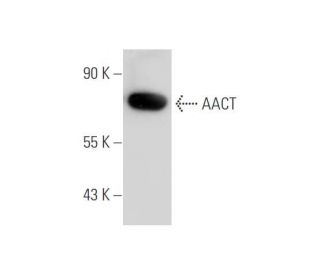

AACT Antibody (1.B.734): sc-69983
- AACT Antibody (1.B.734) is a mouse monoclonal IgG1, cited in 1 publications, provided at 100 µg/ml
- raised against full length native AACT from serum of human origin
- recommended for detection of AACT of human origin by WB, IP and ELISA; non cross-reactive with AAT
- At present, we have not yet completed the identification of the preferred secondary detection reagent(s) for AACT Antibody (1.B.734). This work is in progress.

QUICK LINKS
SEE ALSO...
AACT Antibody (1.B.734) is a mouse monoclonal IgG1 antibody that detects AACT in human samples through applications such as western blotting (WB), immunoprecipitation (IP), and enzyme-linked immunosorbent assay (ELISA). AACT, also known as alpha-1-antichymotrypsin, plays a crucial role as a serine proteinase inhibitor, primarily synthesized in the liver as a single glycopeptide chain. Anti-AACT antibody (1.B.734) helps study physiological processes, including inflammation and tissue repair, by detecting AACT′s regulation of proteolytic enzymes that can cause tissue damage if left unchecked. The structure of AACT features a reactive center loop that allows effective binding to and inhibition of target proteases, thus preventing excessive proteolytic activity during acute phase responses. AACT is one of the major acute phase reactants, with levels significantly increasing in response to trauma, surgery, and infection, which underscores its role in the body′s defense mechanisms. Elevated concentrations of AACT have been observed in the cerebrospinal fluid and plasma of Alzheimer′s disease patients, highlighting its potential as a biomarker for neurodegenerative conditions. Additionally, AACT′s interaction with prostate-specific antigen (PSA) has made AACT a valuable component in the diagnosis of prostate cancer, further emphasizing AACT′s importance in clinical settings.
Alexa Fluor® is a trademark of Molecular Probes Inc., OR., USA
LI-COR® and Odyssey® are registered trademarks of LI-COR Biosciences
AACT Antibody (1.B.734) References:
- Nucleocytoplasmic transit of human alpha1-antichymotrypsin in tobacco leaf epidermal cells. | Benchabane, M., et al. 2009. Plant Biotechnol J. 7: 161-71. PMID: 19055606
- Comparative analysis of the human urinary proteome by 1D SDS-PAGE and chip-HPLC-MS/MS identification of the AACT putative urinary biomarker. | Zhang, Y., et al. 2010. J Chromatogr B Analyt Technol Biomed Life Sci. 878: 3395-401. PMID: 21093387
- In vitro and in vivo assessment of oral autologous artificial connective tissue characteristics that influence its performance as a graft. | Fontanilla, MR. and Espinosa, LG. 2012. Tissue Eng Part A. 18: 1857-66. PMID: 22559831
- Methodology for AACT evidence-based recommendations on the use of intravenous lipid emulsion therapy in poisoning. | Gosselin, S., et al. 2015. Clin Toxicol (Phila). 53: 557-64. PMID: 26059735
- Alpha-1-antichymotrypsin as a novel biomarker for diagnosis, prognosis, and therapy prediction in human diseases. | Jin, Y., et al. 2022. Cancer Cell Int. 22: 156. PMID: 35439996
- Cloning, Expression, and Functional Analysis of the Full-Length cDNA of Acetyl-CoA C-acetyltransferase (AACT) Genes Related to Terpenoid Synthesis in Platycodon grandiflorus. | Liu, M., et al. 2022. Protein Pept Lett. 29: 1061-1071. PMID: 36045540
- SERPINA3: Stimulator or Inhibitor of Pathological Changes. | de Mezer, M., et al. 2023. Biomedicines. 11: PMID: 36672665
- Relationship between congenital malformation of the outer ear and hearing. | Zhang, H., et al. 2023. Acta Otolaryngol. 143: S45-S48. PMID: 38113167
- Increased plasma AACT level as an indicator of poor prognosis in patients hospitalised with community-acquired pneumonia: a multicentre prospective cohort study. | Zhao, L., et al. 2024. BMC Infect Dis. 24: 946. PMID: 39251931
- Polymorphism in AACT gene may lower age of onset of Alzheimer's disease. | Talbot, C., et al. 1996. Neuroreport. 7: 534-6. PMID: 8730823
Ordering Information
| Product Name | Catalog # | UNIT | Price | Qty | FAVORITES | |
AACT Antibody (1.B.734) | sc-69983 | 100 µg/ml | $322.00 |