
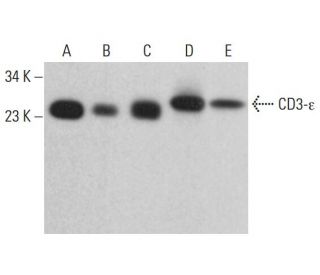

CD3-epsilon Antibody (LE-CD3): sc-69733
- CD3-ε Antibody (LE-CD3) is a mouse monoclonal IgG1, cited in 1 publications, provided at 200 µg/ml
- raised against C-terminus of CD3-ε of human origin
- recommended for detection of CD3-ε of human origin by WB, IP, IF and IHC(P)
- m-IgG Fc BP-HRP and m-IgG1 BP-HRP are the preferred secondary detection reagents for CD3-ε Antibody (LE-CD3) for WB and IHC(P) applications. These reagents are now offered in bundles with CD3-ε Antibody (LE-CD3) (see ordering information below).

CD3-ε Antibody (LE-CD3) is a mouse monoclonal IgG1 antibody that detects CD3-ε in human samples through applications such as western blotting (WB), immunoprecipitation (IP), immunofluorescence (IF), and immunohistochemistry. CD3-ε is a crucial component of the T cell antigen receptor (TCR) complex, playing a vital role in T cell activation and signaling. CD3-ε forms a heterodimer with CD3-γ and is essential for the transduction of signals that lead to T cell proliferation and differentiation upon antigen recognition. The presence of CD3-ε in the TCR complex is significant because CD3-ε contains an immunoreceptor tyrosine-based activation motif (ITAM) that is critical for initiating downstream signaling cascades. This motif is phosphorylated upon TCR engagement, creating docking sites for various signaling proteins, including ZAP-70, which further propagate the activation signal within the T cell. The interaction of CD3-ε with other proteins in the signaling pathway underscores CD3-ε′s importance in immune responses, making CD3-ε a valuable target for research in immunology and therapeutic applications. Anti-CD3-ε antibody (LE-CD3) is therefore an essential tool for studying T cell biology and the mechanisms underlying immune activation.
Alexa Fluor® is a trademark of Molecular Probes Inc., OR., USA
LI-COR® and Odyssey® are registered trademarks of LI-COR Biosciences
Contains Mercury: All HRP conjugates (including bundle forms) contain thiomersal, a mercury compound. Do not dispose in trash. Dispose as hazardous chemical waste according to local, state and federal regulations.
Download thiomersal SDS
CD3-epsilon Antibody (LE-CD3) References:
- Expression of cytoplasmic CD3 epsilon proteins in activated human adult natural killer (NK) cells and CD3 gamma, delta, epsilon complexes in fetal NK cells. Implications for the relationship of NK and T lymphocytes. | Lanier, LL., et al. 1992. J Immunol. 149: 1876-80. PMID: 1387664
- Differential Src family kinase activity requirements for CD3 zeta phosphorylation/ZAP70 recruitment and CD3 epsilon phosphorylation. | Lysechko, TL. and Ostergaard, HL. 2005. J Immunol. 174: 7807-14. PMID: 15944285
- Structure of the T cell antigen receptor (TCR): two CD3 epsilon subunits in a functional TCR/CD3 complex. | de la Hera, A., et al. 1991. J Exp Med. 173: 7-17. PMID: 1824636
- The cytoplasmic tail of the T cell receptor CD3 epsilon subunit contains a phospholipid-binding motif that regulates T cell functions. | Deford-Watts, LM., et al. 2009. J Immunol. 183: 1055-64. PMID: 19542373
- A fraction of CD3 epsilon subunits exists as disulfide-linked dimers in both human and murine T lymphocytes. | Jin, YJ., et al. 1990. J Biol Chem. 265: 15850-3. PMID: 2144290
- Most anti-human CD3 monoclonal antibodies are directed to the CD3 epsilon subunit. | Transy, C., et al. 1989. Eur J Immunol. 19: 947-50. PMID: 2472280
- Deletion of the cytoplasmic region of the CD3 epsilon subunit does not prevent assembly of a functional T-cell receptor. | Transy, C., et al. 1989. Proc Natl Acad Sci U S A. 86: 7108-12. PMID: 2528731
- An RFLP in mice detected by a CD3-epsilon probe. | Tunnacliffe, A. and D'Hoostelaere, L. 1989. Nucleic Acids Res. 17: 4418. PMID: 2567983
- CD3-negative lymphokine-activated cytotoxic cells express the CD3 epsilon gene. | Biassoni, R., et al. 1988. J Immunol. 140: 1685-9. PMID: 2894394
- Specific interaction of topoisomerase II beta and the CD3 epsilon chain of the T cell receptor complex. | Nakano, H., et al. 1996. J Biol Chem. 271: 6483-9. PMID: 8626450
Ordering Information
| Product Name | Catalog # | UNIT | Price | Qty | FAVORITES | |
CD3-ε Antibody (LE-CD3) | sc-69733 | 200 µg/ml | $322.00 | |||
CD3-ε Antibody (LE-CD3): m-IgG Fc BP-HRP Bundle | sc-539233 | 200 µg Ab; 10 µg BP | $361.00 | |||
CD3-ε Antibody (LE-CD3): m-IgG1 BP-HRP Bundle | sc-541342 | 200 µg Ab; 20 µg BP | $361.00 |