
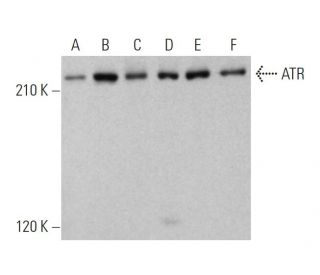
ATR Antibody (C-1): sc-515173
- ATR Antibody (C-1) is a mouse monoclonal IgG1 κ ATR antibody, cited in 50 publications, provided at 200 µg/ml
- specific for an epitope mapping between amino acids 2596-2621 near the C-terminus of ATR of human origin
- ATR Antibody (C-1) is recommended for detection of ATR of mouse, rat and human origin by WB, IP, IF and ELISA
- Anti-ATR Antibody (C-1) is available conjugated to agarose for IP; HRP for WB, IHC(P) and ELISA; and to either phycoerythrin or FITC for IF, IHC(P) and FCM
- also available conjugated to Alexa Fluor® 488, Alexa Fluor® 546, Alexa Fluor® 594 or Alexa Fluor® 647 for WB (RGB), IF, IHC(P) and FCM, and for use with RGB fluorescent imaging systems, such as iBright™ FL1000, FluorChem™, Typhoon, Azure and other comparable systems
- also available conjugated to Alexa Fluor® 680 or Alexa Fluor® 790 for WB (NIR), IF and FCM; for use with Near-Infrared (NIR) detection systems, such as LI-COR®Odyssey®, iBright™ FL1000, FluorChem™, Typhoon, Azure and other comparable systems
- m-IgG Fc BP-HRP, m-IgG1 BP-HRP and m-IgGκ BP-HRP are the preferred secondary detection reagents for ATR Antibody (C-1) for WB applications. These reagents are now offered in bundles with ATR Antibody (C-1) (see ordering information below).

QUICK LINKS
SEE ALSO...
ATR Antibody (C-1) is a mouse monoclonal IgG1 kappa light chain antibody that detects ATR protein of mouse, rat, and human origin by western blotting (WB), immunoprecipitation (IP), immunofluorescence (IF), and enzyme-linked immunosorbent assay (ELISA). Anti-ATR antibody (C-1) is available in both non-conjugated and various conjugated forms, including agarose, horseradish peroxidase (HRP), phycoerythrin (PE), fluorescein isothiocyanate (FITC), and multiple Alexa Fluor® conjugates. ATR, also known as ataxia-telangiectasia and Rad3-related protein, plays a crucial role in the cellular response to DNA damage, particularly in the activation of cell cycle checkpoints. ATR phosphorylates key proteins involved in the DNA damage response, such as checkpoint kinase CHK1 and tumor suppressor BRCA1, making ATR vital for maintaining genomic stability. ATR is primarily located in the nucleus, where ATR forms intranuclear foci in response to DNA damage or replication stress, highlighting ATR′s importance in cellular repair mechanisms. ATR is essential for early embryonic development, underscoring ATR′s significance in both normal cellular function and the prevention of diseases associated with genomic instability.
Alexa Fluor® is a trademark of Molecular Probes Inc., OR., USA
LI-COR® and Odyssey® are registered trademarks of LI-COR Biosciences
ATR Antibody (C-1) References:
- Molecular association between ATR and two components of the nucleosome remodeling and deacetylating complex, HDAC2 and CHD4. | Schmidt, DR. and Schreiber, SL. 1999. Biochemistry. 38: 14711-7. PMID: 10545197
- ATR is a caffeine-sensitive, DNA-activated protein kinase with a substrate specificity distinct from DNA-PK. | Hall-Jackson, CA., et al. 1999. Oncogene. 18: 6707-13. PMID: 10597277
- An overactivated ATR/CHK1 pathway is responsible for the prolonged G2 accumulation in irradiated AT cells. | Wang, X., et al. 2003. J Biol Chem. 278: 30869-74. PMID: 12791699
- MSH2 and ATR form a signaling module and regulate two branches of the damage response to DNA methylation. | Wang, Y. and Qin, J. 2003. Proc Natl Acad Sci U S A. 100: 15387-92. PMID: 14657349
- A novel protein activity mediates DNA binding of an ATR-ATRIP complex. | Bomgarden, RD., et al. 2004. J Biol Chem. 279: 13346-53. PMID: 14724280
- The ATR-p53 pathway is suppressed in noncycling normal and malignant lymphocytes. | Jones, GG., et al. 2004. Oncogene. 23: 1911-21. PMID: 14755251
- Inhibition of ATR leads to increased sensitivity to hypoxia/reoxygenation. | Hammond, EM., et al. 2004. Cancer Res. 64: 6556-62. PMID: 15374968
- ATR takes a crack at the nuclear envelope. | Smolka, MB. and Lammerding, J. 2023. Mol Cell. 83: 3588-3590. PMID: 37863026
- FBXW7-loss Sensitizes Cells to ATR Inhibition Through Induced Mitotic Catastrophe. | O'Brien, S., et al. 2023. Cancer Res Commun. 3: 2596-2607. PMID: 38032106
- First-in-Human Study of the Ataxia Telangiectasia and Rad3-Related (ATR) Inhibitor Tuvusertib (M1774) as Monotherapy in Patients with Solid Tumors. | Yap, TA., et al. 2024. Clin Cancer Res. 30: 2057-2067. PMID: 38407317
- cDNA cloning and gene mapping of a candidate human cell cycle checkpoint protein. | Cimprich, KA., et al. 1996. Proc Natl Acad Sci U S A. 93: 2850-5. PMID: 8610130
- The Atr and Atm protein kinases associate with different sites along meiotically pairing chromosomes. | Keegan, KS., et al. 1996. Genes Dev. 10: 2423-37. PMID: 8843195
Ordering Information
| Product Name | Catalog # | UNIT | Price | Qty | FAVORITES | |
ATR Antibody (C-1) | sc-515173 | 200 µg/ml | $322.00 | |||
ATR Antibody (C-1): m-IgG Fc BP-HRP Bundle | sc-531302 | 200 µg Ab; 10 µg BP | $361.00 | |||
ATR Antibody (C-1): m-IgGκ BP-HRP Bundle | sc-524960 | 200 µg Ab, 40 µg BP | $361.00 | |||
ATR Antibody (C-1): m-IgG1 BP-HRP Bundle | sc-544473 | 200 µg Ab; 20 µg BP | $361.00 | |||
ATR Antibody (C-1) AC | sc-515173 AC | 500 µg/ml, 25% agarose | $424.00 | |||
ATR Antibody (C-1) HRP | sc-515173 HRP | 200 µg/ml | $322.00 | |||
ATR Antibody (C-1) FITC | sc-515173 FITC | 200 µg/ml | $336.00 | |||
ATR Antibody (C-1) PE | sc-515173 PE | 200 µg/ml | $349.00 | |||
ATR Antibody (C-1) Alexa Fluor® 488 | sc-515173 AF488 | 200 µg/ml | $364.00 | |||
ATR Antibody (C-1) Alexa Fluor® 546 | sc-515173 AF546 | 200 µg/ml | $364.00 | |||
ATR Antibody (C-1) Alexa Fluor® 594 | sc-515173 AF594 | 200 µg/ml | $364.00 | |||
ATR Antibody (C-1) Alexa Fluor® 647 | sc-515173 AF647 | 200 µg/ml | $364.00 | |||
ATR Antibody (C-1) Alexa Fluor® 680 | sc-515173 AF680 | 200 µg/ml | $364.00 | |||
ATR Antibody (C-1) Alexa Fluor® 790 | sc-515173 AF790 | 200 µg/ml | $364.00 | |||
ATR (C-1) Neutralizing Peptide | sc-515173 P | 100 µg/0.5 ml | $69.00 |