
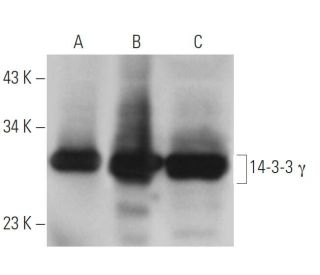

14-3-3 γ Antibody (KC21): sc-59421
- 14-3-3 γ Antibody (KC21) is a mouse monoclonal IgG2a, cited in 1 publications, provided at 50 µg/0.5 ml
- raised against the N-terminus of 14-3-3 γ of human origin
- recommended for detection of 14-3-3 γ where the N-terminal Met is removed, resulting in an acetylated N-terminal Valine of mouse, rat and human origin by WB and IP; not recommended for detection of unprocessed (non-modified) 14-3-3 γ
- See pan 14-3-3 (B-8): sc-133233 for 14-3-3 γ antibody conjugates, including AC, HRP, FITC, PE, Alexa Fluor® 488, 594, 647, 680 and 790.
- At present, we have not yet completed the identification of the preferred secondary detection reagent(s) for 14-3-3 γ Antibody (KC21). This work is in progress.

14-3-3 γ Antibody (KC21) is a mouse monoclonal IgG2a antibody that detects 14-3-3 γ in mouse, rat, and human samples through applications such as western blotting (WB) and immunoprecipitation (IP). 14-3-3 γ is a member of the 14-3-3 protein family, which plays a crucial role in regulating various cellular processes, including apoptosis, mitogenic signaling, and cell-cycle checkpoints, making 14-3-3 γ vital for maintaining cellular homeostasis and preventing tumorigenesis. 14-3-3 γ is predominantly located in the cytoplasm, where 14-3-3 γ interacts with a wide range of partner proteins, facilitating their proper function and localization. The ability of 14-3-3 γ to sequester proteins in the cytoplasm is particularly important, as 14-3-3 γ prevents their premature degradation and ensures availability for signaling pathways when needed. Additionally, 14-3-3 γ can modulate binding partner activity through mechanisms such as phosphorylation, which can alter protein conformation and function. Dysregulation of 14-3-3 γ expression or function has been implicated in various diseases, including cancer, underscoring 14-3-3 γ significance as a target for therapeutic intervention. With robust performance in western blotting (WB) and immunoprecipitation (IP), anti-14-3-3 γ antibody (KC21) is an essential tool for researchers investigating cellular signaling and disease.
Alexa Fluor® is a trademark of Molecular Probes Inc., OR., USA
LI-COR® and Odyssey® are registered trademarks of LI-COR Biosciences
14-3-3 γ Antibody (KC21) References:
- p53 suppresses 14-3-3γ by stimulating proteasome-mediated 14-3-3γ protein degradation. | Chen, DY., et al. 2015. Int J Oncol. 46: 818-24. PMID: 25384678
- Role of glial 14-3-3 gamma protein in autoimmune demyelination. | Lee, DH., et al. 2015. J Neuroinflammation. 12: 187. PMID: 26438180
- Down-regulation and gene hypermethylation of the 14-3-3 gamma in uterine leiomyoma. | Jiang, W., et al. 2016. Front Biosci (Landmark Ed). 21: 1286-95. PMID: 27100507
- 14-3-3γ Prevents Centrosome Amplification and Neoplastic Progression. | Mukhopadhyay, A., et al. 2016. Sci Rep. 6: 26580. PMID: 27253419
- 14-3-3γ Haploinsufficient Mice Display Hyperactive and Stress-sensitive Behaviors. | Kim, DE., et al. 2019. Exp Neurobiol. 28: 43-53. PMID: 30853823
- Emerging roles of 14-3-3γ in the brain disorder. | Cho, E. and Park, JY. 2020. BMB Rep. 53: 500-511. PMID: 32958119
- 14-3-3γ prevents centrosome duplication by inhibiting NPM1 function. | Bose, A., et al. 2021. Genes Cells. 26: 426-446. PMID: 33813791
- 14-3-3γ haploinsufficiency leads to altered dopamine pathway and Parkinson's disease-like motor incoordination in mice. | Cho, E., et al. 2023. Mol Brain. 16: 2. PMID: 36604743
- Thromboxane A2 Modulates de novo Synthesis of Adrenal Corticosterone in Mice via p38/14-3-3γ/StAR Signaling. | Yan, S., et al. 2024. Adv Sci (Weinh). 11: e2307926. PMID: 38460156
- Prospective Role of PAK6 and 14-3-3γ as Biomarkers for Parkinson's Disease. | Giusto, E., et al. 2024. J Parkinsons Dis. 14: 495-506. PMID: 38640169
Ordering Information
| Product Name | Catalog # | UNIT | Price | Qty | FAVORITES | |
14-3-3 γ Antibody (KC21) | sc-59421 | 50 µg/0.5 ml | $322.00 |