
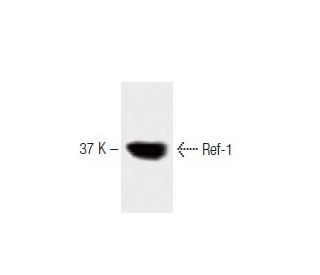


Ref-1 Antibody (15): sc-136057
- Ref-1 Antibody (15) is a mouse monoclonal IgG1, cited in 1 publications, provided at 50 µg/0.5 ml
- raised against amino acids 3-142 of Ref-1 of human origin
- recommended for detection of Ref-1 of mouse, rat, human and canine origin by WB, IP and IF; not recommended for IP
- See Ref-1 (C-4): sc-17774 for Ref-1 antibody conjugates, including AC, HRP, FITC, PE, Alexa Fluor® 488, 594, 647, 680 and 790.
- At present, we have not yet completed the identification of the preferred secondary detection reagent(s) for Ref-1 Antibody (15). This work is in progress.

QUICK LINKS
SEE ALSO...
Ref-1 Antibody (15) is a mouse monoclonal IgG1 antibody that recognizes Ref-1 in mouse, rat, human, and canine samples through western blotting (WB), immunoprecipitation (IP), and immunofluorescence (IF). Ref-1, also known as redox factor 1, plays a crucial role in regulating transcription factor activity by modulating redox state, which maintains proper gene expression. Ref-1 primarily localizes in the nucleus, functioning as a redox regulator with DNA repair capabilities, highlighting Ref-1′s importance in cellular responses to oxidative stress and DNA damage. Anti-Ref-1 antibody (15) enables research into how Ref-1 interacts with and activates transcription factors like Fos and Jun through reversible oxidation of a conserved cysteine residue, underscoring Ref-1′s significance in cellular signaling pathways. By restoring DNA binding activity in transcription factors, Ref-1 ensures fine-tuned gene expression in response to environmental changes, making Ref-1 vital for cellular homeostasis and prevention of diseases related to dysregulated gene expression. Anti-Ref-1 antibody (15) serves as an essential tool for studying gene regulation mechanisms and cellular responses to oxidative stress.
Alexa Fluor® is a trademark of Molecular Probes Inc., OR., USA
LI-COR® and Odyssey® are registered trademarks of LI-COR Biosciences
Ref-1 Antibody (15) References:
- Anticancer clinical utility of the apurinic/apyrimidinic endonuclease/redox factor-1 (APE/Ref-1). | Zhang, Y. and Wang, J. 2010. Chin J Cancer. 29: 333-9. PMID: 20193121
- Apurinic/apyrimidinic endonuclease/redox factor-1 (APE1/Ref-1) redox function negatively regulates NRF2. | Fishel, ML., et al. 2015. J Biol Chem. 290: 3057-68. PMID: 25492865
- APE1/Ref-1 as a Serological Biomarker for the Detection of Bladder Cancer. | Shin, JH., et al. 2015. Cancer Res Treat. 47: 823-33. PMID: 25672588
- Acute exercise stress promotes Ref1/Nrf2 signalling and increases mitochondrial antioxidant activity in skeletal muscle. | Wang, P., et al. 2016. Exp Physiol. 101: 410-20. PMID: 26682532
- Ref-1 protects against FeCl3-induced thrombosis and tissue factor expression via the GSK3β-NF-κB pathway. | Lee, I., et al. 2021. Korean J Physiol Pharmacol. 25: 59-68. PMID: 33361538
- Exploring transcriptional regulators Ref-1 and STAT3 as therapeutic targets in malignant peripheral nerve sheath tumours. | Gampala, S., et al. 2021. Br J Cancer. 124: 1566-1580. PMID: 33658640
- Ref-1 redox activity alters cancer cell metabolism in pancreatic cancer: exploiting this novel finding as a potential target. | Gampala, S., et al. 2021. J Exp Clin Cancer Res. 40: 251. PMID: 34376225
- Bis-Cinnamamide Derivatives as APE/Ref-1 Inhibitors for the Treatment of Human Melanoma. | Alhazmi, R., et al. 2022. Molecules. 27: PMID: 35566022
- Role of APE1/Ref-1 in hydrogen peroxide-induced apoptosis in human renal HK-2 cells. | Kim, HY., et al. 2024. Kidney Res Clin Pract. 43: 186-201. PMID: 37448293
- The Potential of Targeting APE1/Ref-1 as a Therapeutic Intervention for Duchenne Muscular Dystrophy. | Lalunio, H., et al. 2024. Antioxid Redox Signal.. PMID: 39729027
Ordering Information
| Product Name | Catalog # | UNIT | Price | Qty | FAVORITES | |
Ref-1 Antibody (15) | sc-136057 | 50 µg/0.5 ml | $322.00 |