
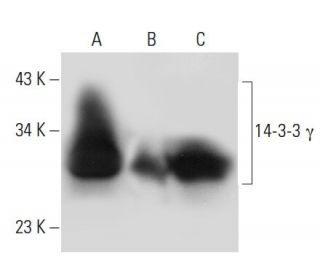

Anticorps 14-3-3 γ (6A1): sc-69955
- L'anticorps 14-3-3 gamma 6A1 est un monoclonal IgG2a de souris, cité dans 4 publications, fourni en 50 µg/0.5 ml
- soulevé contre le N-terminus de 14-3-3 γ d'origine human.
- recommandé pour la détection de 14-3-3 γ where the N-terminal Met is removed, resulting in an acetylated N-terminal Valine d'origine mouse, rat et human par WB et IP; non recommandé pour la détection de unprocessed (non-modified) 14-3-3 γ
- Voir pan 14-3-3 (B-8): sc-133233 pour d'autres anticorps conjugués 14-3-3 γ, dont AC, HRP, FITC, PE, Alexa Fluor® 488, 594, 647, 680 et 790.
- Nous testons actuellement encore nos anticorps secondaires pour trouver la meilleure protéine de liaison pour cet anticorps primaire 14-3-3 γ (6A1). Veuillez nous contacter si vous avez des questions concernant les réactifs de détection secondaire appropriés.

L'anticorps 14-3-3 γ (6A1) est un anticorps monoclonal IgG2a de souris qui détecte la protéine 14-3-3 γ dans des échantillons de souris, de rats et d'humains par des applications telles que le western blotting (WB) et l'immunoprécipitation (IP). 14-3-3 γ est un membre de la famille des protéines 14-3-3, qui joue un rôle crucial dans la régulation de divers processus cellulaires, notamment l'apoptose, la signalisation mitogénique et les points de contrôle du cycle cellulaire, tous essentiels au maintien de l'homéostasie cellulaire et à la prévention de la progression du cancer. La protéine 14-3-3 γ est principalement localisée dans le cytoplasme, où elle agit comme une protéine d'échafaudage qui facilite l'interaction entre différentes molécules de signalisation. La localisation cytoplasmique du 14-3-3 γ permet une modulation rapide des voies de signalisation en réponse à des stimuli cellulaires, garantissant que les réponses cellulaires appropriées sont activées ou inhibées selon les besoins. En se liant aux résidus sérine et thréonine phosphorylés des protéines cibles, le 14-3-3 γ peut influencer la stabilité, la localisation et l'activité, jouant ainsi un rôle essentiel dans la régulation des fonctions cellulaires clés. La formation de dimères et l'interaction de la 14-3-3 γ avec divers ligands soulignent son importance dans les réseaux de signalisation cellulaire, et toute perte d'expression ou tout dysfonctionnement peut entraîner toute une série de pathologies, y compris le cancer.
Alexa Fluor® est une marque déposée de Molecular Probes Inc., OR., USA
LI-COR® et Odyssey® sont marques déposées de LI-COR Biosciences
Anticorps 14-3-3 γ (6A1) Références:
- Réduction de l'expression de 14-3-3 gamma dans le léiomyome utérin identifiée par protéomique. | Lv, J., et al. 2008. Fertil Steril. 90: 1892-8. PMID: 18054924
- La 14-3-3 Gamma est nécessaire pour renforcer les points de contrôle de la phase S incomplète et des lésions de l'ADN en G2. | Hosing, AS., et al. 2008. Cell Cycle. 7: 3171-9. PMID: 18843201
- La protéine 14-3-3γ atténue les lésions des cardiomyocytes induites par le lipopolysaccharide par le biais de la voie famille Bcl-2/mitochondries. | Liu, D., et al. 2014. Int Immunopharmacol. 21: 509-15. PMID: 24957688
- 14-3-3γ régule la différenciation neuronale médiée par Copine1 dans les cellules progénitrices hippocampiques HiB5. | Cheal Yoo, J., et al. 2017. Exp Cell Res. 356: 85-92. PMID: 28412242
- L'interaction directe avec 14-3-3γ favorise l'expression de surface du canal Best1 dans l'astrocyte. | Oh, SJ., et al. 2017. Mol Brain. 10: 51. PMID: 29121962
- La tétraméthylpyrazine atténue l'endothéliotoxicité et la dysfonction mitochondriale causées par la doxorubicine par l'intermédiaire de 14-3-3γ/Bcl-2. | Yang, B., et al. 2019. Oxid Med Cell Longev. 2019: 5820415. PMID: 31885804
- 14-3-3γ, un nouveau régulateur du canal K+ à grande conductance activé par Ca2+. | Chen, S., et al. 2020. Am J Physiol Renal Physiol. 319: F52-F62. PMID: 32463725
- La puérarine atténue les lésions myocardiques induites par le lipopolysaccharide via la voie 14-3-3γ/PKCε activant l'autophagie adaptative. | Peng, Y., et al. 2022. Int Immunopharmacol. 108: 108905. PMID: 35729836
- 14-3-3γ médiateur de l'inhibition à long terme de la signalisation antinociceptive des récepteurs opioïdes kappa périphériques par la norbinaltorphimine. | Wedemeyer, MJ., et al. 2022. Neuropharmacology. 220: 109251. PMID: 36126728
- L'isoforme 14-3-3γ se lie à la protéine membranaire du réticulum endoplasmique (RE) TMCC3 et régule sa localisation pour le réseau réticulaire du RE. | Suhda, S., et al. 2023. J Biol Chem. 299: 102813. PMID: 36549645
Informations pour la commande
| Nom du produit | Ref. Catalogue | COND. | Prix HT | QTÉ | Favoris | |
Anticorps 14-3-3 γ (6A1) | sc-69955 | 50 µg/0.5 ml | $322.00 |