
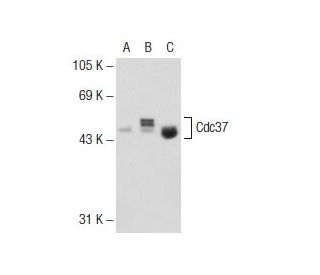
Cdc37 Antibody (15): sc-135862
- Cdc37 Antibody (15) is a mouse monoclonal IgG1 provided at 50 µg/0.5 ml
- raised against amino acids 1-163 of Cdc37 of human origin
- recommended for detection of Cdc37 of mouse, rat, human and canine origin by WB, IP and IF; not recommended for IP
- At present, we have not yet completed the identification of the preferred secondary detection reagent(s) for Cdc37 Antibody (15). This work is in progress.

Cdc37 Antibody (15) is a mouse monoclonal IgG1 antibody that detects Cdc37 in mouse, rat, human, and canine samples through applications such as western blotting (WB), immunoprecipitation (IP), and immunofluorescence (IF). Cdc37 is a crucial co-chaperone that plays a significant role in the stabilization and activation of cyclin-dependent kinases (Cdks) by forming a stable complex with heat shock protein 90 (Hsp90). This interaction is vital for proper cell cycle functioning, as Cdc37 facilitates the assembly of Cdk4/cyclin D1 complexes, which are essential for the transition from G1 phase to S phase of the cell cycle. The significance of Cdc37 in regulating cell division highlights its potential as a therapeutic target in cancer, where dysregulation of the cell cycle is a common feature. Anti-Cdc37 antibody (15) enables researchers to gain insights into cell cycle regulation mechanisms and the role of chaperone proteins in cellular processes.
Alexa Fluor® is a trademark of Molecular Probes Inc., OR., USA
LI-COR® and Odyssey® are registered trademarks of LI-COR Biosciences
Cdc37 Antibody (15) References:
- Supervision of multiple signaling protein kinases by the CK2-Cdc37 couple, a possible novel cancer therapeutic target. | Miyata, Y. and Nishida, E. 2004. Ann N Y Acad Sci. 1030: 150-7. PMID: 15659792
- Suppressing the CDC37 cochaperone in hepatocellular carcinoma cells inhibits cell cycle progression and cell growth. | Wang, Z., et al. 2015. Liver Int. 35: 1403-15. PMID: 25098386
- Hsp90·Cdc37 Complexes with Protein Kinases Form Cooperatively with Multiple Distinct Interaction Sites. | Eckl, JM., et al. 2015. J Biol Chem. 290: 30843-54. PMID: 26511315
- The co-chaperone Cdc37 regulates the rabies virus phosphoprotein stability by targeting to Hsp90AA1 machinery. | Xu, Y., et al. 2016. Sci Rep. 6: 27123. PMID: 27251758
- Cdc37 suppression induces plasma cell immaturation and bortezomib resistance in multiple myeloma via Xbp1s. | Zang, M., et al. 2020. Oncogenesis. 9: 31. PMID: 32139666
- The Activity and Stability of p56Lck and TCR Signaling Do Not Depend on the Co-Chaperone Cdc37. | Kowallik, S., et al. 2020. Int J Mol Sci. 22: PMID: 33374422
- p17-Modulated Hsp90/Cdc37 Complex Governs Oncolytic Avian Reovirus Replication by Chaperoning p17, Which Promotes Viral Protein Synthesis and Accumulation of Viral Proteins σC and σA in Viral Factories. | Huang, WR., et al. 2022. J Virol. 96: e0007422. PMID: 35107368
- Recognition of BRAF by CDC37 and Re-Evaluation of the Activation Mechanism for the Class 2 BRAF-L597R Mutant. | Bjorklund, DM., et al. 2022. Biomolecules. 12: PMID: 35883461
- Mitochondrial respiration promotes Cdc37-dependent stability of the Cdk1 homolog Cdc28. | Leite, AC., et al. 2023. J Cell Sci. 136: PMID: 36594787
- Rational design of peptide inhibitors targeting HSP90-CDC37 protein-protein interaction. | Zhang, Q., et al. 2024. Future Med Chem. 16: 125-138. PMID: 38189168
Ordering Information
| Product Name | Catalog # | UNIT | Price | Qty | FAVORITES | |
Cdc37 Antibody (15) | sc-135862 | 50 µg/0.5 ml | $322.00 |