
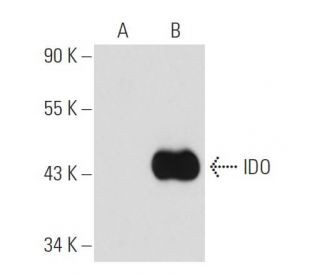
IDO Antikörper (H-11): sc-137012
- IDO Antikörper (H-11) ist ein Maus monoklonales IgG1 κ, verwendet in 24 wissenschaftlichen Veröffentlichungen, in einer Menge von 200 µg/ml
- gezogen gegen die Aminosäuresequenz 1-80 von IDO aus der Spezies mouse
- Anti-IDO Antikörper (H-11) ist empfohlen für die Detektion von IDO aus der Spezies mouse, rat und human per WB, IP, IF, IHC(P) und ELISA
- Anti-IDO Antikörper (H-11) ist erhältlich als Konjugat mit Agarose für IP; HRP für WB, IHC(P) und ELISA; und entweder mit Phycoerythrin oder FITC für IF, IHC(P) und FCM
- auch erhältlich als Konjugat mit Alexa Fluor® 488, Alexa Fluor® 546, Alexa Fluor® 594 oder Alexa Fluor® 647 für IF, IHC(P) und FCM
- auch erhältlich als Konjugat mit Alexa Fluor® 680 oder Alexa Fluor® 790 für WB (NIR), IF und FCM
- 1 BP-HRP">m-IgG1 BP-HRP ist das bevorzugte sekundäre Nachweisreagenz für IDO Antikörper (H-11) für WB- und IHC(P)-Anwendungen. Dieses Reagenz wird jetzt in einem Paket mit IDO Antikörper (H-11) angeboten(siehe Bestellinformationen unten).

Direktverknüpfungen
Der IDO-Antikörper (H-11) ist ein monoklonaler Maus IgG1 κ IDO-Antikörper, der IDO von Maus-, Ratte- und menschlicher Herkunft mittels WB, IP, IF, IHC (P) und ELISA nachweist. Der IDO-Antikörper (H-11) ist als nicht-konjugierte Form des Anti-IDO-Antikörpers sowie als mehrere konjugierte Formen des Anti-IDO-Antikörpers, einschließlich Agarose, HRP, PE, FITC und mehreren Alexa Fluor®-Konjugaten, erhältlich. Die Indolamin-2,3-Dioxygenase (IDO) ist ein IFN-γ-induzierbares Enzym, das die Degradation des essentiellen Aminosäure L-Tryptophan in N-Formylkynurenin katalysiert. Das Gen, das das menschliche IDO kodiert, ist auf Chromosom 8p12-p11 kartiert. IDO, auch als INDO bekannt, ist ein wichtiger Modulator immunologischer Reaktionen und schützt allogene Konzepte vor alloreaktiven mütterlichen Lymphozyten. IDO vermittelt eine interessante inhibitory Wirkung von HeLa-Zellen, die mit humanen PBLs ko-kultiviert werden. Die ILN-2-induzierte Proliferationsantwort der PBLs ist in Anwesenheit von HeLa-Zellen vermindert, während ein IDO-Inhibitor diesen Effekt aufhebt. Die flusszytometrische Analyse zeigt, dass sowohl reife als auch unreife CD123-positive dendritische Zellen die T-Zell-Aktivität mittels IDO unterdrücken. IDO-transfizierte Zellen, die mit T-Zellen ko-kultiviert werden, reduzieren die T-Zell-Proliferation. Darüber hinaus reduziert die adoptierte Übertragung von Spender-T-Zellen die Anzahl der Spender-T-Zellen in IDO-transgenen Mäusen. Die pharmakologische oder genetische Manipulation von IDO kann nützlich sein, um unerwünschte T-Zell-Reaktionen zu unterdrücken.
Alexa Fluor® ist ein Markenzeichen von Molecular Probes Inc., OR., USA
LI-COR® und Odyssey® sind Markenzeichen von LI-COR Biosciences
IDO Antikörper (H-11) Literaturhinweise:
- Neue Einblicke in die Biologie der IDO bei bakteriellen und viralen Infektionen. | Schmidt, SV. and Schultze, JL. 2014. Front Immunol. 5: 384. PMID: 25157255
- Indolamin-2,3-Dioxygenase (IDO): Biologie und Ziel in der Krebsimmuntherapie. | Selvan, SR., et al. 2016. Curr Cancer Drug Targets. 16: 755-764. PMID: 26517538
- Indolamin-2,3-Dioxygenase (IDO)-Hemmung als Strategie zur Verbesserung der Krebsimmuntherapie. | Yentz, S. and Smith, D. 2018. BioDrugs. 32: 311-317. PMID: 29980987
- IDO und TDO als potenzielles therapeutisches Ziel bei verschiedenen Arten von Depressionen. | Qin, Y., et al. 2018. Metab Brain Dis. 33: 1787-1800. PMID: 30014175
- Beitrag von IDO zur Infektion mit dem humanen Respiratorischen Synzytialvirus. | Benavente, FM., et al. 2019. J Leukoc Biol. 106: 933-942. PMID: 31091352
- IDO in der kolorektalen Tumorentstehung: Beteiligung der Immuntoleranz und Bedeutung für Prävention und Therapie. | Tang, S., et al. 2021. Cell Mol Gastroenterol Hepatol. 12: 1503-1504. PMID: 34280382
- Indoleamin-2,3-Dioxygenase (IDO)-Hemmer und ihre Nanomedikamente für die Krebsimmuntherapie. | Guo, Y., et al. 2021. Biomaterials. 276: 121018. PMID: 34284200
- IDO-1-Inhibitor INCB24360 löst Fernmetastasen von basalen extrudierten Krebszellen beim duktalen Pankreas-Adenokarzinom aus. | Buhe, H., et al. 2023. Acta Pharmacol Sin. 44: 1277-1289. PMID: 36517670
- DSS-induzierte Kolitis aktiviert den Kynurenin-Signalweg im Serum und im Gehirn durch Beeinflussung von IDO-1 und Darmmikrobiota. | Zhao, LP., et al. 2022. Front Immunol. 13: 1089200. PMID: 36776388
- Indolamin-2,3-Dioxygenase (IDO)-Aktivität: Ein perspektivischer Biomarker für die Laborbestimmung in der Tumorimmuntherapie. | Yang, P. and Zhang, J. 2023. Biomedicines. 11: PMID: 37509627
Bestellinformation
| Produkt | Katalog # | EINHEIT | Preis | ANZAHL | Favoriten | |
IDO Antikörper (H-11) | sc-137012 | 200 µg/ml | $322.00 | |||
IDO (H-11): m-IgG1 BP-HRP Bundle | sc-531669 | 200 µg Ab; 20 µg BP | $361.00 | |||
IDO Antikörper (H-11) AC | sc-137012 AC | 500 µg/ml, 25% agarose | $424.00 | |||
IDO Antikörper (H-11) HRP | sc-137012 HRP | 200 µg/ml | $322.00 | |||
IDO Antikörper (H-11) FITC | sc-137012 FITC | 200 µg/ml | $336.00 | |||
IDO Antikörper (H-11) PE | sc-137012 PE | 200 µg/ml | $349.00 | |||
IDO Antikörper (H-11) Alexa Fluor® 488 | sc-137012 AF488 | 200 µg/ml | $364.00 | |||
IDO Antikörper (H-11) Alexa Fluor® 546 | sc-137012 AF546 | 200 µg/ml | $364.00 | |||
IDO Antikörper (H-11) Alexa Fluor® 594 | sc-137012 AF594 | 200 µg/ml | $364.00 | |||
IDO Antikörper (H-11) Alexa Fluor® 647 | sc-137012 AF647 | 200 µg/ml | $364.00 | |||
IDO Antikörper (H-11) Alexa Fluor® 680 | sc-137012 AF680 | 200 µg/ml | $364.00 | |||
IDO Antikörper (H-11) Alexa Fluor® 790 | sc-137012 AF790 | 200 µg/ml | $364.00 |