
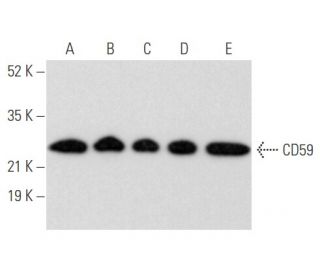
CD59 Antikörper (YTH53.1): sc-59095
- CD59 Antikörper YTH53.1 ist ein monoklonales IgG2b aus der Ratte, verwendet in 12 wissenschaftlichen Veröffentlichungen, in einer Menge von 200 µg/ml
- gegen periphere T-Zellen human
- Anti-CD59 Antikörper (YTH53.1) ist empfohlen für die Detektion von CD59 aus der Spezies mouse, rat und human per WB, IP, IF und FCM
- Anti-CD59 Antikörper (YTH53.1) ist erhältlich als Konjugat mit Agarose für IP; HRP für WB, IHC(P) und ELISA; und entweder mit Phycoerythrin oder FITC für IF, IHC(P) und FCM
- auch erhältlich als Konjugat mit Alexa Fluor® 488, Alexa Fluor® 546, Alexa Fluor® 594 oder Alexa Fluor® 647 für IF, IHC(P) und FCM
- auch erhältlich als Konjugat mit Alexa Fluor® 680 oder Alexa Fluor® 790 für WB (NIR), IF und FCM
- Aktuell testen wir noch unsere Sekundärantikörper um das beste Bindeprotein für diesen Primärantikörper CD59 (YTH53.1) zu finden. Kontaktieren Sie uns bitte, wenn Sie Fragen hierzu haben sollten.

Direktverknüpfungen
Siehe auch...
Der CD59-Antikörper (YTH53.1) ist ein monoklonaler IgG2b-Antikörper der Ratte, der das CD59-Protein von Mäusen, Ratten und Menschen durch Western Blot (WB), Immunpräzipitation (IP), Immunfluoreszenz (IF) und Durchflusszytometrie (FCM) nachweist. Der CD59-Antikörper (YTH53.1) ist sowohl in nicht konjugierter als auch in verschiedenen konjugierten Formen erhältlich, darunter Agarose, Meerrettichperoxidase (HRP), Phycoerythrin (PE), Fluoresceinisothiocyanat (FITC) und mehrere Alexa Fluor®-Konjugate. CD59 ist ein Glykoprotein, das an Glycosylphosphatidylinositol (GPI) verankert ist und sich vorwiegend auf der Oberfläche von Leukozyten, vaskulären Endothelzellen, verschiedenen Epithelzellen und der Plazenta befindet. Es spielt eine entscheidende Rolle bei der Immunregulation. Die strategische Position von CD59 auf Zellmembranen ist von entscheidender Bedeutung, da CD59 als Schutzmittel gegen das Komplementsystem wirkt und die Bildung des Membranangriffskomplexes (MAC) verhindert, der zur Zelllyse führen kann. Durch die Bindung an die C8- und C9-Komponenten des Membranangriffskomplexes hemmt CD59 effektiv die Bildung lytischer Poren und schützt so die Wirtszellen vor durch das Komplementsystem verursachten Schäden. Darüber hinaus ist CD59 an der Regulierung der Calciumfreisetzung und der Aktivierung von Lipid-Raft-assoziierten Signalmolekülen, einschließlich Tyrosinkinasen, beteiligt, die für verschiedene zelluläre Prozesse unerlässlich sind. Das CD59-Gen enthält zwei p53-responsive Domänen, was auf eine mögliche Rolle beim Schutz von Zellen vor Komplement-induzierten Schäden während Entzündungsreaktionen hindeutet und darauf hinweist, dass p53 die Anfälligkeit von Tumorzellen für eine Komplement-Lyse während einer Chemotherapie beeinflussen kann.
Alexa Fluor® ist ein Markenzeichen von Molecular Probes Inc., OR., USA
LI-COR® und Odyssey® sind Markenzeichen von LI-COR Biosciences
CD59 Antikörper (YTH53.1) Literaturhinweise:
- Zusammenhang zwischen GPI-verankerten Ly6-Proteinen uPAR und CD59 und Virusinfektion. | Yu, J., et al. 2019. Viruses. 11: PMID: 31739586
- Assoziation des Blutgruppenantigens CD59 mit Krankheiten. | Weinstock, C. 2022. Transfus Med Hemother. 49: 13-24. PMID: 35221864
- Cd59 und Entzündungen regulieren die Entwicklung von Schwann-Zellen. | Wiltbank, AT., et al. 2022. Elife. 11: PMID: 35748863
- CD59-regulierte Ras-Kompartmentalisierung steuert die Antitumor-T-Zell-Immunität. | Li, L., et al. 2022. Cancer Immunol Res. 10: 1475-1489. PMID: 36206575
- Die Unterdrückung der EGFR-regulierten Expression von CD55 und CD59 aktiviert das Komplementsystem und sensibilisiert Lungenkrebs für Checkpoint-Blockaden. | Shao, F., et al. 2022. Nat Cancer. 3: 1192-1210. PMID: 36271172
- CD59-Expression in Skelettmuskeln und ihre Rolle bei Myasthenia gravis. | Iwasa, K., et al. 2023. Neurol Neuroimmunol Neuroinflamm. 10: PMID: 36396448
- Strukturelle Grundlage für die Hemmung des Membranangriffskomplexes durch CD59. | Couves, EC., et al. 2023. Nat Commun. 14: 890. PMID: 36797260
- Erblicher CD59-Mangel, bei dem Neurologie und Genetik ineinandergreifen. | Almutawea, LM., et al. 2023. Neurosciences (Riyadh). 28: 130-135. PMID: 37045466
- Entschlüsselung der CD59-Antikörper-Interaktionen zur Entwicklung von Paratop-nachahmenden Peptiden für die Komplementmodulation. | Sandomenico, A., et al. 2023. Int J Mol Sci. 24: PMID: 37239905
- Dynamik und molekulare Interaktionen von GPI-verankertem CD59. | Voisin, TB., et al. 2023. Toxins (Basel). 15: PMID: 37505699
Bestellinformation
| Produkt | Katalog # | EINHEIT | Preis | ANZAHL | Favoriten | |
CD59 Antikörper (YTH53.1) | sc-59095 | 200 µg/ml | $322.00 | |||
CD59 Antikörper (YTH53.1) AC | sc-59095 AC | 500 µg/ml, 25% agarose | $424.00 | |||
CD59 Antikörper (YTH53.1) HRP | sc-59095 HRP | 200 µg/ml | $322.00 | |||
CD59 Antikörper (YTH53.1) FITC | sc-59095 FITC | 200 µg/ml | $336.00 | |||
CD59 Antikörper (YTH53.1) PE | sc-59095 PE | 200 µg/ml | $349.00 | |||
CD59 Antikörper (YTH53.1) Alexa Fluor® 488 | sc-59095 AF488 | 200 µg/ml | $364.00 | |||
CD59 Antikörper (YTH53.1) Alexa Fluor® 546 | sc-59095 AF546 | 200 µg/ml | $364.00 | |||
CD59 Antikörper (YTH53.1) Alexa Fluor® 594 | sc-59095 AF594 | 200 µg/ml | $364.00 | |||
CD59 Antikörper (YTH53.1) Alexa Fluor® 647 | sc-59095 AF647 | 200 µg/ml | $364.00 | |||
CD59 Antikörper (YTH53.1) Alexa Fluor® 680 | sc-59095 AF680 | 200 µg/ml | $364.00 | |||
CD59 Antikörper (YTH53.1) Alexa Fluor® 790 | sc-59095 AF790 | 200 µg/ml | $364.00 |