
Date published: 2026-5-21

1-800-457-3801

SCBT Portrait Logo
Seach Input

p-tuberin Antibody (325.Ser 1798): sc-293149

5.0(2)
Write a reviewAsk a question

Datasheets
  • p-tuberin Antibody (325.Ser 1798) is a mouse monoclonal IgG1 κ, cited in 7 publications, provided at 200 µg/ml
  • raised against a short amino acid sequence containing phosphorylated Ser 1798 of tuberin of human origin
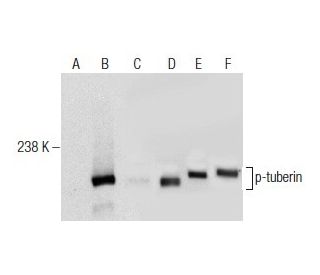
  • recommended for detection of Ser 1798 phosphorylated tuberin of human origin by WB, IP and ELISA
  • available conjugated to agarose for IP; and to HRP for WB, IHC(P) and ELISA
  • m-IgG Fc BP-HRP and m-IgG1 BP-HRP are the preferred secondary detection reagents for p-tuberin Antibody (325.Ser 1798) for WB applications. These reagents are now offered in bundles with p-tuberin Antibody (325.Ser 1798) (see ordering information below).
Gene Editing Promo Banner

QUICK LINKS

SEE ALSO...

p-tuberin Antibody (325.Ser 1798) is a mouse monoclonal IgG1 kappa light chain antibody that detects phosphorylated tuberin at Ser 1798 in human samples through applications such as western blotting (WB), immunoprecipitation (IP), and enzyme-linked immunosorbent assay (ELISA). p-tuberin (325.Ser 1798) antibody is available in both conjugated and non-conjugated forms, providing versatility for various experimental needs. Tuberin, also known as TSC2, plays a crucial role in cell growth and proliferation regulation by forming a functional complex with hamartin (TSC1), which inhibits protein synthesis and acts as a tumor suppressor. Tuberin′s function is vital in the tuberous sclerosis complex (TSC), a genetic disorder caused by mutations in TSC1 and TSC2 genes, leading to benign tumor development in multiple organs. Phosphorylation of tuberin at specific sites, such as serine-939 and threonine-1462, by the phosphoinositide 3-kinase (PI3K)/Akt pathway, inhibits the tumor suppressor function of the TSC complex, promoting cell growth. Phosphorylation of tuberin by the p38-MK2 kinase cascade at serine-1210 creates a binding site for 14-3-3 proteins, which regulates the hamartin-tuberin complex activity during the G2/M phase of the cell cycle. This regulation highlights p-tuberin′s significance in maintaining cellular homeostasis and potential implications in cancer biology and therapeutic interventions.

For Research Use Only. Not Intended for Diagnostic or Therapeutic Use.

Alexa Fluor® is a trademark of Molecular Probes Inc., OR., USA

LI-COR® and Odyssey® are registered trademarks of LI-COR Biosciences

p-tuberin Antibody (325.Ser 1798) References:

  1. The p38 and MK2 kinase cascade phosphorylates tuberin, the tuberous sclerosis 2 gene product, and enhances its interaction with 14-3-3.  |  Li, Y., et al. 2003. J Biol Chem. 278: 13663-71. PMID: 12582162
  2. Inactivation of the tuberous sclerosis complex-1 and -2 gene products occurs by phosphoinositide 3-kinase/Akt-dependent and -independent phosphorylation of tuberin.  |  Tee, AR., et al. 2003. J Biol Chem. 278: 37288-96. PMID: 12867426
  3. Tuberous sclerosis complex gene products, Tuberin and Hamartin, control mTOR signaling by acting as a GTPase-activating protein complex toward Rheb.  |  Tee, AR., et al. 2003. Curr Biol. 13: 1259-68. PMID: 12906785
  4. Cell cycle-regulated phosphorylation of hamartin, the product of the tuberous sclerosis complex 1 gene, by cyclin-dependent kinase 1/cyclin B.  |  Astrinidis, A., et al. 2003. J Biol Chem. 278: 51372-9. PMID: 14551205
  5. Estrogen-induced smooth muscle cell growth is regulated by tuberin and associated with altered activation of platelet-derived growth factor receptor-beta and ERK-1/2.  |  Finlay, GA., et al. 2004. J Biol Chem. 279: 23114-22. PMID: 15039427
  6. Regulation of B-Raf kinase activity by tuberin and Rheb is mammalian target of rapamycin (mTOR)-independent.  |  Karbowniczek, M., et al. 2004. J Biol Chem. 279: 29930-7. PMID: 15150271
  7. Human papillomavirus 16 E6 oncoprotein interferences with insulin signaling pathway by binding to tuberin.  |  Lu, Z., et al. 2004. J Biol Chem. 279: 35664-70. PMID: 15175323
  8. Tuberin binds p27 and negatively regulates its interaction with the SCF component Skp2.  |  Rosner, M. and Hengstschläger, M. 2004. J Biol Chem. 279: 48707-15. PMID: 15355997
  9. Transgenic expression of dominant negative tuberin through a strong constitutive promoter results in a tissue-specific tuberous sclerosis phenotype in the skin and brain.  |  Govindarajan, B., et al. 2005. J Biol Chem. 280: 5870-4. PMID: 15576369
  10. Tuberin nuclear localization can be regulated by phosphorylation of its carboxyl terminus.  |  York, B., et al. 2006. Mol Cancer Res. 4: 885-97. PMID: 17114346
  11. Tuberin: a stimulus-regulated tumor suppressor protein controlled by a diverse array of receptor tyrosine kinases and G protein-coupled receptors.  |  Wu, EH., et al. Neurosignals. 15: 217-27. PMID: 17389815
  12. The tuberous sclerosis gene products hamartin and tuberin are multifunctional proteins with a wide spectrum of interacting partners.  |  Rosner, M., et al. 2008. Mutat Res. 658: 234-46. PMID: 18291711

Ordering Information

Product NameCatalog #UNITPriceQtyFAVORITES

p-tuberin Antibody (325.Ser 1798)

sc-293149
200 µg/ml
$322.00

p-tuberin Antibody (325.Ser 1798): m-IgG Fc BP-HRP Bundle

sc-527326
200 µg Ab; 10 µg BP
$361.00

p-tuberin Antibody (325.Ser 1798): m-IgG1 BP-HRP Bundle

sc-532699
200 µg Ab; 20 µg BP
$361.00

p-tuberin Antibody (325.Ser 1798) AC

sc-293149 AC
500 µg/ml, 25% agarose
$424.00

p-tuberin Antibody (325.Ser 1798) HRP

sc-293149 HRP
200 µg/ml
$322.00

What is the recommended secondary reagent to be used with this mouse monoclonal primary?

Asked by: jerojero
We recommend using one our exclusive Mouse IgG Binding Proteins as a secondary detection reagent. A complete list of available binding proteins is available on our website here: https://www.scbt.com/scbt/browse/support-products-mouse-igg-binding-proteins/_/N-ecrety
Answered by: Technical Support 2
Date published: 2017-02-08
  • y_2026, m_5, d_21, h_10CST
  • bvseo_bulk, prod_bvqa, vn_bulk_3.0.46
  • cp_1, bvpage1
  • co_hasquestionsanswers, tq_1
  • loc_en_US, sid_293149, prod, sort_[SortEntry(order=LAST_APPROVED_ANSWER_SUBMISSION_TIME, direction=DESCENDING)]
  • clientName_scbt
  • bvseo_sdk, java_sdk, bvseo-4.0.0
  • CLOUD, getContent, 98ms
  • QUESTIONS, PRODUCT
Rated 5 out of 5 by from Great phospho-specific antibody!This monoclonal antibody has been demonstrated to be specific for detection of Serine 1798 phosphorylated tuberin through a series of Western blotting experiments using lambda phosphatase as a control.
Date published: 2017-01-26
  • y_2026, m_5, d_21, h_10
  • bvseo_bulk, prod_bvrr, vn_bulk_3.0.46
  • cp_1, bvpage1
  • co_hasreviews, tv_1, tr_1
  • loc_en_US, sid_293149, prod, sort_[SortEntry(order=SUBMISSION_TIME, direction=DESCENDING)]
  • clientName_scbt
  • bvseo_sdk, java_sdk, bvseo-4.0.0
  • CLOUD, getReviews, 14ms
  • REVIEWS, PRODUCT
p-tuberin Antibody (325.Ser 1798) is rated 5.0 out of 5 by 2.
  • y_2026, m_5, d_21, h_10
  • bvseo_bulk, prod_bvrr, vn_bulk_3.0.46
  • cp_1, bvpage1
  • co_hasreviews, tv_1, tr_1
  • loc_en_US, sid_293149, prod, sort_[SortEntry(order=SUBMISSION_TIME, direction=DESCENDING)]
  • clientName_scbt
  • bvseo_sdk, java_sdk, bvseo-4.0.0
  • CLOUD, getAggregateRating, 104ms
  • REVIEWS, PRODUCT
