
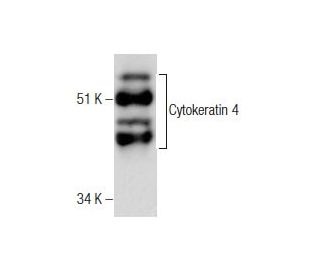

Cytokeratin 4 Antibody (0.N.344): sc-70920
- Cytokeratin 4 Antibody (0.N.344) is a mouse monoclonal IgG1, cited in 1 publications, provided at 100 µg/ml
- raised against cytokeratin preparation from esophagus cells of human origin
- recommended for detection of Cytokeratin 4 of mouse, rat and human origin by WB, IP, IF, IHC(P) and FCM; also reactive with additional species, including and porcine, feline and canine
- See pan-Cytokeratin (C11): sc-8018 for Cytokeratin 4 antibody conjugates, including AC, HRP, FITC, PE, Alexa Fluor® 488, 594, 647, 680 and 790.
- At present, we have not yet completed the identification of the preferred secondary detection reagent(s) for Cytokeratin 4 Antibody (0.N.344). This work is in progress.

QUICK LINKS
SEE ALSO...
Cytokeratin 4 Antibody (0.N.344) is a mouse monoclonal IgG1 antibody that detects Cytokeratin 4 in mouse, rat, and human samples through various applications including western blotting (WB), immunoprecipitation (IP), immunofluorescence (IF), immunohistochemistry with paraffin-embedded sections (IHCP), and flow cytometry (FCM). Cytokeratin 4 is a member of the cytokeratin family, which plays a crucial role in maintaining the structural integrity of epithelial cells. Anti-Cytokeratin 4 antibody (0.N.344) targets proteins primarily located in the differentiated layers of the mucosal and esophageal epithelia, where Cytokeratin 4 contributes to the mechanical resilience of these tissues. Cytokeratin 4 is essential for the proper functioning of epithelial barriers, helping to protect against physical and chemical stressors. Additionally, Cytokeratin 4 expression, along with Cytokeratin 13, indicates the differentiation status of epithelial cells, making Cytokeratin 4 a valuable marker in the study of various epithelial malignancies. Cytokeratin 4 monoclonal antibody (0.N.344) enables researchers to gain insights into both normal physiology and disease states, enhancing our understanding of epithelial biology and pathology.
Alexa Fluor® is a trademark of Molecular Probes Inc., OR., USA
LI-COR® and Odyssey® are registered trademarks of LI-COR Biosciences
Cytokeratin 4 Antibody (0.N.344) References:
- Transcriptional gene expression profiles of oesophageal adenocarcinoma and normal oesophageal tissues. | Hourihan, RN., et al. 2003. Anticancer Res. 23: 161-5. PMID: 12680208
- Isolation and characterization of cultured human conjunctival goblet cells. | Shatos, MA., et al. 2003. Invest Ophthalmol Vis Sci. 44: 2477-86. PMID: 12766046
- Fascin and CK4 as biomarkers for esophageal squamous cell carcinoma. | Takikita, M., et al. 2011. Anticancer Res. 31: 945-52. PMID: 21498718
- Mass spectrometry-based salivary proteomics for the discovery of head and neck squamous cell carcinoma. | Jarai, T., et al. 2012. Pathol Oncol Res. 18: 623-8. PMID: 22350791
- Poly(3-hydroxybutyrate-co-3-hydroxyvalerate)-based nanofibrous scaffolds to support functional esophageal epithelial cells towards engineering the esophagus. | Kuppan, P., et al. 2014. J Biomater Sci Polym Ed. 25: 574-93. PMID: 24502395
- In vitro evaluation of bi-layer silk fibroin scaffolds for gastrointestinal tissue engineering. | Franck, D., et al. 2014. J Tissue Eng. 5: 2041731414556849. PMID: 25396043
- Gene expression profiling to predict recurrence of advanced squamous cell carcinoma of the tongue: discovery and external validation. | Enokida, T., et al. 2017. Oncotarget. 8: 61786-61799. PMID: 28977904
- Evaluation of molecules or extracts modulating seborrhea and its consequences, using normal human culture of sebocytes and keratinocytes, skin explants models and in vivo methods: a case study. | Mondon, P., et al. 2017. J Cosmet Sci. 68: 183-194. PMID: 29619942
- Clinicocytopathological spectrum, including uncommon forms, of nine cases of chordomas with immunohistochemical results, including brachyury immunostaining: A single institutional experience. | Rekhi, B. and Karmarkar, S. 2019. Cytopathology. 30: 229-235. PMID: 30218622
- Topical treatment of ichthyoses and Darier's disease with 13-cis-retinoic acid. A clinical and immunohistochemical study. | Steijlen, PM., et al. 1993. Arch Dermatol Res. 285: 221-6. PMID: 7688204
Ordering Information
| Product Name | Catalog # | UNIT | Price | Qty | FAVORITES | |
Cytokeratin 4 Antibody (0.N.344) | sc-70920 | 100 µg/ml | $322.00 |