
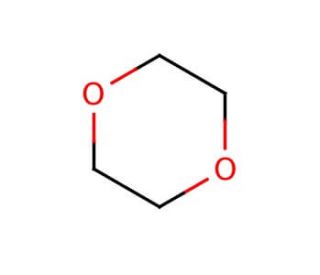

1,4-Dioxane (CAS 123-91-1)
LINKS RÁPIDOS
O 1,4-Dioxano é um produto químico industrial sintético conhecido pelo seu aspeto límpido e incolor e pelo seu odor a éter. Estruturalmente, é caracterizado como um éter cíclico com um anel de seis membros constituído por quatro átomos de carbono e dois átomos de oxigénio nas posições 1 e 4, o que contribui para as suas excelentes propriedades de solvente. Este composto heterocíclico é altamente miscível com a água, bem como com uma vasta gama de solventes orgânicos, o que o torna particularmente útil em várias aplicações na investigação e fabrico de produtos químicos. No domínio da síntese orgânica, o 1,4-dioxano é frequentemente utilizado como um solvente estável para processos de reação, particularmente aqueles que envolvem reagentes sensíveis, devido à sua capacidade de dissolver numerosos compostos orgânicos e ao seu comportamento relativamente inerte sob condições de reação. As suas aplicações estendem-se ao estudo de sistemas poliméricos, onde é utilizado para dissolver polímeros como o polietileno e o polipropileno, facilitando a análise das suas propriedades e comportamentos. Adicionalmente, o 1,4-dioxano é utilizado na investigação em química ambiental para investigar as suas vias e mecanismos de degradação, dada a sua classificação como provável carcinogéneo humano e a sua presença como contaminante em águas subterrâneas e efluentes industriais. Os investigadores estão particularmente interessados nos seus processos de degradação fotolítica e microbiana para melhor compreender e mitigar o seu impacto ambiental.
1,4-Dioxane (CAS 123-91-1) Referencias
- Efeito do dioxano na conformação da lisozima a pH baixo. I. Estudos por dicroísmo circular e medidas de viscosidade. | Izumi, T. and Inoue, H. 1977. J Biochem. 81: 1769-79. PMID: 19446
- Tolerância das β-dicetonas hidrolases como representantes da superfamília das crotonases aos solventes orgânicos. | Siirola, E., et al. 2011. Biotechnol Bioeng. 108: 2815-22. PMID: 21809324
- Avanços na bioremediação de águas contaminadas com 1,4-dioxano. | Zhang, S., et al. 2017. J Environ Manage. 204: 765-774. PMID: 28625566
- Características de degradação do 1,4-Dioxano de Rhodococcus aetherivorans JCM 14343. | Inoue, D., et al. 2018. Biodegradation. 29: 301-310. PMID: 29696449
- Degradação de 1,4-Dioxano por Xanthobacter sp. YN2. | Ma, F., et al. 2021. Curr Microbiol. 78: 992-1005. PMID: 33547937
- Remoção de 1,4-dioxano durante o tratamento de águas residuais no local utilizando biofiltros de remoção de azoto. | Lee, CS., et al. 2021. Sci Total Environ. 771: 144806. PMID: 33548721
- Degradação cometabólica de 1,4-dioxano por uma Arthrobacter sp. WN18 que cresce em tetrahidrofurano. | Wang, P., et al. 2021. Ecotoxicol Environ Saf. 217: 112206. PMID: 33866286
- Estratégias de correção para reduzir a poluição por 1,4-dioxano - ênfase especial em diversas intervenções biotecnológicas. | Kikani, M., et al. 2022. Environ Res. 214: 113939. PMID: 35921903
- Caracterização da comunidade microbiana degradadora de 1,4-dioxano enriquecida a partir de solo não contaminado. | Tang, Y., et al. 2023. Appl Microbiol Biotechnol. 107: 955-969. PMID: 36625913
- Uma avaliação integrada do modo de ação cancerígeno do 1,4-dioxano e do limiar de resposta em roedores. | Lafranconi, M., et al. 2023. Regul Toxicol Pharmacol. 142: 105428. PMID: 37277058
Informacoes sobre ordens
| Nome do Produto | Numero de Catalogo | UNID | Preco | Qde | FAVORITOS | |
1,4-Dioxane, 500 ml | sc-208794 | 500 ml | $88.00 | |||
1,4-Dioxane, 1 L | sc-208794A | 1 L | $154.00 | |||
1,4-Dioxane, 4 L | sc-208794B | 4 L | $413.00 |