
Not CRISPR data: the image illustrates antibody quality for visualizing CRISPR experiment results.
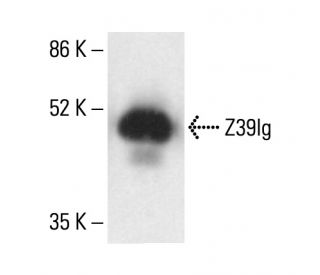
Z39Ig Antibody (6H8): sc-53977. Western blot analysis of Z39Ig expression in HEK293T whole cell lysate. Detection reagent used: m-IgG Fc BP-HRP: sc-525409.
Not CRISPR data: the image illustrates antibody quality for visualizing CRISPR experiment results.
Not CRISPR data: the image illustrates antibody quality for visualizing CRISPR experiment results.
Z39Ig CRISPR Activation Plasmid (h): sc-404067-ACT
- Target species: human
- 20 µg of transfection-ready, purified plasmid DNA; Suitable for up to 20 transfections
- Z39Ig CRISPR Activation Plasmid (h) is a synergistic activation mediator (SAM) transcription activation system designed to specifically upregulate gene expression
- Z39Ig CRISPR Activation Plasmid (h) consists of three plasmids at a 1:1:1 mass ratio: a plasmid encoding the deactivated Cas9 (dCas9) nuclease (D10A and N863A) fused to the transactivation domain VP64, and a blasticidin resistance gene; a plasmid encoding the MS2-p65-HSF1 fusion protein, and a hygromycin resistance gene; a plasmid encoding a target-specific 20 nt guide RNA fused to two MS2 RNA aptamers, and a puromycin resistance gene
- The resulting SAM complex binds to a site-specific region approximately 200-250 nt upstream of the transcriptional start site and provides robust recruitment of transcription factors for highly efficient gene activation
- gRNAs encoded by Z39Ig CRISPR Activation Plasmid (h) and Z39Ig CRISPR Activation Plasmid (h2) target distinct regulatory regions upstream of the VSIG4 transcriptional start site. One or both designs may be available
- Following transfection, gene knockout efficiency can be assayed by WB, IF or IHC using antibody: Z39Ig Antibody (6H8): sc-53977

Ordering Information
| Product Name | Catalog # | UNIT | Price | Qty | FAVORITES | |
Z39Ig CRISPR Activation Plasmid (h) | sc-404067-ACT | 20 µg | $397.00 | |||
Z39Ig CRISPR Activation Plasmid (h2) | sc-404067-ACT-2 | 20 µg | $397.00 |