
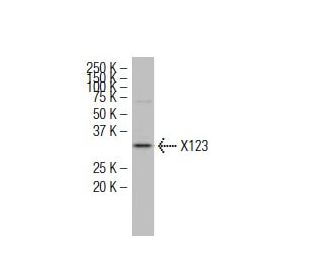

X123 Antibody (3C7): sc-100741
- X123 Antibody (3C7) is a mouse monoclonal IgG2a κ X123 antibody, cited in 1 publications, provided at 100 µg/ml
- raised against recombinant X123 of human origin
- recommended for detection of X123 of mouse, rat and human origin by WB, IP and ELISA
- At present, we have not yet completed the identification of the preferred secondary detection reagent(s) for X123 Antibody (3C7). This work is in progress.

QUICK LINKS
SEE ALSO...
X123 Antibody (3C7) is a mouse monoclonal IgG2a kappa light chain antibody that detects X123 protein of mouse, rat, and human origin by western blotting (WB), immunoprecipitation (IP), and enzyme-linked immunosorbent assay (ELISA). X123 (3C7) antibody is available as the non-conjugated form. X123, also known as C9orf61 (chromosome 9 open reading frame 61), plays a crucial role in cellular processes, particularly in Friedreich′s ataxia, a hereditary condition characterized by the degeneration of spinal cord and nerve tissue. This 289 amino acid protein is predominantly expressed in skeletal muscle, with lower expression levels found in the brain, heart, and lung, indicating significant involvement in muscle function and health. The gene encoding X123 is situated within the Friedreich′s ataxia region on chromosome 9, suggesting that alterations in X123 may contribute to the disease′s pathogenesis. Understanding X123 function and expression may provide insights into potential therapeutic targets for managing Friedreich′s ataxia and related disorders.
Alexa Fluor® is a trademark of Molecular Probes Inc., OR., USA
LI-COR® and Odyssey® are registered trademarks of LI-COR Biosciences
X123 Antibody (3C7) References:
- Partial duplication of the APBA2 gene in chromosome 15q13 corresponds to duplicon structures. | Sutcliffe, JS., et al. 2003. BMC Genomics. 4: 15. PMID: 12720574
- Targeting the gene in Friedreich ataxia. | Hebert, MD. 2008. Biochimie. 90: 1131-9. PMID: 18206656
- Characterization of a new type of variant of rat basophilic leukemia 2H3 cells presenting a different pattern of calcium signal. | Kato, K., et al. 1990. Exp Cell Res. 188: 247-53. PMID: 2159404
- Carbonic anhydrase 4 and crystallin α-B immunoreactivity may distinguish benign from malignant thyroid nodules in patients with indeterminate thyroid cytology. | Davidov, T., et al. 2014. J Surg Res. 190: 565-74. PMID: 24880201
- Three DUF1996 Proteins Localize in Vacuoles and Function in Fungal Responses to Multiple Stresses and Metal Ions. | Tong, SM., et al. 2016. Sci Rep. 6: 20566. PMID: 26839279
- Colossal Stability of Gas-Phase Trianions: Super-Pnictogens. | Zhao, T., et al. 2017. Angew Chem Int Ed Engl. 56: 13421-13425. PMID: 28726300
- Investigating neutron activated contrast agent imaging for tumor localization in proton therapy: a feasibility study for proton neutron gamma-x detection (PNGXD). | Van Delinder, KW., et al. 2020. Phys Med Biol. 65: 035005. PMID: 31851952
- Poly(8-aminoguanylic acid): formation of ordered self-structures and interaction with poly(cytidylic acid). | Hattori, M., et al. 1975. Biochemistry. 14: 5033-45. PMID: 37
- The murine IL 2 receptor. I. Monoclonal antibodies that define distinct functional epitopes on activated T cells and react with activated B cells. | Ortega, G., et al. 1984. J Immunol. 133: 1970-5. PMID: 6206144
- The Friedreich ataxia region: characterization of two novel genes and reduction of the critical region to 300 kb. | Duclos, F., et al. 1994. Hum Mol Genet. 3: 909-14. PMID: 7951235
- Clinical and genetic abnormalities in patients with Friedreich's ataxia. | Dürr, A., et al. 1996. N Engl J Med. 335: 1169-75. PMID: 8815938
- Friedreich's ataxia protein: phylogenetic evidence for mitochondrial dysfunction. | Gibson, TJ., et al. 1996. Trends Neurosci. 19: 465-8. PMID: 8931268
Ordering Information
| Product Name | Catalog # | UNIT | Price | Qty | FAVORITES | |
X123 Antibody (3C7) | sc-100741 | 100 µg/ml | $339.00 |