
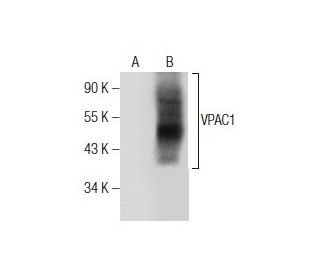

VPAC1 (h): 293T Lysate: sc-116969
- human VPAC1 transfected 293T lysate
- 100 µg protein in 200 µl SDS-PAGE buffer; suitable as Western Blotting control for VPAC1 antibodies
- Suitable control antibody: VPAC1 Antibody (B-4): sc-377152 is recommended as control antibody for monitoring of VPAC1 expression knockdown by Western blotting or immunofluorescence
- should be stored at -20° C and repeated freezing and thawing should be minimized
- sample vial should be boiled once prior to use
- non-transfected control 293T lysate (sc-117752)

QUICK LINKS
VPAC1 (h): 293T Lysate is derived from the human embryonic kidney 293T cell line, genetically engineered to express the human Vasoactive Intestinal Peptide Receptor 1 (VPAC1). VPAC1 is a G protein-coupled receptor (GPCR) that binds to vasoactive intestinal peptide (VIP) and pituitary adenylate cyclase-activating polypeptide (PACAP), playing a critical role in regulating various physiological processes such as smooth muscle relaxation, secretion of water and electrolytes, and modulation of immune responses. The 293T cell line is ideal for producing VPAC1 lysates due to its high transfection efficiency and robust protein expression capabilities. In research, VPAC1 (h): 293T Lysate is utilized to study the molecular mechanisms of GPCR signaling pathways. Upon binding of its ligands, VPAC1 activates adenylate cyclase through Gs proteins, leading to increased cyclic AMP (cAMP) levels and subsequent activation of protein kinase A (PKA). This signaling cascade results in the modulation of downstream effectors involved in diverse cellular responses. Researchers employ this lysate in biochemical assays such as Western blotting, immunoprecipitation, and cAMP assays to analyze VPAC1 expression, ligand binding, and downstream signaling events. Additionally, VPAC1 (h): 293T Lysate is valuable in functional studies to investigate the receptor's role in cellular communication and its regulatory effects on various physiological processes.
Ordering Information
| Product Name | Catalog # | UNIT | Price | Qty | FAVORITES | |
VPAC1 (h): 293T Lysate | sc-116969 | 100 µg/200 µl | $236.00 |