
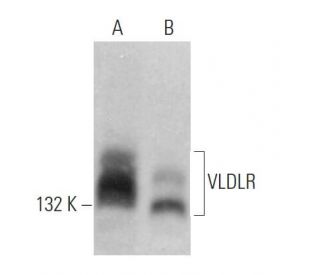
VLDLR Antibody (6A6): sc-18824
- VLDLR Antibody (6A6) is a mouse monoclonal IgG1 λ VLDLR antibody, cited in 50 publications, provided at 200 µg/ml
- raised against a C-terminus 10 amino acid peptide corresponding to VLDL receptor of rat origin
- VLDLR Antibody (6A6) is recommended for detection of VLDLR of mouse, rat and human origin by WB, IP, IF and IHC(P)
- Anti-VLDLR Antibody (6A6) is available conjugated to agarose for IP; HRP for WB, IHC(P) and ELISA; and to either phycoerythrin or FITC for IF, IHC(P) and FCM
- also available conjugated to Alexa Fluor® 488, Alexa Fluor® 546, Alexa Fluor® 594 or Alexa Fluor® 647 for WB (RGB), IF, IHC(P) and FCM, and for use with RGB fluorescent imaging systems, such as iBright™ FL1000, FluorChem™, Typhoon, Azure and other comparable systems
- also available conjugated to Alexa Fluor® 680 or Alexa Fluor® 790 for WB (NIR), IF and FCM; for use with Near-Infrared (NIR) detection systems, such as LI-COR®Odyssey®, iBright™ FL1000, FluorChem™, Typhoon, Azure and other comparable systems
- m-IgGλ BP-HRP (mouse IgGλ binding protein-HRP) is the preferred secondary detection reagent for VLDLR Antibody (6A6) for WB and IHC(P) applications. This reagent is now offered in a bundle with VLDLR Antibody (6A6) (see ordering information below). For additional m-IgGλ BP conjugates see our complete list of Mouse IgG Binding Proteins.

QUICK LINKS
SEE ALSO...
VLDLR Antibody (6A6) is a mouse monoclonal IgG1 antibody that detects the VLDLR protein of mouse, rat, and human origin by western blotting (WB), immunoprecipitation (IP), immunofluorescence (IF), and immunohistochemistry. VLDLR monoclonal antibody (6A6) is available in both non-conjugated and various conjugated forms, including agarose, horseradish peroxidase (HRP), phycoerythrin (PE), fluorescein isothiocyanate (FITC), and multiple Alexa Fluor® conjugates. The VLDLR protein, or very low density lipoprotein receptor, is a crucial member of the LDL receptor gene family, which plays a significant role in lipid metabolism and neuronal development. VLDLR is primarily located in the brain, heart, skeletal muscle, and adipose tissue, where VLDLR is involved in mediating the interaction between extracellular Reelin and cytosolic mDab1 (mammalian disabled protein). This interaction is essential for activating a tyrosine kinase pathway that regulates the migration of neurons along the radial glial fiber network during brain development, highlighting VLDLR′s importance in both neurodevelopmental processes and lipid homeostasis. Additionally, VLDLR associates with receptor-associated protein (RAP) during folding, which is critical for the proper secretion of VLDLR′s extracellular region, further emphasizing VLDLR′s functional significance in cellular processes.
Alexa Fluor® is a trademark of Molecular Probes Inc., OR., USA
LI-COR® and Odyssey® are registered trademarks of LI-COR Biosciences
VLDLR Antibody (6A6) References:
- Reeler/Disabled-like disruption of neuronal migration in knockout mice lacking the VLDL receptor and ApoE receptor 2. | Trommsdorff, M., et al. 1999. Cell. 97: 689-701. PMID: 10380922
- 39-kDa receptor-associated protein (RAP) facilitates secretion and ligand binding of extracellular region of very-low-density-lipoprotein receptor: implications for a distinct pathway from low-density-lipoprotein receptor. | Sato, A., et al. 1999. Biochem J. 341 (Pt 2): 377-83. PMID: 10393096
- The carboxyl-terminal domain of receptor-associated protein facilitates proper folding and trafficking of the very low density lipoprotein receptor by interaction with the three amino-terminal ligand-binding repeats of the receptor. | Savonen, R., et al. 1999. J Biol Chem. 274: 25877-82. PMID: 10464330
- Mouse very low-density lipoprotein receptor (VLDLR): gene structure, tissue-specific expression and dietary and developmental regulation. | Tiebel, O., et al. 1999. Atherosclerosis. 145: 239-51. PMID: 10488949
- Functional domains of the very low density lipoprotein receptor: molecular analysis of ligand binding and acid-dependent ligand dissociation mechanisms. | Mikhailenko, I., et al. 1999. J Cell Sci. 112 (Pt 19): 3269-81. PMID: 10504332
- Reelin is a ligand for lipoprotein receptors. | D'Arcangelo, G., et al. 1999. Neuron. 24: 471-9. PMID: 10571240
- Direct binding of Reelin to VLDL receptor and ApoE receptor 2 induces tyrosine phosphorylation of disabled-1 and modulates tau phosphorylation. | Hiesberger, T., et al. 1999. Neuron. 24: 481-9. PMID: 10571241
- Very low density lipoprotein receptor regulates dendritic spine formation in a RasGRF1/CaMKII dependent manner. | DiBattista, AM., et al. 2015. Biochim Biophys Acta. 1853: 904-17. PMID: 25644714
- Very Low Density Lipoprotein Receptor Sequesters Lipopolysaccharide Into Adipose Tissue During Sepsis. | Shimada, T., et al. 2020. Crit Care Med. 48: 41-48. PMID: 31651422
- Soluble very low-density lipoprotein receptor (sVLDLR) inhibits fibrosis in neovascular age-related macular degeneration. | Ma, X., et al. 2021. FASEB J. 35: e22058. PMID: 34820908
- Very-low-density lipoprotein receptor-enhanced lipid metabolism in pancreatic stellate cells promotes pancreatic fibrosis. | Yang, X., et al. 2022. Immunity. 55: 1185-1199.e8. PMID: 35738281
- Thrombospondin 1 and Reelin act through Vldlr to regulate cardiac growth and repair. | Pei, L., et al. 2024. Basic Res Cardiol. 119: 169-192. PMID: 38147128
Ordering Information
| Product Name | Catalog # | UNIT | Price | Qty | FAVORITES | |
VLDLR Antibody (6A6) | sc-18824 | 200 µg/ml | $322.00 | |||
VLDLR Antibody (6A6): m-IgGλ BP-HRP Bundle | sc-520686 | 200 µg Ab, 40 µg BP | $361.00 | |||
VLDLR Antibody (6A6) AC | sc-18824 AC | 500 µg/ml, 25% agarose | $424.00 | |||
VLDLR Antibody (6A6) HRP | sc-18824 HRP | 200 µg/ml | $322.00 | |||
VLDLR Antibody (6A6) FITC | sc-18824 FITC | 200 µg/ml | $336.00 | |||
VLDLR Antibody (6A6) PE | sc-18824 PE | 200 µg/ml | $349.00 | |||
VLDLR Antibody (6A6) Alexa Fluor® 488 | sc-18824 AF488 | 200 µg/ml | $364.00 | |||
VLDLR Antibody (6A6) Alexa Fluor® 546 | sc-18824 AF546 | 200 µg/ml | $364.00 | |||
VLDLR Antibody (6A6) Alexa Fluor® 594 | sc-18824 AF594 | 200 µg/ml | $364.00 | |||
VLDLR Antibody (6A6) Alexa Fluor® 647 | sc-18824 AF647 | 200 µg/ml | $364.00 | |||
VLDLR Antibody (6A6) Alexa Fluor® 680 | sc-18824 AF680 | 200 µg/ml | $364.00 | |||
VLDLR Antibody (6A6) Alexa Fluor® 790 | sc-18824 AF790 | 200 µg/ml | $364.00 |