
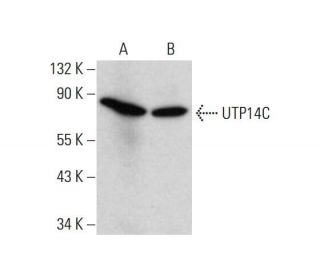


UTP14C Antibody (H-1): sc-365603
- UTP14C Antibody (H-1) is a mouse monoclonal IgM κ UTP14C antibody provided at 200 µg/ml
- specific for an epitope mapping between amino acids 679-711 within an internal region of UTP14C of human origin
- recommended for detection of UTP14C of human origin and UTP14A of mouse, rat and human origin by WB, IP, IF and ELISA
- m-IgGκ BP-HRP is the preferred secondary detection reagent for UTP14C Antibody (H-1) for WB applications. This reagent is now offered in a bundle with UTP14C Antibody (H-1) (see ordering information below). For additional m-IgGκ BP conjugates see our complete list of Mouse IgG Binding Proteins.

QUICK LINKS
SEE ALSO...
UTP14C Antibody (H-1) is a mouse monoclonal IgM antibody that detects UTP14C of mouse, rat, and human origin by western blotting (WB), immunoprecipitation (IP), immunofluorescence (IF), and enzyme-linked immunosorbent assay (ELISA). Anti-UTP14C antibody (H-1) is available as the non-conjugated form. UTP14C, also known as UTP14 or U3 small nucleolar ribonucleoprotein, is a 766 amino acid protein primarily localized in the nucleolus, where UTP14C plays a critical role in ribosome biogenesis. This nucleolar localization is essential as ribosomal RNA synthesis and assembly occur here, making UTP14C vital for ribosome production necessary for protein synthesis in all cells. During male meiosis, UTP14C is specifically required for proper sperm cell development, highlighting UTP14C′s importance in spermatogenesis. The UTP14C gene is located on human chromosome 13, a region containing over 400 genes, including those associated with significant health conditions. Understanding UTP14C′s function and localization not only reveals its role in reproductive biology but also emphasizes potential implications in various diseases, including infertility and certain genetic disorders.
Alexa Fluor® is a trademark of Molecular Probes Inc., OR., USA
LI-COR® and Odyssey® are registered trademarks of LI-COR Biosciences
UTP14C Antibody (H-1) References:
- An X-to-autosome retrogene is required for spermatogenesis in mice. | Bradley, J., et al. 2004. Nat Genet. 36: 872-6. PMID: 15258580
- The mouse juvenile spermatogonial depletion (jsd) phenotype is due to a mutation in the X-derived retrogene, mUtp14b. | Rohozinski, J. and Bishop, CE. 2004. Proc Natl Acad Sci U S A. 101: 11695-700. PMID: 15289605
- UTP14c is a recently acquired retrogene associated with spermatogenesis and fertility in man. | Rohozinski, J., et al. 2006. Biol Reprod. 74: 644-51. PMID: 16354793
- Spermatogonial differentiation in juvenile spermatogonial depletion (jsd) mice with androgen receptor or follicle-stimulating hormone mutations. | Shetty, G., et al. 2006. Endocrinology. 147: 3563-70. PMID: 16627582
- Utp14b: a unique retrogene within a gene that has acquired multiple promoters and a specific function in spermatogenesis. | Zhao, M., et al. 2007. Dev Biol. 304: 848-59. PMID: 17291484
- Spermatogenesis associated retrogenes are expressed in the human ovary and ovarian cancers. | Rohozinski, J., et al. 2009. PLoS One. 4: e5064. PMID: 19333399
Ordering Information
| Product Name | Catalog # | UNIT | Price | Qty | FAVORITES | |
UTP14C Antibody (H-1) | sc-365603 | 200 µg/ml | $322.00 | |||
UTP14C Antibody (H-1): m-IgGκ BP-HRP Bundle | sc-522286 | 200 µg Ab, 40 µg BP | $361.00 | |||
UTP14C (H-1) Neutralizing Peptide | sc-365603 P | 100 µg/0.5 ml | $69.00 |