
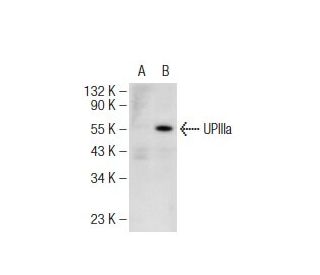


UPIIIa (h): 293T Lysate: sc-158053
- human UPIIIa transfected 293T lysate
- 100 µg protein in 200 µl SDS-PAGE buffer; suitable as Western Blotting control for UPIIIa antibodies
- Suitable control antibody: UPIIIa Antibody (F-11): sc-166598 is recommended as control antibody for monitoring of UPIIIa expression knockdown by Western blotting or immunofluorescence
- should be stored at -20° C and repeated freezing and thawing should be minimized
- sample vial should be boiled once prior to use
- non-transfected control 293T lysate (sc-117752)

QUICK LINKS
UPIIIa (h): 293T Lysate is derived from the human embryonic kidney 293T cell line, which has been genetically engineered to express human Uroplakin IIIa (UPIIIa). UPIIIa is a crucial component of the uroplakin complex, which forms the asymmetric unit membrane in urothelial cells, playing a significant role in the permeability barrier function of the urinary bladder. The 293T cell line is chosen for its high transfection efficiency and robust protein expression, making it an ideal system for producing UPIIIa lysates. In research, UPIIIa (h): 293T Lysate is used to study the molecular mechanisms underlying urothelial differentiation and barrier function. UPIIIa, along with other uroplakins, is involved in forming urothelial plaques that strengthen the apical surface of urothelial cells, contributing to the barrier against urine and pathogens. Researchers employ this lysate in various biochemical assays, such as Western blotting and immunoprecipitation, to analyze UPIIIa expression, post-translational modifications, and interactions with other uroplakins. Additionally, UPIIIa (h): 293T Lysate is utilized in functional studies to investigate the assembly and trafficking of the uroplakin complex and its role in urothelial biology. This lysate is also valuable in examining the signaling pathways that regulate uroplakin expression and assembly, providing insights into the molecular mechanisms of urothelial differentiation and barrier maintenance. Through these studies, researchers gain a deeper understanding of the structural and functional aspects of urothelial cells, advancing knowledge in cell biology and tissue engineering.
Ordering Information
| Product Name | Catalog # | UNIT | Price | Qty | FAVORITES | |
UPIIIa (h): 293T Lysate | sc-158053 | 100 µg/200 µl | $236.00 |