
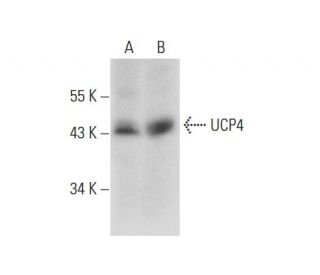


UCP4 Antibody (A-5): sc-365295
- UCP4 Antibody (A-5) is a mouse monoclonal IgM κ UCP4 antibody, cited in 6 publications, provided at 200 µg/ml
- specific for an epitope mapping between amino acids 17-37 at the N-terminus of UCP4 of human origin
- recommended for detection of UCP4 of mouse, rat and human origin by WB, IP, IF, IHC(P) and ELISA
- At present, we have not yet completed the identification of the preferred secondary detection reagent(s) for UCP4 Antibody (A-5). This work is in progress.

QUICK LINKS
UCP4 Antibody (A-5) is a mouse monoclonal IgM antibody that detects UCP4 of mouse, rat, and human origin by western blotting (WB), immunoprecipitation (IP), immunofluorescence (IF), immunohistochemistry, and enzyme-linked immunosorbent assay (ELISA). Anti-UCP4 antibody (A-5) is available as the non-conjugated form. UCP4, also known as SLC25A27, is a member of the uncoupling protein family, which plays a crucial role in thermoregulation and energy metabolism. UCP4 is primarily located in the inner mitochondrial membrane, where UCP4 facilitates proton transport, dissipating the proton gradient and generating heat instead of ATP. This function is particularly important in thermogenic tissues, such as brown adipose tissue, where UCPs help regulate metabolic rate and energy expenditure. UCP4 is unique among its family members due to expression in both fetal and adult brain tissues, indicating potential involvement in brain thermoregulation and metabolic adaptation. UCP4 mRNA levels increase in response to acute cold exposure, suggesting a role in the brain′s response to environmental changes. UCP4 consists of 323 amino acids and features specific sequences in its alpha-helices that are critical for fatty acid anion binding and translocation, further underscoring importance in metabolic processes.
Alexa Fluor® is a trademark of Molecular Probes Inc., OR., USA
LI-COR® and Odyssey® are registered trademarks of LI-COR Biosciences
UCP4 Antibody (A-5) References:
- UCP4, a novel brain-specific mitochondrial protein that reduces membrane potential in mammalian cells. | Mao, W., et al. 1999. FEBS Lett. 443: 326-30. PMID: 10025957
- Uncoupling protein homologs: emerging views of physiological function. | Adams, SH. 2000. J Nutr. 130: 711-4. PMID: 10736318
- Specific sequence of motifs of mitochondrial uncoupling proteins. | Jezek, P. and Urbánková, E. 2000. IUBMB Life. 49: 63-70. PMID: 10772343
- Characterization of novel UCP5/BMCP1 isoforms and differential regulation of UCP4 and UCP5 expression through dietary or temperature manipulation. | Yu, XX., et al. 2000. FASEB J. 14: 1611-8. PMID: 10928996
- Mitochondrial uncoupling proteins and phylogenesis--UCP4 as the ancestral uncoupling protein. | Hanák, P. and Jezek, P. 2001. FEBS Lett. 495: 137-41. PMID: 11334880
- The role of uncoupling proteins in pathophysiological states. | Argilés, JM., et al. 2002. Biochem Biophys Res Commun. 293: 1145-52. PMID: 12054495
- Mitochondrial potassium channels and uncoupling proteins in synaptic plasticity and neuronal cell death. | Mattson, MP. and Liu, D. 2003. Biochem Biophys Res Commun. 304: 539-49. PMID: 12729589
- Evolution of mitochondrial uncoupling proteins: novel invertebrate UCP homologues suggest early evolutionary divergence of the UCP family. | Sokolova, IM. and Sokolov, EP. 2005. FEBS Lett. 579: 313-7. PMID: 15642337
- Transcriptional regulation of UCP4 by NF-kappaB and its role in mediating protection against MPP+ toxicity. | Ho, JW., et al. 2010. Free Radic Biol Med. 49: 192-204. PMID: 20385226
- UCP4 overexpression improves fatty acid oxidation and insulin sensitivity in L6 myocytes. | Gao, CL., et al. 2011. J Bioenerg Biomembr. 43: 109-18. PMID: 21607879
- Uncoupling protein-4 (UCP4) increases ATP supply by interacting with mitochondrial Complex II in neuroblastoma cells. | Ho, PW., et al. 2012. PLoS One. 7: e32810. PMID: 22427795
- Ucp4 Knockdown of Cerebellar Purkinje Cells Induces Bradykinesia. | Wang, YY., et al. 2024. Mol Neurobiol. 61: 1119-1139. PMID: 37688710
Ordering Information
| Product Name | Catalog # | UNIT | Price | Qty | FAVORITES | |
UCP4 Antibody (A-5) | sc-365295 | 200 µg/ml | $322.00 | |||
UCP4 (A-5) Neutralizing Peptide | sc-365295 P | 100 µg/0.5 ml | $69.00 |