
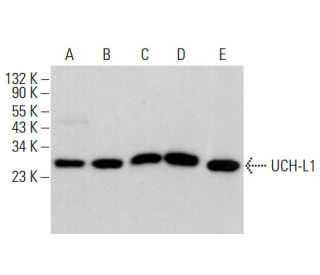
Anticorpo UCH-L1 (13C4): sc-58594
- UCH-L1 Antibody 13C4 è un monoclonale di topo IgG2a κ, citato in 3 pubblicazioni, fornito in 200 µg/ml
- sensibilizzato contro la proteina nativa UCH-L1 di origine human
- raccomandato per il rilevamento di UCH-L1 on neuronal cell bodies and axons in the CNS and periphery, small nerve fibers in peripheral tissues, neuroendocrine cells in the pituitary, thyroid, pancreas and tumors of the DNES di origine mouse, rat e human in WB, IP, IF e IHC(P); raccomandato anche per il rilevamento di UCH-L1 in human adult gut
- m-IgGκ BP-HRP è il reagente secondario di rilevazione preferito per l'anticorpo UCH-L1 (13C4) per applicazioni WB e IHC(P). Questo reagente è ora offerto in combinazione con l'anticorpo UCH-L1 (13C4)(vedere le informazioni per l'ordine sotto). Per ulteriori coniugati m-IgGκ BP, consultare l'elenco completo delle proteine leganti le IgG di topo.

UCH-L1 (ubiquitina idrolasi C-terminale) è un membro di una famiglia di geni i cui prodotti idrolizzano piccoli addotti C-terminali dell'ubiquitina per generare il monomero ubiquitina. L'espressione di UCH-L1 è altamente specifica per i neuroni e per le cellule del sistema neuroendocrino diffuso e dei loro tumori. UCH-L1 è espresso nei neuroni del cervello. L'esame di regioni cerebrali specifiche rivela l'espressione in tutte le aree analizzate, in particolare nella substantia nigra. UCH-L1 rappresenta l'1-2% delle proteine cerebrali solubili totali. La sua presenza nei corpi di Lewy e la sua funzione nella via del proteasoma lo rendono un gene candidato interessante nella malattia di Parkinson. Il gene che codifica UCH-L1 mappa sul cromosoma umano 4p13. La proteina umana UCH-L3, di 230 aminoacidi, è identica al 54% a quella di UCH-L1. UCH-L3 è la proteasi tiolica predominante e possiede siti di legame ad alta affinità per l'ubiquitina.
Alexa Fluor® è un marchio registrato di Molecular Probes Inc., OR., USA
LI-COR® e Odyssey® sono marchi registrati di LI-COR Biosciences
Anticorpo UCH-L1 (13C4) Riferimenti:
- Le funzioni di UCH-L1 e la sua relazione con le malattie neurodegenerative. | Setsuie, R. and Wada, K. 2007. Neurochem Int. 51: 105-11. PMID: 17586089
- Mutazioni familiari e modifiche post-traduzionali di UCH-L1 nella malattia di Parkinson e nei disturbi neurodegenerativi. | Lee, YC. and Hsu, SD. 2017. Curr Protein Pept Sci. 18: 733-745. PMID: 26899237
- Corso temporale e accuratezza diagnostica dei biomarcatori ematici gliali e neuronali GFAP e UCH-L1 in un'ampia coorte di pazienti traumatizzati con e senza lesione cerebrale traumatica lieve. | Papa, L., et al. 2016. JAMA Neurol. 73: 551-60. PMID: 27018834
- L'ubiquitina C-terminale idrolasi-L1 (UCH-L1) come bersaglio terapeutico e diagnostico nella neurodegenerazione, nei neurotraumi e nelle neurolesioni. | Wang, KK., et al. 2017. Expert Opin Ther Targets. 21: 627-638. PMID: 28434268
- Ubiquitina C-Terminale Idrolasi-L1 (UCH-L1) nella previsione dei risultati della tomografia computerizzata nella lesione cerebrale traumatica; una meta-analisi. | Ramezani, F., et al. 2018. Emerg (Tehran). 6: e62. PMID: 30788389
- S100B, GFAP, UCH-L1 e NSE come predittori di anomalie sulla tomografia computerizzata dopo una lesione cerebrale traumatica lieve: una revisione sistematica e una meta-analisi dell'accuratezza dei test diagnostici. | Amoo, M., et al. 2022. Neurosurg Rev. 45: 1171-1193. PMID: 34709508
- UCH-L1 e UCH-L3 regolano le proprietà simili alle cellule staminali del cancro attraverso la via di segnalazione PI3 K/Akt nelle cellule del cancro alla prostata. | Lee, JE., et al. 2021. Anim Cells Syst (Seoul). 25: 312-322. PMID: 34745437
- Valore prognostico delle concentrazioni plasmatiche di GFAP e UCH-L1 del giorno della lesione per prevedere il recupero funzionale dopo una lesione cerebrale traumatica nei pazienti della coorte statunitense TRACK-TBI: uno studio di coorte osservazionale. | Korley, FK., et al. 2022. Lancet Neurol. 21: 803-813. PMID: 35963263
- UCH-L1 disfunzionale inibisce la proteostasi. | Wang, M. 2023. Nat Rev Nephrol. 19: 424. PMID: 37258710
- La proteomica di prossimità rivela UCH-L1 come regolatore essenziale della produzione di IL-1&beta mediata da NLRP3; nei macrofagi e nelle microglia umane. | Liang, Z., et al. 2024. Cell Rep. 43: 114152. PMID: 38669140
Informazioni ordini
| Nome del prodotto | Codice del prodotto | UNITÀ | Prezzo | Quantità | Preferiti | |
UCH-L1 Anticorpo (13C4) | sc-58594 | 200 µg/ml | $322.00 | |||
UCH-L1 (13C4): m-IgGκ BP-HRP Bundle | sc-521055 | 200 µg Ab, 40 µg BP | $361.00 |