
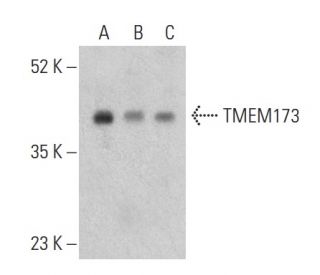
TMEM173 Antibody (C-10): sc-518172
- TMEM173 Antibody (C-10) is a mouse monoclonal IgG1 κ, cited in 1 publications, provided at 200 µg/ml
- specific for an epitope mapping between amino acids 360-378 of TMEM173 of mouse origin
- recommended for detection of TMEM173 of mouse, rat and human origin by WB, IP, IF and ELISA
- Anti-TMEM173 Antibody (C-10) is available conjugated to agarose for IP; HRP for WB, IHC(P) and ELISA; and to either phycoerythrin or FITC for IF, IHC(P) and FCM
- also available conjugated to Alexa Fluor® 488, Alexa Fluor® 546, Alexa Fluor® 594 or Alexa Fluor® 647 for WB (RGB), IF, IHC(P) and FCM, and for use with RGB fluorescent imaging systems, such as iBright™ FL1000, FluorChem™, Typhoon, Azure and other comparable systems
- also available conjugated to Alexa Fluor® 680 or Alexa Fluor® 790 for WB (NIR), IF and FCM; for use with Near-Infrared (NIR) detection systems, such as LI-COR®Odyssey®, iBright™ FL1000, FluorChem™, Typhoon, Azure and other comparable systems
- m-IgG1 BP-HRP and m-IgGκ BP-HRP are the preferred secondary detection reagents for TMEM173 Antibody (C-10) for WB applications. These reagents are now offered in bundles with TMEM173 Antibody (C-10) (see ordering information below).

QUICK LINKS
SEE ALSO...
TMEM173 Antibody (C-10) is a mouse monoclonal IgG1 kappa light chain antibody that detects TMEM173 in mouse, rat, and human samples through applications such as western blotting (WB), immunoprecipitation (IP), immunofluorescence (IF), and enzyme-linked immunosorbent assay (ELISA). Anti-TMEM173 antibody (C-10) is available in both non-conjugated and various conjugated forms, including agarose, horseradish peroxidase (HRP), phycoerythrin (PE), fluorescein isothiocyanate (FITC), and multiple Alexa Fluor® conjugates. TMEM173, also known as transmembrane protein 173, plays a crucial role in the immune response by acting as a sensor for cytosolic DNA, which is vital for the detection of viral infections and the activation of innate immune pathways. This function is particularly important as TMEM173 helps to initiate the production of type I interferons, which are essential for antiviral defense and modulating the adaptive immune response. TMEM173 is located in the endoplasmic reticulum and the cytoplasm, where TMEM173 interacts with various signaling pathways to regulate immune responses. Understanding TMEM173′s role in immune signaling can provide insights into therapeutic strategies for autoimmune diseases and cancer, making TMEM173 a significant target for research and clinical applications.
Alexa Fluor® is a trademark of Molecular Probes Inc., OR., USA
LI-COR® and Odyssey® are registered trademarks of LI-COR Biosciences
TMEM173 Antibody (C-10) References:
- Duodenal adenomatosis in familial adenomatous polyposis coli. A review of the literature and results from the Heidelberg Polyposis Register. | Kadmon, M., et al. 2001. Int J Colorectal Dis. 16: 63-75. PMID: 11355321
- The gene for Treacher Collins syndrome maps to the long arm of chromosome 5. | Dixon, MJ., et al. 1991. Am J Hum Genet. 49: 17-22. PMID: 1676560
- Cockayne syndrome exhibits dysregulation of p21 and other gene products that may be independent of transcription-coupled repair. | Cleaver, JE., et al. 2007. Neuroscience. 145: 1300-8. PMID: 17055654
- A new genomic mechanism leading to cri-du-chat syndrome. | South, ST., et al. 2006. Am J Med Genet A. 140: 2714-20. PMID: 17103439
- Redefining monosomy 5 by molecular cytogenetics in 23 patients with MDS/AML. | Herry, A., et al. 2007. Eur J Haematol. 78: 457-67. PMID: 17391336
- Somatic APC mosaicism: a frequent cause of familial adenomatous polyposis (FAP). | Aretz, S., et al. 2007. Hum Mutat. 28: 985-92. PMID: 17486639
- Telomerase reverse transcriptase haploinsufficiency and telomere length in individuals with 5p- syndrome. | Du, HY., et al. 2007. Aging Cell. 6: 689-97. PMID: 17875000
- Molecular mechanisms of skin aging: state of the art. | Makrantonaki, E. and Zouboulis, CC. 2007. Ann N Y Acad Sci. 1119: 40-50. PMID: 18056953
- Expression of STING Is Increased in Liver Tissues From Patients With NAFLD and Promotes Macrophage-Mediated Hepatic Inflammation and Fibrosis in Mice. | Luo, X., et al. 2018. Gastroenterology. 155: 1971-1984.e4. PMID: 30213555
- Ferroptotic damage promotes pancreatic tumorigenesis through a TMEM173/STING-dependent DNA sensor pathway. | Dai, E., et al. 2020. Nat Commun. 11: 6339. PMID: 33311482
- The STING1 network regulates autophagy and cell death. | Zhang, R., et al. 2021. Signal Transduct Target Ther. 6: 208. PMID: 34078874
- A physical map of 15 loci on human chromosome 5q23-q33 by two-color fluorescence in situ hybridization. | Saltman, DL., et al. 1993. Genomics. 16: 726-32. PMID: 8325647
Ordering Information
| Product Name | Catalog # | UNIT | Price | Qty | FAVORITES | |
TMEM173 Antibody (C-10) | sc-518172 | 200 µg/ml | $322.00 | |||
TMEM173 Antibody (C-10): m-IgGκ BP-HRP Bundle | sc-550694 | 200 µg Ab; 40 µg BP | $361.00 | |||
TMEM173 Antibody (C-10): m-IgG1 BP-HRP Bundle | sc-550695 | 200 µg Ab; 20 µg BP | $361.00 | |||
TMEM173 Antibody (C-10) AC | sc-518172 AC | 500 µg/ml, 25% agarose | $424.00 | |||
TMEM173 Antibody (C-10) HRP | sc-518172 HRP | 200 µg/ml | $322.00 | |||
TMEM173 Antibody (C-10) FITC | sc-518172 FITC | 200 µg/ml | $336.00 | |||
TMEM173 Antibody (C-10) PE | sc-518172 PE | 200 µg/ml | $349.00 | |||
TMEM173 Antibody (C-10) Alexa Fluor® 488 | sc-518172 AF488 | 200 µg/ml | $364.00 | |||
TMEM173 Antibody (C-10) Alexa Fluor® 546 | sc-518172 AF546 | 200 µg/ml | $364.00 | |||
TMEM173 Antibody (C-10) Alexa Fluor® 594 | sc-518172 AF594 | 200 µg/ml | $364.00 | |||
TMEM173 Antibody (C-10) Alexa Fluor® 647 | sc-518172 AF647 | 200 µg/ml | $364.00 | |||
TMEM173 Antibody (C-10) Alexa Fluor® 680 | sc-518172 AF680 | 200 µg/ml | $364.00 | |||
TMEM173 Antibody (C-10) Alexa Fluor® 790 | sc-518172 AF790 | 200 µg/ml | $364.00 |