
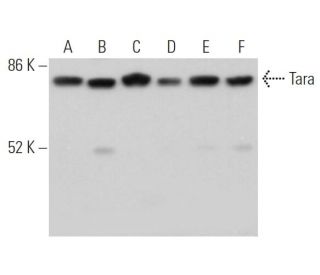
Tara Antibody (G-9): sc-377474
- Tara Antibody (G-9) is a mouse monoclonal IgG3 κ Tara antibody, cited in 1 publications, provided at 200 µg/ml
- raised against amino acids 2214-2283 mapping near the C-terminus of Tara of human origin
- recommended for detection of Tara of mouse, rat and human origin by WB, IP, IF, IHC(P) and ELISA
- m-IgGκ BP-HRP is the preferred secondary detection reagent for Tara Antibody (G-9) for WB and IHC(P) applications. This reagent is now offered in a bundle with Tara Antibody (G-9) (see ordering information below). For additional m-IgGκ BP conjugates see our complete list of Mouse IgG Binding Proteins.

QUICK LINKS
SEE ALSO...
Tara Antibody (G-9) is a mouse monoclonal IgG3 kappa light chain antibody that detects Tara protein of mouse, rat, and human origin by western blotting (WB), immunoprecipitation (IP), immunofluorescence (IF), immunohistochemistry with paraffin-embedded sections (IHCP), and enzyme-linked immunosorbent assay (ELISA). Tara (G-9) antibody is available as the non-conjugated form. Tara protein, also known as TRIOBP (trio and F-actin-binding protein) or DFNB28, is a crucial component in neural tissue development and actin cytoskeleton organization, with highest expression levels in heart and placenta. Tara primarily localizes in nucleus and cytoplasm, playing a significant role in stabilizing F-actin structures and influencing cell growth and motility. Tara features a pleckstrin homology domain at N-terminus and a coiled-coil region at C-terminus, essential for interactions with Trio, TRF1, and F-actin. These interactions maintain cytoskeleton integrity and facilitate cellular processes. Mutations in Tara can lead to autosomal recessive nonsyndromic sensorineural deafness type 28 (DFNB28), highlighting Tara′s importance in auditory function. Five isoforms of Tara exist due to alternative splicing, with isoform 3, known as the long isoform, being exclusively expressed in fetal retina, cochlea, and brain, further underscoring Tara′s diverse roles in development and cellular dynamics.
Alexa Fluor® is a trademark of Molecular Probes Inc., OR., USA
LI-COR® and Odyssey® are registered trademarks of LI-COR Biosciences
Tara Antibody (G-9) References:
- Tara, a novel F-actin binding protein, associates with the Trio guanine nucleotide exchange factor and regulates actin cytoskeletal organization. | Seipel, K., et al. 2001. J Cell Sci. 114: 389-99. PMID: 11148140
- Identification of novel transcribed sequences on human chromosome 22 by expressed sequence tag mapping. | Hirosawa, M., et al. 2001. DNA Res. 8: 1-9. PMID: 11258795
- [Isolation of Tara protein and its gene cloning]. | Lan, JP., et al. 2004. Zhejiang Da Xue Xue Bao Yi Xue Ban. 33: 486-90. PMID: 15586403
- Mutations in TRIOBP, which encodes a putative cytoskeletal-organizing protein, are associated with nonsyndromic recessive deafness. | Riazuddin, S., et al. 2006. Am J Hum Genet. 78: 137-43. PMID: 16385457
- Mutations in a novel isoform of TRIOBP that encodes a filamentous-actin binding protein are responsible for DFNB28 recessive nonsyndromic hearing loss. | Shahin, H., et al. 2006. Am J Hum Genet. 78: 144-52. PMID: 16385458
- Identification of HLA-A24 restricted shared antigen recognized by autologous cytotoxic T lymphocytes from a patient with large cell carcinoma of the lung. | Sugaya, M., et al. 2007. Int J Cancer. 120: 1055-62. PMID: 17131342
- Expression, purification, and characterization of Tara, a novel telomere repeat-binding factor 1 (TRF1)-binding protein. | Li, X., et al. 2007. Protein Expr Purif. 55: 84-92. PMID: 17629495
Ordering Information
| Product Name | Catalog # | UNIT | Price | Qty | FAVORITES | |
Tara Antibody (G-9) | sc-377474 | 200 µg/ml | $322.00 | |||
Tara Antibody (G-9): m-IgGκ BP-HRP Bundle | sc-552158 | 200 µg Ab; 40 µg BP | $361.00 |