
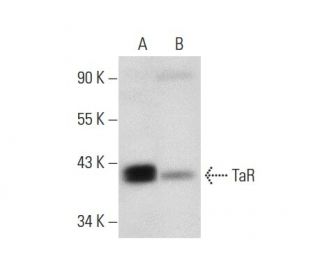


TaR Antibody (D-7): sc-398096
- TaR Antibody (D-7) is a mouse monoclonal IgG3 κ TaR antibody, cited in 1 publications, provided at 200 µg/ml
- raised against amino acids 181-247 mapping near the C-terminus of TaR-1 of mouse origin
- recommended for detection of TaR-1 of mouse and rat origin by WB, IP, IF and ELISA
- m-IgGκ BP-HRP is the preferred secondary detection reagent for TaR Antibody (D-7) for WB applications. This reagent is now offered in a bundle with TaR Antibody (D-7) (see ordering information below). For additional m-IgGκ BP conjugates see our complete list of Mouse IgG Binding Proteins.

QUICK LINKS
SEE ALSO...
TaR Antibody (D-7) is a mouse monoclonal IgG3 kappa light chain antibody that detects TaR protein of mouse and rat origin by western blotting (WB), immunoprecipitation (IP), immunofluorescence (IF), and enzyme-linked immunosorbent assay (ELISA). Anti-TaR antibody (D-7) is available as the non-conjugated form. TaR protein, part of the trace-amine-associated receptor family, plays a crucial role in the detection of social cues and is implicated in various neuropsychiatric conditions. These receptors are activated by trace amines, which are endogenous molecules structurally related to classical biogenic amines and are found in low levels in mammalian tissues. The unique structure of TaRs, which includes seven transmembrane regions similar to those found in the rhodopsin β-adrenergic receptor superfamily, allows for specific ligand-binding interactions that are essential for their function. This structural similarity provides insights into the mechanisms of receptor activation and the potential for therapeutic targeting. TaRs are particularly important in the context of drug abuse and neuropsychiatric disorders, as they are potential targets for substances like amphetamine and MDMA, as well as conditions such as schizophrenia, depression, and attention deficit disorder. TaR (D-7) antibody′s ability to effectively detect TaR protein across various applications makes this reagent a valuable tool for researchers studying these critical pathways.
Alexa Fluor® is a trademark of Molecular Probes Inc., OR., USA
LI-COR® and Odyssey® are registered trademarks of LI-COR Biosciences
TaR Antibody (D-7) References:
- Elusive amines and cluster headache: mutational analysis of trace amine receptor cluster on chromosome 6q23. | Aridon, P., et al. 2004. Neurol Sci. 25 Suppl 3: S279-80. PMID: 15549560
- Trace amine-associated receptors form structurally and functionally distinct subfamilies of novel G protein-coupled receptors. | Lindemann, L., et al. 2005. Genomics. 85: 372-85. PMID: 15718104
- Primate trace amine receptor 1 modulation by the dopamine transporter. | Miller, GM., et al. 2005. J Pharmacol Exp Ther. 313: 983-94. PMID: 15764732
- A second class of chemosensory receptors in the olfactory epithelium. | Liberles, SD. and Buck, LB. 2006. Nature. 442: 645-50. PMID: 16878137
- Pharmacologic characterization of the cloned human trace amine-associated receptor1 (TAAR1) and evidence for species differences with the rat TAAR1. | Wainscott, DB., et al. 2007. J Pharmacol Exp Ther. 320: 475-85. PMID: 17038507
Ordering Information
| Product Name | Catalog # | UNIT | Price | Qty | FAVORITES | |
TaR Antibody (D-7) | sc-398096 | 200 µg/ml | $322.00 | |||
TaR Antibody (D-7): m-IgGκ BP-HRP Bundle | sc-524214 | 200 µg Ab, 40 µg BP | $361.00 |