
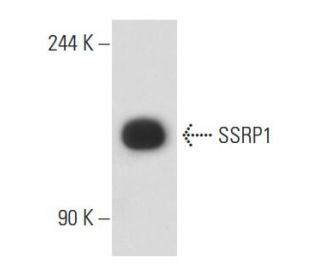


SSRP1 Antibody (10D7): sc-56781
- SSRP1 Antibody (10D7) is a mouse monoclonal IgG2b, cited in 1 publications, provided at 100 µg/ml
- raised against recombinant SSRP1 fragment of human origin
- recommended for detection of SSRP1 of human origin by WB and IP
- At present, we have not yet completed the identification of the preferred secondary detection reagent(s) for SSRP1 Antibody (10D7). This work is in progress.

QUICK LINKS
SEE ALSO...
SSRP1 Antibody (10D7) is a mouse monoclonal IgG2b antibody that detects SSRP1 in human samples through western blotting (WB) and immunoprecipitation (IP) applications. SSRP1 plays a crucial role in the regulation of gene expression by acting as a chromatin-specific elongation factor, essential for the transcription of chromatin templates. SSRP1 is part of the FACT complex, which is vital for the disassembly of nucleosomes during transcription, thereby facilitating the progression of RNA polymerase along the DNA. The interaction of SSRP1 with nucleosomes and histone H2A/H2B dimers is significant because it allows for the dynamic remodeling of chromatin, which is necessary for proper gene expression and cellular function. Additionally, SSRP1 interacts with serum response factors (SRF), serving as a positive co-regulatory protein that enhances SRF-dependent gene expression. Understanding SSRP1 function and interactions is important for elucidating the mechanisms of transcription regulation and the potential implications in various diseases where gene expression is disrupted.
Alexa Fluor® is a trademark of Molecular Probes Inc., OR., USA
LI-COR® and Odyssey® are registered trademarks of LI-COR Biosciences
SSRP1 Antibody (10D7) References:
- Crystal Structure of Human SSRP1 Middle Domain Reveals a Role in DNA Binding. | Zhang, W., et al. 2015. Sci Rep. 5: 18688. PMID: 26687053
- SSRP1 Contributes to the Malignancy of Hepatocellular Carcinoma and Is Negatively Regulated by miR-497. | Ding, Q., et al. 2016. Mol Ther. 24: 903-14. PMID: 26755331
- Structure-specific recognition protein-1 (SSRP1) is an elongated homodimer that binds histones. | Marcianò, G., et al. 2018. J Biol Chem. 293: 10071-10083. PMID: 29764934
- SSRP1-mediated histone H1 eviction promotes replication origin assembly and accelerated development. | Falbo, L., et al. 2020. Nat Commun. 11: 1345. PMID: 32165637
- SSRP1 Is a Prognostic Biomarker Correlated with CD8+ T Cell Infiltration in Hepatocellular Carcinoma (HCC). | Luo, G., et al. 2021. Biomed Res Int. 2021: 9409836. PMID: 33688504
- SSRP1 Worsens Malignant Melanoma Progression by Activating MAPKs Pathway. | Yu, Y., et al. 2021. Ann Clin Lab Sci. 51: 783-789. PMID: 34921031
- SSRP1 affects the growth and apoptosis of gastric cancer cells through AKT pathway. | Jin, G., et al. 2022. J Med Biochem. 41: 100-107. PMID: 35291495
- Exosomes loaded with circPARD3 promotes EBV-miR-BART4-induced stemness and cisplatin resistance in nasopharyngeal carcinoma side population cells through the miR-579-3p/SIRT1/SSRP1 axis. | Ai, J., et al. 2023. Cell Biol Toxicol. 39: 537-556. PMID: 35844005
- Histone chaperone SSRP1 is required for apoptosis inhibition and mitochondrial function in HCC via transcriptional promotion of TRAP1. | Chen, X., et al. 2023. Biochem Cell Biol. 101: 361-376. PMID: 37084412
- Pseudokinase TRIB3 stabilizes SSRP1 via USP10-mediated deubiquitination to promote multiple myeloma progression. | Wang, H., et al. 2024. Oncogene.. PMID: 39653795
Ordering Information
| Product Name | Catalog # | UNIT | Price | Qty | FAVORITES | |
SSRP1 Antibody (10D7) | sc-56781 | 100 µg/ml | $322.00 |