
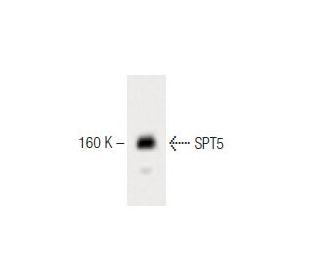


SPT5 Antibody (17): sc-136075
- SPT5 Antibody (17) is a mouse monoclonal IgG1, cited in 1 publications, provided at 50 µg/0.5 ml
- raised against amino acids 866-985 of SPT5 of human origin
- recommended for detection of SPT5 of mouse, rat, human and canine origin by WB, IP and IF
- At present, we have not yet completed the identification of the preferred secondary detection reagent(s) for SPT5 Antibody (17). This work is in progress.

SPT5 Antibody (17) is a mouse monoclonal IgG1 antibody that detects SPT5 in mouse, rat, human, and canine samples through applications such as western blotting (WB), immunoprecipitation (IP), and immunofluorescence (IF). SPT5, also known as DSIF p160, plays a crucial role in the regulation of transcriptional elongation, particularly in RNA polymerase II activity. SPT5 is essential for the formation of the DSIF (DRB-sensitivity-inducing factor) complex when binding to SPT4, which subsequently interacts with RNA polymerase II to modulate transcription elongation. Notably, SPT5 undergoes significant post-translational modifications, particularly phosphorylation, which affects mobility on SDS-PAGE; SPT5 from mitotic HeLa cells migrates more slowly than that from interphase cells due to enhanced phosphorylation. The C-terminal CTR1 domain of SPT5 is specifically targeted for phosphorylation by the P-TEFb complex, a modification that is vital for function as a transcriptional elongation regulator. SPT5′s ability to respond to such modifications underscores importance in the dynamic regulation of gene expression, making anti-SPT5 antibody (17) an invaluable tool for researchers studying transcriptional mechanisms and their implications in various biological processes.
Alexa Fluor® is a trademark of Molecular Probes Inc., OR., USA
LI-COR® and Odyssey® are registered trademarks of LI-COR Biosciences
SPT5 Antibody (17) References:
- Domains in the SPT5 protein that modulate its transcriptional regulatory properties. | Ivanov, D., et al. 2000. Mol Cell Biol. 20: 2970-83. PMID: 10757782
- The spt5 C-terminal region recruits yeast 3' RNA cleavage factor I. | Mayer, A., et al. 2012. Mol Cell Biol. 32: 1321-31. PMID: 22290438
- The DSIF subunits Spt4 and Spt5 have distinct roles at various phases of immunoglobulin class switch recombination. | Stanlie, A., et al. 2012. PLoS Genet. 8: e1002675. PMID: 22570620
- Structural basis for Spt5-mediated recruitment of the Paf1 complex to chromatin. | Wier, AD., et al. 2013. Proc Natl Acad Sci U S A. 110: 17290-5. PMID: 24101474
- Insights into how Spt5 functions in transcription elongation and repressing transcription coupled DNA repair. | Li, W., et al. 2014. Nucleic Acids Res. 42: 7069-83. PMID: 24813444
- The elongation factor Spt5 facilitates transcription initiation for rapid induction of inflammatory-response genes. | Diamant, G., et al. 2016. Nat Commun. 7: 11547. PMID: 27180651
- A meiosis-specific Spt5 homolog involved in non-coding transcription. | Gruchota, J., et al. 2017. Nucleic Acids Res. 45: 4722-4732. PMID: 28053118
- Peptidyl inhibition of Spt4-Spt5: Protein-protein inhibitors for targeting the transcriptional pathway related to C9orf72 expansion repeats. | Rayevsky, A., et al. 2020. J Cell Biochem. 121: 4922-4930. PMID: 32628322
- The transient Spt4-Spt5 complex as an upstream regulator of non-coding RNAs during development. | Owsian, D., et al. 2022. Nucleic Acids Res. 50: 2603-2620. PMID: 35188560
- Spt5 orchestrates cryptic transcript suppression and transcriptional directionality. | An, H., et al. 2024. Commun Biol. 7: 1370. PMID: 39438667
Ordering Information
| Product Name | Catalog # | UNIT | Price | Qty | FAVORITES | |
SPT5 Antibody (17) | sc-136075 | 50 µg/0.5 ml | $322.00 |