
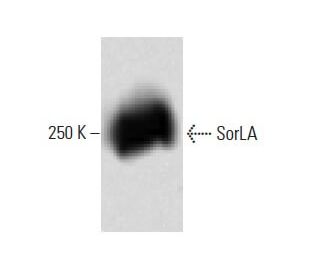

SorLA Antibody (48): sc-136073
- SorLA Antibody (48) is a mouse monoclonal IgG2a, cited in 1 publications, provided at 50 µg/0.5 ml
- raised against amino acids 1220-1337 of SorLA of human origin
- recommended for detection of SorLA of mouse, rat, human and Drosophila origin by WB and IP; not recommended for IF
- At present, we have not yet completed the identification of the preferred secondary detection reagent(s) for SorLA Antibody (48). This work is in progress.

QUICK LINKS
SEE ALSO...
SorLA Antibody (48) is a mouse monoclonal IgG2a antibody that detects SorLA in mouse, rat, and human samples through western blotting (WB) and immunoprecipitation (IP) applications. SorLA, also known as Sorting protein-related receptor containing LDLR class A, is a Type I membrane protein that plays a crucial role in cellular processes, particularly in the uptake of lipoproteins and proteases. This multifunctional endocytic receptor is essential for maintaining lipid homeostasis and facilitating cell-cell interactions, which are vital for various physiological functions. SorLA is synthesized as a proreceptor and undergoes processing by furin-like propeptidases to achieve its mature form, allowing SorLA to effectively bind low-density lipoprotein (LDL) and transport LDL into cells via endocytosis. Additionally, SorLA interacts with receptor-associated protein (RAP) and the neuropeptide head activator (HA), highlighting SorLA′s importance in neuropeptide signaling and function. While predominantly expressed in the brain, particularly in the cerebral cortex, cerebellum, and occipital pole, SorLA is also found in other tissues such as the liver, spinal cord, kidney, testis, and pancreas, underscoring SorLA′s diverse biological roles. anti-SorLA antibody (48) is an invaluable tool for researchers investigating the intricate mechanisms of lipid metabolism and neuropeptide signaling in various biological contexts.
Alexa Fluor® is a trademark of Molecular Probes Inc., OR., USA
LI-COR® and Odyssey® are registered trademarks of LI-COR Biosciences
SorLA Antibody (48) References:
- miR-142-3p down-regulation contributes to thyroid follicular tumorigenesis by targeting ASH1L and MLL1. | Colamaio, M., et al. 2015. J Clin Endocrinol Metab. 100: E59-69. PMID: 25238203
- Genetic alterations of histone lysine methyltransferases and their significance in breast cancer. | Liu, L., et al. 2015. Oncotarget. 6: 2466-82. PMID: 25537518
- ASH1L (a histone methyltransferase protein) is a novel candidate globin gene regulator revealed by genetic study of an English family with beta-thalassaemia unlinked to the beta-globin locus. | Breton, A., et al. 2016. Br J Haematol. 175: 525-530. PMID: 27434206
- Integrated Analysis of Genetic Abnormalities of the Histone Lysine Methyltransferases in Prostate Cancer. | Zhang, Y., et al. 2019. Med Sci Monit. 25: 193-239. PMID: 30616239
- Analysis of the role of mutations in the KMT2D histone lysine methyltransferase in bladder cancer. | Ding, B., et al. 2019. FEBS Open Bio. 9: 693-706. PMID: 30984543
- MRG Proteins Are Shared by Multiple Protein Complexes With Distinct Functions. | Devoucoux, M., et al. 2022. Mol Cell Proteomics. 21: 100253. PMID: 35636729
- A Computational Approach to Predict the Role of Genetic Alterations in Methyltransferase Histones Genes With Implications in Liver Cancer. | Aravena, TI., et al. 2023. Cancer Inform. 22: 11769351231161480. PMID: 37008071
- Novel NUP98::ASH1L Gene Fusion in Acute Myeloid Leukemia Detected by Optical Genome Mapping. | Tembrink, M., et al. 2023. Cancers (Basel). 15: PMID: 37296904
- Thioamides in medicinal chemistry and as small molecule therapeutic agents. | Huang, G., et al. 2024. Eur J Med Chem. 277: 116732. PMID: 39106658
- Loss-of-function mutations of microRNA-142-3p promote ASH1L expression to induce immune evasion and hepatocellular carcinoma progression. | Yu, XH., et al. 2025. World J Gastroenterol. 31: 101198. PMID: 39777247
Ordering Information
| Product Name | Catalog # | UNIT | Price | Qty | FAVORITES | |
SorLA Antibody (48) | sc-136073 | 50 µg/0.5 ml | $322.00 |