
Date published: 2026-2-15

1-800-457-3801

SCBT Portrait Logo
Seach Input

RGS9-1 Antibody (D7): sc-59677

4.0(1)
Write a reviewAsk a question

Datasheets
  • RGS9-1 Antibody (D7) is a mouse monoclonal IgG1 κ provided at 200 µg/ml
  • raised against full length RGS9-1 mouse origin
  • recommended for detection of RGS9-1 of mouse and rat origin by WB, IP, IF and ELISA; also reactive with additional species, including bovine
  • At present, we have not yet completed the identification of the preferred secondary detection reagent(s) for RGS9-1 Antibody (D7). This work is in progress.

    Crispr Promo Banner

    QUICK LINKS

    SEE ALSO...

    RGS9-1 Antibody (D7) is a mouse monoclonal IgG1 antibody that detects RGS9-1 in mouse and rat samples through applications such as western blotting (WB), immunoprecipitation (IP), immunofluorescence (IF), and enzyme-linked immunosorbent assay (ELISA). RGS9-1 is a crucial isoform of the RGS9 protein family, primarily located in the cone and rod photoreceptors of vertebrates, where RGS9-1 plays a vital role in the visual signaling pathway. RGS9-1 is essential for the rapid recovery of the light response, allowing photoreceptors to adapt quickly to changes in light intensity, which is critical for maintaining visual acuity in varying lighting conditions. RGS9-1 is tightly bound to the disk membranes, and RGS9-1′s interaction with R9AP anchors RGS9-1 effectively, ensuring proper localization and function. Additionally, RGS9-1 undergoes phosphorylation by protein kinase A, a modification that enhances RGS9-1′s activity and contributes to a stronger photoresponse in dark-adapted cells. RGS9-1′s ability to facilitate rapid signaling recovery underscores RGS9-1′s importance in visual processing and highlights the relevance of anti-RGS9-1 antibody (D7) in studying visual system dynamics and related disorders.

    For Research Use Only. Not Intended for Diagnostic or Therapeutic Use.

    Ordering Information

    Product NameCatalog #UNITPriceQtyFAVORITES

    RGS9-1 Antibody (D7)

    sc-59677
    200 µg/ml
    $322.00

    What is the recommended starting dilution for Western blot for RGS9-1 (D7): sc-59677 monoclonal antibody?

    Asked by: jenniferc
    Thank you for your question. The recommended starting dilution for Western blot is 1:100 with a dilution range of 1:100-1:1000. This information, along with other technical specifications, can be found in the “datasheet” link at the top of the product page, for which I have provided the link: https://datasheets.scbt.com/sc-59677.pdf If you have any further questions or concerns, please contact our Technical Service department by calling 800-457-3801 option 2, emailing scbt@scbt.com, or using the Live Chat function on our website.
    Answered by: Technical Support
    Date published: 2017-03-01
    • y_2026, m_2, d_14, h_9CST
    • bvseo_bulk, prod_bvqa, vn_bulk_3.0.42
    • cp_1, bvpage1
    • co_hasquestionsanswers, tq_1
    • loc_en_US, sid_59677, prod, sort_[SortEntry(order=LAST_APPROVED_ANSWER_SUBMISSION_TIME, direction=DESCENDING)]
    • clientName_scbt
    • bvseo_sdk, java_sdk, bvseo-4.0.0
    • CLOUD, getContent, 118ms
    • QUESTIONS, PRODUCT
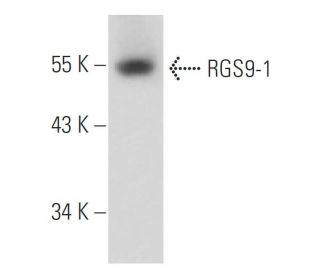
    Rated 4 out of 5 by from Positive signal in WB in PCPositive signal in WB in PC-12 whole cell lysate under non-reducing conditions. -SCBT QC
    Date published: 2013-10-03
    • y_2026, m_2, d_14, h_9
    • bvseo_bulk, prod_bvrr, vn_bulk_3.0.42
    • cp_1, bvpage1
    • co_hasreviews, tv_0, tr_1
    • loc_en_US, sid_59677, prod, sort_[SortEntry(order=SUBMISSION_TIME, direction=DESCENDING)]
    • clientName_scbt
    • bvseo_sdk, java_sdk, bvseo-4.0.0
    • CLOUD, getReviews, 13ms
    • REVIEWS, PRODUCT
    RGS9-1 Antibody (D7) is rated 4.0 out of 5 by 1.
    • y_2026, m_2, d_14, h_9
    • bvseo_bulk, prod_bvrr, vn_bulk_3.0.42
    • cp_1, bvpage1
    • co_hasreviews, tv_0, tr_1
    • loc_en_US, sid_59677, prod, sort_[SortEntry(order=SUBMISSION_TIME, direction=DESCENDING)]
    • clientName_scbt
    • bvseo_sdk, java_sdk, bvseo-4.0.0
    • CLOUD, getAggregateRating, 102ms
    • REVIEWS, PRODUCT