
Date published: 2026-1-9

1-800-457-3801

SCBT Portrait Logo
Seach Input

REEP4 Antibody (H-12): sc-398191

5.0(1)
Write a reviewAsk a question

Datasheets
  • REEP4 Antibody (H-12) is a mouse monoclonal IgG2a κ REEP4 antibody provided at 200 µg/ml
  • specific for an epitope mapping between amino acids 174-207 within an internal region of REEP4 of human origin
  • REEP4 Antibody (H-12) is recommended for detection of REEP4 of mouse, rat and human origin by WB, IP, IF and ELISA
  • Anti-REEP4 Antibody (H-12) is available conjugated to agarose for IP; HRP for WB, IHC(P) and ELISA; and to either phycoerythrin or FITC for IF, IHC(P) and FCM
  • also available conjugated to Alexa Fluor® 488, Alexa Fluor® 546, Alexa Fluor® 594 or Alexa Fluor® 647 for WB (RGB), IF, IHC(P) and FCM, and for use with RGB fluorescent imaging systems, such as iBright™ FL1000, FluorChem™, Typhoon, Azure and other comparable systems
  • also available conjugated to Alexa Fluor® 680 or Alexa Fluor® 790 for WB (NIR), IF and FCM; for use with Near-Infrared (NIR) detection systems, such as LI-COR®Odyssey®, iBright™ FL1000, FluorChem™, Typhoon, Azure and other comparable systems
  • m-IgG Fc BP-HRP and m-IgG2a BP-HRP are the preferred secondary detection reagents for REEP4 Antibody (H-12) for WB applications. These reagents are now offered in bundles with REEP4 Antibody (H-12) (see ordering information below).

    QUICK LINKS

    SEE ALSO...

    REEP4 Antibody (H-12) is a mouse monoclonal IgG2a kappa light chain antibody that detects REEP4 protein of mouse, rat, and human origin by western blotting (WB), immunoprecipitation (IP), immunofluorescence (IF), and enzyme-linked immunosorbent assay (ELISA). REEP4 (H-12) antibody is available in both non-conjugated and various conjugated forms, including agarose, horseradish peroxidase (HRP), phycoerythrin (PE), fluorescein isothiocyanate (FITC), and multiple Alexa Fluor® conjugates. REEP4 protein, also known as receptor expression-enhancing protein 4, plays a crucial role in trafficking and expression of odorant receptors on the cell surface, which is vital for proper functioning of the olfactory system. Although REEP4 is not expressed in olfactory neurons, REEP4′s interaction with odorant receptor proteins suggests that REEP4 may enhance receptor availability, thereby influencing sensitivity and specificity of odor detection. REEP4 is a member of the DP1 family and exists in two isoforms due to alternative splicing events. The gene encoding REEP4 is located on human chromosome 8p21.3, a region associated with various diseases, including schizophrenia, bipolar disorder, and certain types of cancer, highlighting the importance of understanding REEP4′s functional dynamics in both health and disease.

    For Research Use Only. Not Intended for Diagnostic or Therapeutic Use.

    Alexa Fluor® is a trademark of Molecular Probes Inc., OR., USA

    LI-COR® and Odyssey® are registered trademarks of LI-COR Biosciences

    REEP4 Antibody (H-12) References:

    1. Chromosomes 8 and 10 workshop.  |  Wildenauer, DB. and Schwab, SG. 1999. Am J Med Genet. 88: 239-43. PMID: 10374738
    2. Preferential expression of an intact WRN gene in Werner syndrome cell lines in which a normal chromosome 8 has been introduced.  |  Kashino, G., et al. 2001. Biochem Biophys Res Commun. 289: 111-5. PMID: 11708785
    3. Cytogenetic mapping of a novel locus for type II Waardenburg syndrome.  |  Selicorni, A., et al. 2002. Hum Genet. 110: 64-7. PMID: 11810298
    4. RTP family members induce functional expression of mammalian odorant receptors.  |  Saito, H., et al. 2004. Cell. 119: 679-91. PMID: 15550249
    5. Combined analysis from eleven linkage studies of bipolar disorder provides strong evidence of susceptibility loci on chromosomes 6q and 8q.  |  McQueen, MB., et al. 2005. Am J Hum Genet. 77: 582-95. PMID: 16175504
    6. DNA sequence and analysis of human chromosome 8.  |  Nusbaum, C., et al. 2006. Nature. 439: 331-5. PMID: 16421571
    7. Epigenetic inactivation of the premature aging Werner syndrome gene in human cancer.  |  Agrelo, R., et al. 2006. Proc Natl Acad Sci U S A. 103: 8822-7. PMID: 16723399
    8. Non-Hodgkin's lymphomas with Burkitt-like cells are associated with c-Myc amplification and poor prognosis.  |  Mossafa, H., et al. 2006. Leuk Lymphoma. 47: 1885-93. PMID: 17065002

    Ordering Information

    Product NameCatalog #UNITPriceQtyFAVORITES

    REEP4 Antibody (H-12)

    sc-398191
    200 µg/ml
    $322.00

    REEP4 Antibody (H-12): m-IgG Fc BP-HRP Bundle

    sc-526295
    200 µg Ab; 10 µg BP
    $361.00

    REEP4 Antibody (H-12): m-IgG2a BP-HRP Bundle

    sc-546569
    200 µg Ab; 10 µg BP
    $361.00

    REEP4 Antibody (H-12) AC

    sc-398191 AC
    500 µg/ml, 25% agarose
    $424.00

    REEP4 Antibody (H-12) HRP

    sc-398191 HRP
    200 µg/ml
    $322.00

    REEP4 Antibody (H-12) FITC

    sc-398191 FITC
    200 µg/ml
    $336.00

    REEP4 Antibody (H-12) PE

    sc-398191 PE
    200 µg/ml
    $349.00

    REEP4 Antibody (H-12) Alexa Fluor® 488

    sc-398191 AF488
    200 µg/ml
    $364.00

    REEP4 Antibody (H-12) Alexa Fluor® 546

    sc-398191 AF546
    200 µg/ml
    $364.00

    REEP4 Antibody (H-12) Alexa Fluor® 594

    sc-398191 AF594
    200 µg/ml
    $364.00

    REEP4 Antibody (H-12) Alexa Fluor® 647

    sc-398191 AF647
    200 µg/ml
    $364.00

    REEP4 Antibody (H-12) Alexa Fluor® 680

    sc-398191 AF680
    200 µg/ml
    $364.00

    REEP4 Antibody (H-12) Alexa Fluor® 790

    sc-398191 AF790
    200 µg/ml
    $364.00

    REEP4 (H-12) Neutralizing Peptide

    sc-398191 P
    100 µg/0.5 ml
    $69.00

    What application is the blocking peptide sc-398191 P appropriate for?

    Asked by: Cweed
    Thank you for your question. The blocking peptide is intended for use as a negative control, by pre-adsorbing the mouse monoclonal antibody against the antigen. For full protocol details, please contact our Technical Services Department or view our online protocol here: https://www.scbt.com/scbt/resources/protocols/peptide-neutralization
    Answered by: Technical Support
    Date published: 2017-02-27
    • y_2025, m_12, d_30, h_8CST
    • bvseo_bulk, prod_bvqa, vn_bulk_3.0.42
    • cp_1, bvpage1
    • co_hasquestionsanswers, tq_1
    • loc_en_US, sid_398191, prod, sort_[SortEntry(order=LAST_APPROVED_ANSWER_SUBMISSION_TIME, direction=DESCENDING)]
    • clientName_scbt
    • bvseo_sdk, java_sdk, bvseo-4.0.0
    • CLOUD, getContent, 102ms
    • QUESTIONS, PRODUCT
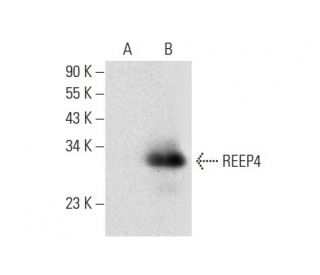
    Rated 5 out of 5 by from Great Western blot data of REEP4 expression in nonGreat Western blot data of REEP4 expression in non-transfected and human REEP4 transfected 293T whole cell lysates. -SCBT QC
    Date published: 2013-03-07
    • y_2025, m_12, d_30, h_8
    • bvseo_bulk, prod_bvrr, vn_bulk_3.0.42
    • cp_1, bvpage1
    • co_hasreviews, tv_0, tr_1
    • loc_en_US, sid_398191, prod, sort_[SortEntry(order=SUBMISSION_TIME, direction=DESCENDING)]
    • clientName_scbt
    • bvseo_sdk, java_sdk, bvseo-4.0.0
    • CLOUD, getReviews, 14ms
    • REVIEWS, PRODUCT
    REEP4 Antibody (H-12) is rated 5.0 out of 5 by 1.
    • y_2025, m_12, d_30, h_8
    • bvseo_bulk, prod_bvrr, vn_bulk_3.0.42
    • cp_1, bvpage1
    • co_hasreviews, tv_0, tr_1
    • loc_en_US, sid_398191, prod, sort_[SortEntry(order=SUBMISSION_TIME, direction=DESCENDING)]
    • clientName_scbt
    • bvseo_sdk, java_sdk, bvseo-4.0.0
    • CLOUD, getAggregateRating, 111ms
    • REVIEWS, PRODUCT
