
Date published: 2026-5-16

1-800-457-3801

SCBT Portrait Logo
Seach Input

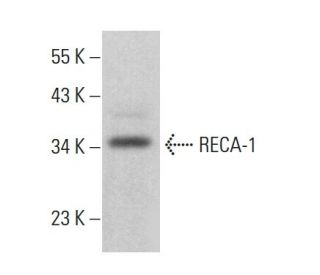
RECA-1 Antibody (RECA-1): sc-52665

4.0(4)
Write a reviewAsk a question

Datasheets
  • RECA-1 Antibody (RECA-1) is a mouse monoclonal IgG1 κ RECA-1 antibody, cited in 8 publications, provided at 200 µg/ml
  • raised against peripheral and mesenteric lymph nodes of AO rat origin
  • recommended for detection of RECA-1 of mouse and rat origin by WB, IP and IF
  • At present, we have not yet completed the identification of the preferred secondary detection reagent(s) for RECA-1 Antibody (RECA-1). This work is in progress.
Gene Editing Promo Banner

QUICK LINKS

SEE ALSO...

RECA-1 Antibody (RECA-1) is a mouse monoclonal IgG1 kappa light chain antibody that detects the RECA-1 protein of mouse and rat origin by western blotting (WB), immunoprecipitation (IP), and immunofluorescence (IF). Anti-RECA-1 antibody (RECA-1) is available as a non-conjugated format. RECA-1, also known as rat endothelial cell antigen-1, plays a crucial role in identifying and characterizing endothelial cells, which are essential for maintaining vascular integrity and function. Endothelial cells form a selective barrier that regulates the exchange of substances between the bloodstream and surrounding tissues, thereby influencing processes such as inflammation, blood clotting, and the immune response. RECA-1 expression on the surface of endothelial cells allows for identification of these cells in various tissues, making RECA-1 (RECA-1) antibody a valuable marker in studies related to vascular biology and pathology. Endothelial cells expressing RECA-1 are involved in maintaining vascular homeostasis and play a pivotal role in forming specialized structures like the blood-brain barrier and renal glomerulus, which are critical for organ function and protection. Using RECA-1 (RECA-1) monoclonal antibody in research can provide insights into endothelial cell behavior and their interactions within the vascular system, contributing to a better understanding of cardiovascular diseases and potential therapeutic targets.

For Research Use Only. Not Intended for Diagnostic or Therapeutic Use.

Alexa Fluor® is a trademark of Molecular Probes Inc., OR., USA

LI-COR® and Odyssey® are registered trademarks of LI-COR Biosciences

RECA-1 Antibody (RECA-1) References:

  1. Blood vessel response to pan-endothelium (RECA-1) antibody in normal and tooth loaded rat periodontal ligament.  |  Sims, MR. 1999. Eur J Orthod. 21: 469-79. PMID: 10565087
  2. Expression of Von Willebrand factor, an endothelial cell marker, is up-regulated by angiogenesis factors: a potential method for objective assessment of tumor angiogenesis.  |  Zanetta, L., et al. 2000. Int J Cancer. 85: 281-8. PMID: 10629090
  3. Conditionally immortalized retinal capillary endothelial cell lines (TR-iBRB) expressing differentiated endothelial cell functions derived from a transgenic rat.  |  Hosoya, K., et al. 2001. Exp Eye Res. 72: 163-72. PMID: 11161732
  4. Labelling of rat endothelial cells with antibodies to vWF, RECA-1, PECAM-1, ICAM-1, OX-43 and ZO-1.  |  Ulger, H., et al. 2002. Anat Histol Embryol. 31: 31-5. PMID: 11841355
  5. Circulating thrombomodulin as a novel endothelial cell marker: comparison of its behavior with von Willebrand factor and tissue-type plasminogen activator.  |  Takahashi, H., et al. 1992. Am J Hematol. 41: 32-9. PMID: 1323930
  6. Expression of a lymphatic endothelial cell marker in benign and malignant vascular tumors.  |  Xu, H., et al. 2004. Hum Pathol. 35: 857-61. PMID: 15257549
  7. Antibodies defining rat endothelial cells: RECA-1, a pan-endothelial cell-specific monoclonal antibody.  |  Duijvestijn, AM., et al. 1992. Lab Invest. 66: 459-66. PMID: 1583886
  8. Molecular identification of PAL-E, a widely used endothelial-cell marker.  |  Niemelä, H., et al. 2005. Blood. 106: 3405-9. PMID: 16099878
  9. Id1 gene transfer confers angiogenic property on fully differentiated endothelial cells and contributes to therapeutic angiogenesis.  |  Nishiyama, K., et al. 2005. Circulation. 112: 2840-50. PMID: 16267257
  10. Improvement of endothelial function by systemic transfusion of vascular progenitor cells.  |  Wassmann, S., et al. 2006. Circ Res. 99: e74-83. PMID: 16990568
  11. Characterization and differential expression of an endothelial cell-specific surface antigen in continuous and sinusoidal endothelial, in skin vascular lesions and in vitro.  |  Goerdt, S., et al. 1989. Exp Cell Biol. 57: 185-92. PMID: 2599260
  12. Serum angiotensin-converting enzyme: an endothelial cell marker. Application to thromboembolic pathology.  |  Drouet, L., et al. 1988. J Lab Clin Med. 112: 450-7. PMID: 2844937

Ordering Information

Product NameCatalog #UNITPriceQtyFAVORITES

RECA-1 Antibody (RECA-1)

sc-52665
200 µg/ml
$322.00

请问RECA-1抗体的二抗检测试剂是什么?

Asked by: huangge
感谢您的提问。您可以拨打电话:021-60936350,发送邮件到asia@scbio.cn,或者我们官网上的在线聊天,联系我们的亚洲技术支持团队,了解更多信息。 Thank you for your question. Please contact our Technical Service Department for more information. Our Asian Technical Service team is available at (+86) 021-60936350 or asia@scbio.cn or by live chat on our website.
Answered by: Sen Li
Date published: 2024-01-02

What is the recommended fixation method for immunofluorescence staining with RECA-1 (RECA-1): sc-52665 monoclonal antibody?

Asked by: TinTin
Thank you for your inquiry. We recommend fixing cells for 5 minutes in -10ºC methanol and allowing to air dry. The full protocol can be viewed here: https://www.scbt.com/scbt/resources/protocols/immunofluorescence-cell-staining
Answered by: Technical Support
Date published: 2018-06-16
  • y_2026, m_5, d_14, h_12CST
  • bvseo_bulk, prod_bvqa, vn_bulk_3.0.43
  • cp_1, bvpage1
  • co_hasquestionsanswers, tq_2
  • loc_en_US, sid_52665, prod, sort_[SortEntry(order=LAST_APPROVED_ANSWER_SUBMISSION_TIME, direction=DESCENDING)]
  • clientName_scbt
  • bvseo_sdk, java_sdk, bvseo-4.0.0
  • CLOUD, getContent, 114ms
  • QUESTIONS, PRODUCT
Rated 4 out of 5 by from Buon prodottoHo provato questo anticorpo in immunofluorescenza, su fettine di midollo spinale di topo criostatate. Diluizione 1:100, funziona bene, il segnale è pulito e specifico. Prossimamente lo proverò anche in WB
Date published: 2019-09-18
Rated 4 out of 5 by from IHC using frozen section of rat tissueWe performed immunohistochemistry using the antibody and the frozen section of rat tissue fixed by 4% PFA. As a results, we can get specific positive signals by the antibody. Very good.
Date published: 2018-01-19
Rated 4 out of 5 by from This antibody was used in a publication forThis antibody was used in a publication for IF on rat brain - SCBT Publication Review
Date published: 2015-01-18
Rated 4 out of 5 by from IF publishable data with rat hepatic stellateIF publishable data with rat hepatic stellate cells - SCBT Publication Review
Date published: 2013-11-01
  • y_2026, m_5, d_15, h_13
  • bvseo_bulk, prod_bvrr, vn_bulk_3.0.43
  • cp_1, bvpage1
  • co_hasreviews, tv_0, tr_4
  • loc_en_US, sid_52665, prod, sort_[SortEntry(order=SUBMISSION_TIME, direction=DESCENDING)]
  • clientName_scbt
  • bvseo_sdk, java_sdk, bvseo-4.0.0
  • CLOUD, getReviews, 9ms
  • REVIEWS, PRODUCT
RECA-1 Antibody (RECA-1) is rated 4.0 out of 5 by 4.
  • y_2026, m_5, d_15, h_13
  • bvseo_bulk, prod_bvrr, vn_bulk_3.0.43
  • cp_1, bvpage1
  • co_hasreviews, tv_0, tr_4
  • loc_en_US, sid_52665, prod, sort_[SortEntry(order=SUBMISSION_TIME, direction=DESCENDING)]
  • clientName_scbt
  • bvseo_sdk, java_sdk, bvseo-4.0.0
  • CLOUD, getAggregateRating, 99ms
  • REVIEWS, PRODUCT
